
Translated material
Coronavirus is Zumer

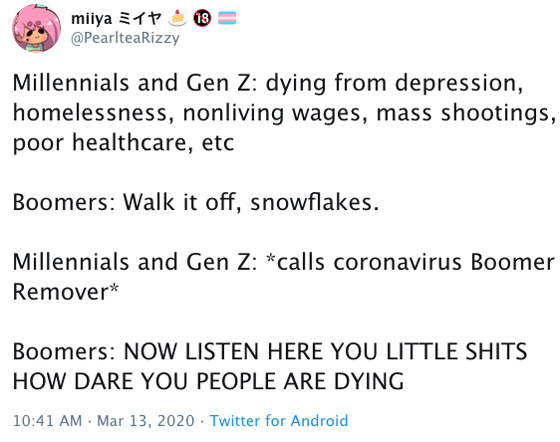
Pandemia works like a separation machine. Among those whom she, according to experts , is even more rapidly separated than before are Zumers and boomers. Here you can read, for example, about Boomer Remover, known on Twitter, as some young people call coronavirus.
The editors decided to find out more about these matters and ordered the text about the pandemia through the eyes of the young one of the authors of the "Dictionary of Zumers" , published on the Colt in December, - Nastya Usacheva.
At the beginning of last week, Nastya sent the first version of the text, which seemed to the editorial office too called, too in the “mono” mode. The editors offered to process it and after a couple of days received a completely new one, made in another tonality and coming to other conclusions.
The editorial office thought a little and came to an unobvious conclusion: both options work best in pairs. Therefore, we went to the experiment - and we suggest you read two versions of the text on one topic written by one author with a gap of several days. That is, we propose to take a look at the attitude of the zomers to pandemia more stereoscopically.
It is unnecessary to remind that the editorial office does not necessarily share the opinions and wording of the authors and provides readers with the opportunity to make their own judgment about everything.
Option 1 (March 22)
From the very beginning of the epidemic, a feeling of monstrous injustice took shape. Coronavirus is blound and shared along and down, and no one even sorry for him. Perhaps the generational solidarity speaks in me, but take a look: coronavirus is an ordinary offended Zumer-maximalist who found a way to put his offenders in place. It seems as if the Zumers all their lives for this coronaccrisis were preparing.
Firstly, the world has forced to come to the most Zumerian practice-self-isolation. Everyone can now understand the very teenager who lives in his room, plays games and watches TV shows.

But the epidemic disconnects only physically - it is morally that it unites communities. The offline occurs incredible: the neighbors in the balconies meet, play and even sing together. Well, what a shock did Djital survived! In a logical way, in social networks, approximately everything became more actively: bloggers who arrange direct broadcasts from boredom, and parents in chats in Votsap, spreading an uncontrollable panic, and brands that have no other communication channels in principle.
Secondly, quarantine is fighting with the hated by Zumer capitalism. After all, the point is not even in the general economic crisis, but in the fact that the culture of consumption in the conditions of isolation loses all value. Well, why does a person sneakers for crazy money, if they don’t take a walk in the color, not to smash in study, work or a party?
In parallel with capitalism, in general, our angry virus destroys the hydrocarbon market. Yes, perhaps he is a little overdoing. But understand: his associates, gourdows of leather and flesh, are already tired of asking large corporations to stop producing oil and pollute our planet. Yes, he went to extreme measures. But again: let's react with understanding to his maximalism.
Another element that issues a typical representative of the younger generation in the virus is, of course, his ill -wishes for the elderly. Who else can be a virus, which is generally calmly tolerated by youth, but causes irreparable damage to the elderly? At the same time, he himself does not kill them, but only weakens the body to such an extent that it makes it possible to “finish” the unfortunate Boomer with his chronic diseases. Truly Zumerian cynicism. Alas, with the new generation you either find a common language and cooperate, or your time has passed.
The epidemic releases all our internal demons: we hate in others what we cannot accept in ourselves. We can not stand the moralization and culture of “Told You So” , but deep down we dream of sooner or later to say this ourselves. Koronavirus in this sense made the most ironic “Told You So” in history. Boomers, well, is it incomprehensible Bill Gates said in 2015 that we are not ready for a new outbreak of the epidemic? Yes, he even suggested that next time infected people will be able to feel good enough to move freely. Well, where did the whole world listen to at that moment?
The most ironic in this to everyone is, of course, the hysteria that the virus provoked. Was it possible to more clearly show that the older generation has no less serious than ours? We are monstrously alarming, we go to psychotherapists and drink antidepressants, but it could not occur to us to arrange such a panic. Perhaps our muscle of anxiety is so developed that the next shocks are already worried. At this time, Zen Bummers simply turn into a lump of nerves, instinctively digging into the sand with a pair of rice packages. True, the coronacrisis touched even his brothers in the mind: a sinful thing, and we looked into the store and at ease grabbed cereals and canned food.
This virus is the biological materialization of Tiktoka: it has neither meaning nor conscience, only an irresistible desire to extend to the fun of the Zumers. Cynical, but we do not even notice the mass death of people. The media perception of this epidemic begins and immediately ends with memes.
It is impossible to think about the deaths when Cardi Bi screens the “coronavirus” under the bit, and the Italian on quarantine makes a “chin-chin” with a mirror. Not all our memes about the epidemic are purely entertaining: for example, one very popular hamster in Tiktok teaches users to wash their hands and sneeze in a very small napkin.
The worst thing is what this isolation can turn into. Zumerskaya Mantra - safety. Coronavirus ratified this letter and decided: close the boundaries, measure the temperature, close institutions, ban mass events, and be at home to everyone. What is the temptation to leave everything! But this is already too much. I don’t know if it is safe, but ugly - for sure.
Option 2 (March 24)
What is happening in the world is difficult to describe. But we can at least try to understand how the epidemic is experiencing (mine) the young generation.
The key to the Zumerian view of the situation is the understanding of their media sex, where the main communicative unit is the meme: coronavirus has become another filler for meme-shapes.
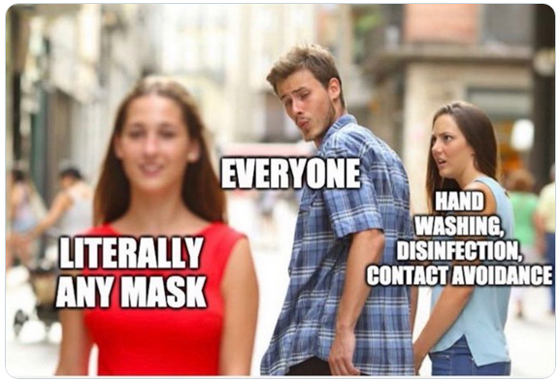
The meme is an educational type of message that processes the information a second time, simplifies it, encodes it in an easily assimilated format and transmits with lightning speed: Zumer read one article about the prevention of the virus, and then the tape presented him with a dozen memes about the same thing. A multiple repetition is poured into a strong conviction of its expertia, and the ratio 1 to 10 in the proportion of the news/meme leads to the loss of understanding of the need for reality itself.
An ordinary person is convinced of the existence of the material world and the true facts that he is trying to know through media. Zumer is confident in the existence of Media Mira, which we comprehend through memes.
The destiny of boomers is still trying to link the reality with media output, while sacrificing logic and common sense (for example, in the form of conspiracyology). But this generation does not even give birth to conspiracy theories about coronavirus.
The perception of Zumers is not aimed at constructing true reality at all. The situation is the same as with comprehension: the generation descends along the steps of loss of communication with reality to Simulyakram. To say that they have a different understanding of reality will be loaded, because it is generally incorrect to call their world a reality in the old understanding. For them, the habitat is media. Mediazi is the maximum level of reality in the zomers.
This follows the discriminatory "-yism" of the new generation-by analogy with sexism and Aijism. So prejudices are formed in relation to people with a different structure of media consumption. This "-yism" deeply and almost unconsciously affects judgments about others. And coronavirus makes it clear.
Before the epidemic has reached Russia, an individually adjusted Zumer tape has already brought them all the necessary information. Important: they didn’t even look for her. It’s just that virologists and doctors appeared in weekly podcasts, who spread everything on the shelves. When the value of this information became obvious, the Zumers immediately suffered it to their native older generation. The motive served the same “-yism”: “They watch their TV, somewhere they say that the masks help not to become infected, or even at all-that the Americans have grown the virus: they definitely need my correct information.” This belief is built precisely on the idea of media consumption: Zumer proceeds from the fragments of information about parallel discourse, and not about what kind of boomers the education, character, experience and personality have. They are presented incapable of their own judgment. It turns out that the Zumers-controlfriks in advance covered the right media sex in advance and shared its vital elements with the beams close to heart.
In parallel with the training of family members, youth took responsibility for the media -enlightenment of another class of boomers - teachers. The widespread introduction of remote learning systems objectively showed helplessness before the technologies of most teachers, which the Zumers were happy to perceive. Firstly, this is their chance to demonstrate their underestimated skills and truly help. Secondly, of course, this is a moment of feeling of their own superiority.
The situation forced everyone to turn to the most Zumer practice - isolation. How else to characterize the situation when a person is not very worried about how to survive, but on the Internet they already told him what to do and gave a promotional code. If earlier the Zumer-introvert constantly encountered condemnation, now his sitting at home received not only social approval, but even a raid of highly morality. He immediately jumped out of the outcasts of society to his best representatives. It is difficult to determine the main motive for isolation: responsibility, swagger or laziness. I wonder how many Zumers would be engaged in self-sacrifice, if for this it was necessary not to sit at home, but to do something more active? It seems less.
It is much more significant that the Zumers were locked up with their own boomers, with which it was more difficult to talk heart to heart. The prisoners in one apartment were different worlds, different media sex, different people. They got that rare opportunity to really get acquainted, which can turn into both an improvement in mutual understanding and emotional burnout.
Previously, a teenager ran from home-either physically or virtually-because the family was not perceived as a place where they can teach something important or give advice. The front door closed. Zumer has two options left: to immerse yourself in an online world or start systematic communication with cohabitants. Of course, someone will choose the first option, but the rest, still breathing in the desire of material offline existence, will get acquainted with their parents. Perhaps, in a collision with reality, the same "-im" will disappear. In a strange way, insulation contributes to rapprochement.
Improving the environmental situation due to stopping the work of factories and the abolition of air travel, reducing cash turnover, the prosperity of social networks and the Internet as a whole, the opportunity to sit at home and get rid of peace from grumbling boomers-coronavirus seemed to fulfill all the most secret dreams of the young generation. They have the impression that they had been preparing all their lives for this epidemic.
But the main difference between this phenomenon and the dream is incompleteness. If the epidemic had an obvious limb, of course, it would be a dream. As in childhood: you got sick and stay at home for a couple of days, where the whole world is rebuilt for you, and after you are embedded in the standard regime. Now not childhood, but an epidemic - not a flu for a couple of days. The hedonistic dream should be completed, but the epidemic does not even closely look like that. In it, in fact, more eschatological and infernal motifs, and torment of infinity is characteristic only of hell.
Either from the joy of the allegedly falling out of the dream, or from the awareness of its ambivalence, or from isolation or even from an excess of Dijita, Zumer's thoughts reduces in convulsions. This is still not fear. There is no fear as a conscious reaction here. But there is, for example, a sudden awareness of death. Paradoxically, his media sex is silent about this, but in his head - two plus two: these endangered grumbling boomers are your relatives. A very non -standard way to comprehend death: not from mediashum, but from being in the same room with people who threaten death.
Another manifestation of these mental convulsions against the background of isolation is conversations with parents about the crises that they experienced. The Zumers are the first, and they came to the exam not that unprepared, but in general by chance. So they stand from the audience and ask everyone who came out: “And how? Difficult?"