
Translated material
The fight against corruption has begun!
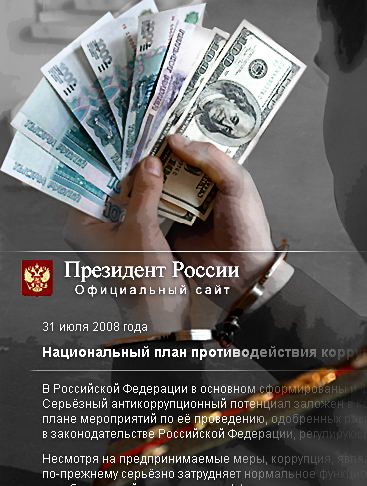
A national plan for anti -corruption has been posted on the President of the Russian Federation. To criticize him is the same as to beat a child - neither valor nor an educational effect. Therefore, I ask you not to consider my brief comments as criticism - these are just woeful thoughts.
To begin with, one quote, one point of the plan that issues with the head and its compilers, and the plan itself, and its initiator:
“Section II
Measures to improve public administration in order to prevent corruption
2. The implementation of the system of measures aimed at improving the functioning of the state apparatus and including:
g) the development of the optimal system of interaction of civil society institutions and the media with state bodies, excluding the possibility of unlawful interference in the activities of civil servants. ” (My selection - S.)
In this amazing formulation of paragraph II-2-Z, a lot lies. It reflects the fact that the document does not have a word about the accountability of power to society; They did not even stutter about ensuring the maximum transparency of the authorities with all available means, because the lack of transparency always indulges corruption. In it, the psychology of our power, which is convinced that officials prevent public organizations and the media from working. In terms of, for example, references to political and administrative pressure on the court cannot be found. There are no references to the administrative management of the highest legislative power. All this does not belong to the category of "interference in the activity ...". But the society ... Really our weak civil society, which, according to their own statements, is practically absent in the country, they got so that it must be “optimized”!?
It is easy to guess that we will have bureaucrats themselves to develop the topic of “unlawful intervention”. We already have examples of their security creativity in terms of extremism and the fight against terrorism. Now they are given another prize: the opportunity to fence away from all control, sculpting the criteria of “unlawful intervention” and the norm that prevents it. The result, taking into account the mentioned experience, is quite predictable. And all this is combined in a document with beautiful and empty returns like: “Development of the Institute of Public and Parliamentary Control over compliance with the anti -corruption legislation of the Russian Federation” or “Creation of a system for monitoring the activities of state and municipal employees from civil society institutions”.
The above quote allows you to make a peremptory medical opinion: we are dealing with exhibitionism in an extremely neglected form.
Scientific ethics reads: you cannot criticize the work for what is not in it. But, as agreed, I do not criticize, but think. And the only science to which the text of the plan can be ranked is not listed according to the classification of the VAK: this is the science of bureaucratic unsubscription. Therefore, I still speculate about what is not in the plan.
As expected, it does not have an honest diagnosis of the situation. Instead, we read: "In the Russian Federation, the legal and organizational foundations of counteracting corruption are mainly formed and functioning." Like this. “Formed”, “operates”. And why is it fussing? A! Even corruption is growing with us. Strange. But we must "react." And the population is pleasant. I do not find any other use of the entire venture.
Any plan that claims to seriously solve a difficult problem is to solve a long and persistently, needs criteria for achieving goals, monitoring. In this regard, there are no serious goals, no tasks, no criteria, no monitoring. Just a word. Do you believe in such a plan? I am not.
I would be able to tell for a long time what is not in plan. But readers have the right to ask, but what is in it? And there are numerous references to the quietly bending administrative reform. Evidence of its lethal state is numerous rewriting from it. There are many scattered initiatives collected from different old bills. There are decisive formulations like: "Consideration of the issue of the appropriateness of creating ...". There is, as an appendix, a long list of laws in which we should make amendments after ratification of the UN anti -corruption convention. In short, they put on the plan everything that was poorly lying and that, in their opinion, could somehow be given out for the fight against corruption. And there is still a whole section, which, of course, can be considered for the conceptual revolution: “Section III: measures to increase the professional level of legal personnel and legal education”. And four sections are four. After all, everything is fine with us, only trouble with legal personnel. But there is no mention in this section that the highest corruption in the field of higher education is precisely at the bred law faculties in forestry and other specialized institutions. And where does corruption?
Not sure that the document deserves some other proceedings. I will probably still return to him in my cycle of articles “Corruption”. Still, the document is unique. He is sure, will go down in history. And how many people will say that they have nothing to do with his preparation!
Author - President of the Indem Foundation