
Translated material
The case of free people
(performance at the National Assembly on May 17, 2008)
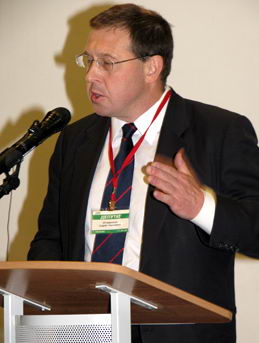 Dear deputies
National Assembly!
Dear colleagues!
In my speech, I want to offer answers to five questions that we often ask us, deputies of the National Assembly, gathered here for her first session.
First. Who are we? Who do we imagine?
We represent, first of all, ourselves. Civil, public, political activists. Disagreed with what is happening in our country. Sincerely interested in the fate of the homeland. Ready to work for the benefit of their fellow citizens and for the good of their fatherland.
Second. What unites us here?
We are aware of our own, individual rights, our own freedom. We became free before we came here. This freedom was not given to us. No government could and cannot give us this freedom. And no power can take it away from us. Freedom, individual rights are given to us from birth. They can leave us only with our lives. We are free regardless of where we are - whether we are in this hall or, like some of our colleagues and comrades, were not of our own free will. But even where they cannot join us now, they still remain free people. This was recently reminded by Stanislav Yakovlev, talking about his stay in prison. He noted the most important claim that the government makes us. This claim is called "arbitrariness." It seems to me that this is a good word. This is a good Russian word, meaning that we ourselves manage our own fate, our own decisions, our own choice. The fact that we ourselves think is what we ourselves say, and what we do ourselves. Self -conference, self -government is the quintessence of freedom, it is a loan of a free person.
Third. What do we disagree with? What is unacceptable to us in modern Russian life?
Each of us, who is here, and many of our colleagues, who do not have here, have different lists of claims to power. They are of different lengths and different completeness. Everyone has their own account to her. And everyone has its own point of fork with it. Someone has this on March 2, 2008, for someone-December 2, 2007, for someone-October 7, 2006, for some-on September 3, 2004, someone-2003, for someone-2002, for someone-1999, for someone-1993, for someone-1991, for someone-1917. These are different events, and our views on these events are worried. But this is our story, this is the history of our country. We do not refuse this story.
What unites all these events, these very different events with different participants? They are united by the fact that violence was applied in all these events. Violence by the authorities in relation to their citizens, in relation to their rights, freedoms, health, life. And this is precisely what - the rejection of state violence in relation to their own citizens - unites us. We are united by rejection of state deception, fraud, blackmail, threats, terror. We are united by the rejection of political killings.
Today, Harry Kasparov mentioned what happened on May 17 in our country and other countries of the world. I will mention another date. May 17 is the birthday of Galina Starovoitova. She is not with us today. I think that if she was alive, then she would most likely be here. Today, there is no and, alas, there is no Sergey Yushenkov, Yuri Shchokochikhin, Alexander Lebed, Anna Politkovskaya, Alexander Litvinenko, Yuri Chervochkin. Today there are no children and mothers of Beslan. Today there are no spectators of Nord-Ost. Today there are no those who were in their beds, in their homes in the fall of 1999 in Moscow, in Volgodonsk, Buinaksk.
Let's honor their memory with a moment of silence.
Thank you.
What unites us today is the unacceptability of political violence for us, the unacceptability of political killings. Murders for the sake of any goals, no matter how they are motivated, in relation to anyone, in relation to the representatives of any views. Political violence is absolutely unacceptable. And therefore, the power that does not know and does not want to know any other methods and ways to communicate with their citizens, with their country, except violence, threats, and blackmail, is unacceptable. The power that has grown out of violence, living in violence, imposing violence to all Russian society.
Decades ago, the prisoner of the Gulag developed a code of conduct in relation to the camp power: "Do not believe. Do not be afraid. Do not ask." Today we say: "We do not believe this illegitimate power. We are not afraid of this illegitimate power. We do not ask for anything from this illegitimate government. We do not care with it." This is a credo of free people.
Fourth. What do we agree with?
We agree with peaceful, non -violent, cooperative actions, with cooperation between different people, regardless of what the views of this or that person are. We adhere to the great Voltaire principle: "I do not agree with your opinion, but I am ready to give my life so that you have the opportunity to express your point of view." This is true - we have different opinions. We will have different opinions. We should not have coinciding opinions. We do not declare the so -called "Water" truce - we are not afraid of criticism. We are not afraid of criticism of the Assembly and its participants from the outside, nor criticism of each other. Criticism is a normal phenomenon in a free society. The right to criticism is the sacred right of free people. Who has no different opinions? Who always has the same opinion? At slaves. At Kholuyev. The bureaucrats. Free people have different opinions.
In recent weeks, we are constantly asked from different corners: "How can you be next to each other? How can you be at the same table?" And for each group of deputies, the assemblies offer different lists of people, with whom, according to the questioners, it is impossible to be nearby. We can answer all those interested in: "Yes, we can be at the same table. Yes, we can work with each other." Why? Because in fact, it is precisely those people who are here in this room, who listen to each other, who are trying to work with each other - this is really people of democratic views. Because they recognize in another person, even a political opponent, equal to their partner. A person who has the right to another point of view that has the right to defend it. It is here that the democrats are located. Where they consider it impossible to communicate with their own kind, there are extremists. They are not ready to sit at the same table. They are not ready to cooperate with other people. This is impossible for them. Only a monopoly, arrogant, contemptuous attitude to their own fellow citizens is possible for them.
Democracy, as you know, is an extremely imperfect system. Winston Churchil also spoke about this. But other political systems are even worse. And what is happening here today, and what happened during these weeks and months in preparation for the National Assembly is the first step towards the formation of a new democratic system in the country. This is the first step towards violence, from dominance, from war to discussions, to agreements, to cooperation. This is, perhaps, the first step towards overcoming a long period of the Civil War in our country. Hot and cold, which has been going on for a whole century. This is not overcoming it, but this is the first step to overcome it. The weapon of a free person is a word. Not a machine gun, not a tunity of a riot police, not a kettle with polonium, not armored equipment on the streets of Moscow, not bombers over civilians. The word and argument are the weapon of a free person.
Fifth. Why are we going here?
We have many goals, many objectives. Much has already been said here and much will be said about this and other sessions of the National Assembly. To what has already been called, I would add three more tasks.
First. Perhaps nothing has been subjected to such destruction in our country in recent years as law, as a legal order. In past decades, of course, we did not have the perfect supremacy of the law, this is true. The legal order was very imperfect. But now, instead of the imperfect supremacy of the law, we have the rule of the punks. This is completely unacceptable for our country. When the shirt is hooligan, they call the police. And when is the police hooligan? When is riot police hooligan? When is the mound hooligan? When the FSB, the prosecutor’s office, the court, the government, the authorities, who call then call?
Then they call society. Then civil society itself is organized in order to find ways to counteract this hooliganism from the authorities. And then it, society, and not the authorities, forms the rules of conduct. This is what we begin to do by accepting the charter of the National Assembly, preparing and accepting other documents of the assembly. We begin to develop a new system of law, a new system of institutions, a new system of legal order. Only a legal country can be a free country. The creation of the right of a free country is the most important strategic task of the National Assembly.
Second. What is the most urgent of what we need to do? This has already been discussed a little. Today, the National Assembly is a forum. This is a special forum, this is an exceptional forum, it is a unique forum. This, perhaps, is really the first such forum in the history of the country over the past decades. Our forum is not yet parliament. But this is the first step, a very important step towards real parliament. We need to become such a body, the body of the representative office of millions of our free fellow citizens. And for this we need elections. Free, competitive, honest elections. Elections in which deputies of the National Assembly of the Second convocation will be elected.
Now we tell us all the corners that our country did not “grown” to the real parliament, that our citizens have not “grown” to free elections. We are told that for free elections you need either an appropriate education, or a special level of income, or something else. Perhaps our "specialists" should recall that the Icelanders created their first parliament in 930. More than a thousand years ago. It is safe to say that with the level of education and with income, and with mores they were far from the same as in today's Russia. The Indians have been electing their authorities in free elections since 1947. Just like many other nations in the world. How do one need to hate your own people, how to despise their own fellow citizens in order to refuse to do the right to do what the Icelanders did more than a thousand years ago, what the Indians have been doing for more than 60 years, what do they do, and for a long time, hundreds of peoples on our planet?
Third. Our national assembly is probably not accurately. In her organization, preparation, work, and there were mistakes. They will probably still be. But we are not afraid of them. Free people are not afraid of mistakes, because they are not afraid to correct them. These are slaves, these are slaves, these serfs are afraid to correct mistakes, because most of all are not afraid of mistakes, but bosses. We are not afraid of correcting errors, because we made the main choice for ourselves - the choice to become and be free. Alas, today not everything is with us. Today, there are no those who are in custody with us here. Therefore, I would like to offer one of the resolutions that the National Assembly could adopt, the resolution "Freedom to political prisoners!"
A free country is created by free people. Free people gathered here in this room. Free people who are many in our country. We have chosen freedom for ourselves. Today we offer everyone who also feels free to make their choice - to join us.
Choose freedom for yourself! For their loved ones! For their fellow citizens! For our whole country!