
Translated material
Russian Revolution - 2
4
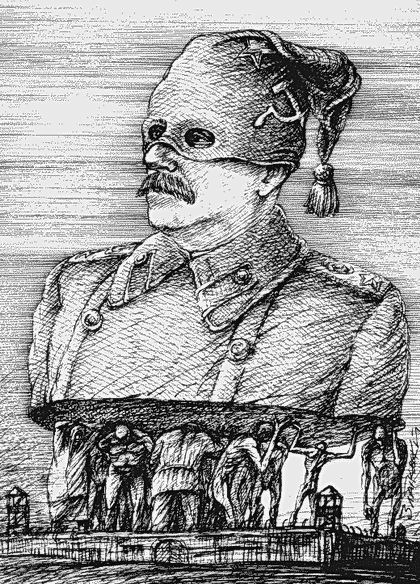
Through the total terror, through the "sea of blood and one hundred million heads", as Dostoevsky said, the dream of mankind of socialism was realized. But having built socialism, Stalin told everyone clearly and clearly: this is socialism and there can be no other. He proved what Dostoevsky warned about in the "demons" - that socialism by his nature is evil. Indeed, in all countries where the Communists came to power - in Russia, Yugoslavia, China, Vietnam, Cambodia and Cuba - the system that they created was characterized by the same features: total dictatorship, compulsory worldview, mass repressions, executions, camps, turning the population into obedient slaves. There were no exceptions. Socialism with a human face did not arise anywhere.
The Stalin Total Terror was carried out by the state security organs. These were his most devoted assistants. The revelry of sadism is striking. Employees of the bodies not only tracked down, arrested, wound up to innocent people, shot them and sent them to the camps, but tortured and tormented them. The tortures of prisoners have become the norm of behavior of GB employees. The tortures continued in the camps. Overcoming labor (in Kolyma golden slaves forced to work at 14-16 hours), terrible hunger (many prisoners died in 3-4 weeks). The prisoners were beaten by the camp officers, and the warders, and thieves, often scoring to death. The tone for these atrocities was set by the operated GB in the camps.
Sadist impulses emanated from Stalin. A. Orlov in the book “The Secret History of Stalinist Crimes” says that when Stalin was reported to Zinoviev and Kamenev, refusing to sign interrogation protocols, he became fury and shouted to the Chekists: “Work on them until they crawl to you on a belly with confessions in their teeth.” Stalin reveled in the torment of his enemies. Orlov tells how Stalin had fun, listening to the story of the dying minutes of Zinoviev. Stalin arranged a party for the Chekist elite. The head of the security of Stalin Pauker amused them with a story about how Zinoviev’s execution took place. He fell, grabbed his legs and screamed, depicting Zinoviev: “For the sake of God, comrade, call Joseph Vissarionovich!” The guests laughed. The spacer repeated the scene. The guests laughed even more. When the spacer began for the third time, Stalin ordered him to stop with signs, he would die with laughter.
In 1938, Kolyma did not fulfill the gold plan. Stalin called the head of Dalstroy Pavlov. He referred to great mortality. “But is it bad if the enemies of the people die,” said Stalin. “We will send you more as much as you need.”
How many “knights of revolution” destroyed their compatriots? The most reliable are the numbers reported by Shatunovskaya. Upon returning from the Kolyma camps, she, one of the few old Bolsheviks who escaped the execution, was staged by Khrushchev at the head of the commission to investigate the Stalinist repressions.
By order of Khrushchev, all archives were opened for the work of the commission, including the KGB archive and the archive of the Main Directorate of the Camps. For two years, the commission amounted to 60 volumes of reports. Shatunovskaya invited Khrushchev to publish these materials, but he said that this could never be done, since the CPSU would be completely discredited, especially before the foreign committees. After the investigation, Shatunovskaya retired, leaving 60 volumes in a safe in one of the departments of the Central Committee. Their further fate is unknown to her. Since many senior party officials (Suslov, the chairman of the KGB Serov) were literally in rabies that Shatunovskaya was allowed to the most secret materials, and repaired all kinds of obstacles, she suggested that they destroyed the most compromising documents. But the main figures established by the commission, Shatunovskaya remembered and informed them.
5
From 1935 to 1940, 19 million 700 thousand people were arrested. Of these, seven million are shot. These are the scale of the Stalinist repressions that he had begun after the murder of Kirov. Antonov-Ovseenko also gives a close assessment. He said that in 1956, the Politburo requested information about repressions from the GB and that the answer was this: 18 million 840 thousand were arrested from 1935 to 1940, of which seven million were shot. The period indicated in the Shatunovskaya report and the number of executed ones coincides. A small difference is only in the total number of those arrested: 19.7 million at Shatunovskaya and 18.8 million at Antonov-Ovseenko.
In exile, Professor Kurganov made calculations of the number of repressed in the USSR from 1918 to 1959. If we subtract the victims during the civil war (he included them in the total number), then it will turn out about 55 million. If to 19-20 million reported by Shatunovskaya and Antonov-Ovseenko to add 10 million destroyed during collectivization (this is, apparently, the minimum figure, since, according to Ukrainian historians, only five to ten million were destroyed in Ukraine), it will turn out about 30 million. The remaining 25 occurs on prisoners, executed and dead in camps until 1935 and after 1940. From large groups of the population, “dispossessed”, peoples evicted by Stalin after the war, our prisoners of war, who, from the German camps, having passed Smersh, went transit to Soviet camps, Ukrainian and Baltic partisans, who fought for independence after the war, and simply exiled to all sorts of other categories, which are counted up to five million.
It turns out that the assessment of Kurganov, with whom many disagree, looks reliable. Solzhenitsyn also agreed with her. We also note that GB gives a completely ridiculous assessment: three million arrested for political reasons from 1918 to1953.
The fact that most repressed were innocent people, one could see in 1956, when by order of Khrushchev the mass release of political prisoners began. At the Kolyma camp, the D-2, from which in the summer of 1954, was taken to Moscow for a transition, there were three thousand prisoners. In 1956, he returned to Moscow with the D-2 friend who was released on the Khrushchev commission. He said that only 150 people left the D-2-policemen, punishers, those who actively cooperated with the Germans.
95% were recognized as innocent. Similar information came from other camps.
When they talk about the guilt of the Gabists in the murder of millions of their fellow citizens, they often indicate the fact that many of them also became victims of Stalin's purges as a mitigating guilt. The general numbers are unknown, but Yezhov, when he was judged, shouted: “I cleaned (it was a synonym for the execution - approx. Author) fourteen thousand Chekists. It was necessary more. " In the bloody Stalinist carousel, the Chekists shot the Chekists, their colleagues yesterday, so that after a short time they themselves were lowered into the basement and their yesterday's colleagues put a bullet in the back of their heads. “Drying Russian fairy tale, wooden spoon, ay! Where are you, three glorious guys from the GPU Iron Gate? ”
From February to October 1917, two revolutions unfolded in parallel in Russia.
The first participated in the formed estate. It began with the performance of the Decembrists, developed throughout the 19th century and was crowned in February1917 by the formation of the Provisional Government. The second was folk, and it took place at the front and in the rear garrisons in the form of constant rallies, which developed the attitude of the soldiers to revolutionary events. Since most soldiers were peasants (82% in 1918), they must be recognized as the most peasant. She was essentially a continuation of the peasant uprisings of Razin and Pugachev, which was confirmed when reprisals began with officers at the front and with the landowners in the village. And the ideals were the same - the peasant kingdom without a bar and gentlemen.
6
The soldier’s mass was so saturated with revolutionary moods that when the front began to fall apart, even the Cossacks, this bastion of the tsarist power, returned home with red bows on overcoats. And when in Novocherkassk generals Alekseev and Kornilov began to collect the first volunteer detachments, the Cossacks asked them to leave the Don.
In the Russian revolutionary movement, several currents were formed in the 19th century: from a moderate wing that sought to establish parliamentary democracy in Russia, to extremist, represented by the Bolsheviks, who affirmed Marx and Lenin that the construction of a new society is impossible without dictatorship. The Bolsheviks won. Having seized power, they immediately established a dictatorship and terror.
Disputes are still underway, whether the people of the Bolsheviks supported or their power was kept only on terror. The answer seems obvious: most of the Russian people followed the Bolsheviks. This is proved simply: without the support of the people, they would not win in the civil war. The inevitability of the defeat of the White Army recognized Milyukov back in 1920.
“It turned out with undoubtedness for me,” he wrote, “that even military liberation is impossible, because it turned out that Russia could not be freed contrary to the will of the people.”
And in October 2009, in an interview with Radio “Freedom”, historian Yu. Afanasyev expressed the same idea. “It should be looked at the October Revolution,” he said, “like the victory of the vast majority of the Russian people.”
We are talking about recognizing an extremely important fact disputed by many: the peasant revolution won in Russia, which led to the authorities of the Bolsheviks. Two revolutionary streams merged: the peasant, Razinsko-Pugachevsky, and Bolshevik-the most extremist stream in the social democratic movement, and they dared the revolution of the educated estate, which began on Senate Square and tragically ended with the overclocking of the Constituent Assembly. The victory of the Bolsheviks and three quarters of the communist rule in Russia were the largest geopolitical disaster of the twentieth century and, possibly, the end of Russia. When asked what happened to Russia, Bezanson answered briefly: "Destroyed by communism."
Most anti -communists still believe that the Bolsheviks supported the minority of the people. This concept is called “minority victory”. There is even a point of view that the Red Army won because the detachments stood everywhere, the deserters were immediately shot and the Red Army did not run from the front only because of fear. If this were so, then the Red Army soldiers would surrender to the White Army. The detachments can be placed behind the troops, but not ahead.
It is more difficult with the problem of supporting the Bolsheviks by the majority of the people after the civil war. After the introduction of the surplus, peasant uprisings began. They lasted several years and were suppressed with terrible cruelty. It was essentially the second civil war. According to historians, when suppressing uprisings, up to a million peasants died. Strong resistance was rendered by the peasants during the period of collectivization.
The Bolshevik elite, led by Stalin, was so angry that she unleashed hunger in the village, as a result of which up to ten million peasants died, of which more than half were children. In the first months of the war, the Red Army, most of which (67% in 1940) was from the peasants, almost did not give the Germans resistance. In the first year of the war, more than three million Red Army soldiers were captured. When in the late 40s, having got into the camps, I asked our prisoners of war, why the Red Army suffered such defeats, the answers were the same: “And what, for collective farms, or something, to fight?” And: "And what, for Stalin, or something, to fight?"
7
The uprisings in response to the surplust, the resistance of collectivization and the reluctance to fight for Stalin and the collective farms do not leave, it would seem, doubts that the peasants were disappointed in the Bolshevik power and stood in the opposition. The impression was that not only the peasants, but the urban population is in the opposition to the communist regime and does not show open discontent only out of the fear of repression, and after the death of Stalin due to the inertia of fear.
Many in our dissident cuisines were sure that the people were only waiting for the Soviet government to collapse, and when this will happen, people will breathe deeply and joyfully meet freedom. “And the people to rebel are ready,/ from the fate of Surovaya,/ from Smolensk to Tashkent,/ with impatience I was waiting for the student.”
Under the Soviet regime, it was impossible to recognize genuine moods of people. In the era of "Moskvoshwei" surveys of the population were not carried out. But the era of VTIOMA came, and it turned out that a completely unexpected and amazing picture. Twenty years after the collapse of the Soviet state, about half of the Russian population believes that a national state was built in the USSR, that is, a national ideal was carried out - a kingdom without a bar and gentlemen. That socialism, in which private property was abolished and the state was the owner of not only the means of production, but also all enterprises and institutions, schools, hospitals, kindergartens, etc., that such a system is the most suitable for the people. For the desilation of the return of this form of the structure of the society, not even 50, but up to 90 percent of the respondents, was expressed in some surveys. The majority of the population of modern Russia, at least at the worldview level, does not accept capitalism and is expressed for the return of the socialism of the Soviet model. And this is not only in the Yeltsin period, which would be clear, given that after shock therapy, the incomes of the population fell almost three times, but also in the relatively prosperous Putin.
How to understand this? I think Dostoevsky can help here. Speaking in the “Writer’s Diary” about disputes between Slavophiles and Westerners, he believed that the contradictions between them would be allowed, since we are talking about the errors of the mind. Much more complicated with the errors of the heart. It is terribly difficult to abandon them, and another person will even prefer to die than to admit that he was mistaken. This can happen, says Dostoevsky, and with an entire people.
This is what, apparently, is happening with most people in Russia. These people do not want to abandon the dream of the national kingdom without a bar and masters and believe that, at least, it was mainly built in the USSR.
It is appropriate to recall that the Soviet intelligentsia did not reject socialism, but, starting in the mid-60s, began to demand the democratization of the Soviet social system. Therefore, she with such enthusiasm perceived the Prague Spring. It is important, however, to note that the requirements of the democratization of Soviet public life were not accompanied by rejection of socialism.
Not only the Soviet, but also the Western liberal intelligentsia believed that the world's first state of workers and peasants is being created in the USSR. Even the bloody theater of Stalinist political processes could not sink it. The victory over Nazi Germany only strengthened this faith. The first doubts appeared after the suppression of the Hungarian uprising in 1956 and Prague Spring in 1968. The legitimacy of the USSR government was also greatly undermined by the Soviet human rights movement. The final blow was dealt by the "Gulag Archipelago."
To be continued