
Translated material
Mikhail Bode. Diary
Exhibitions are not for the public
The exhibitions are made, naturally, in the calculation of the public. However, there are such exhibitions, the purpose of which is to impress their authors and organizers themselves. Two such expositions opened last week in the New Manege and the Museum of Architecture. Both photographic, both huge, both foreign. In the "New Manege" as part of the Helsinki days in Moscow, the Moscow City Hall and the Helsinki City Hall organized and opened the exhibition "Youth of the capital". Young people, of course, Finnish and, as you know, are hot. A retrospective of more than two hundred pictures demonstrates how this steel has been repented from the late 1950s and now. In short, the usual excursion from Betniks and hippies to steep punk and skins. For those who did not watch in the 80s of the Redix film about the informals “is it easy to be young”, who did not leaf through the “lights” and “springs” and now the “poke” and “hammer”, who did not see the pictures of young heaks of hiyers and stripes in the Moscow photobiennal, finally, who does not go out into the street, the exhibition seems to be a revelation. We believe that it is difficult to find such even among our main municipalities. However, they had to examine the faces of Finnish informals with attention, since at that time their Helsinsky colleagues looked at them with attention.
Another fifteen years ago, the top -top topic touched on the Russian North photo exhibition at our Museum of Architecture, American Professor Slavicism William Brumfield. The professor loves the subject of his research, that is, us, our culture, including architecture. He not only loves, but also knows our language well. He also knows the fact that "in the villages of Ryazan, in the villages of Smolensk region the word" love "is unusual for a woman ..." that love in Russian means to regret. And William Brumfield regrets our abandoned and rickety, unhaled and gnawed with mold and all the winds of the Church and huts with all his might and for a very long time. For the sake of such a sting, he regularly plowed on the crossroads in the Vologda and Arkhangelsk regions, visited Kizhi and Solovki, climbed and completely into the deaf. He photographed direct fire, without any frills, betraying the concept of "amateur photography" ethical meaning. The only thing the professor was overdated was in the "design" of the exhibition, putting his photos in cracked glasses. The beggars and miserable in the transitions combined ulcers and sores combed the same manner of pity. The professor knows our customs and tricks well. But actually, with his compassionate exhibition, Mr. Brumfield was late for at least ten years. This is in perestroika times in every “light” or “our heritage” it was customary to give photographs like “Russia, which we have lost”, “memory of centuries” or “road to the temple”. Now on this material only marginal roster publications are speculated. Since the ceremony of the old people usually do not go to the architecture museum, the exposition at the exposition is the only grateful viewer - William Brumfield himself, who reports for the work done before himself. He could not make this exhibition, we already regret it. Already for pitying us.
A strange exhibition was composed by the Gallery "Ark" in the restaurant "Old attic".
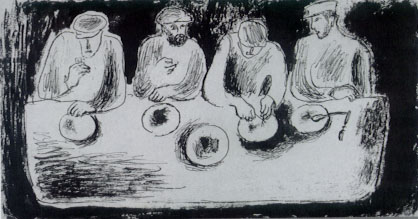
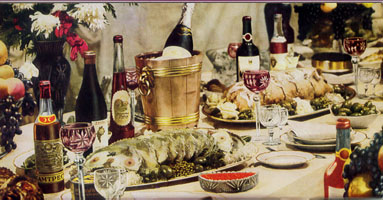
The gallery is engaged in the promotion of high-quality Soviet, but imperfect art of the 1920-50s: a good and sometimes just excellent machine painting and a graphics of little-known and forgotten masters of the second plan. A good mission is to open eyes to museum workers to this art and prepare a new echelon of quite condition works for our antique market. But why the gallery climbed into the conceptual monastery is not very clear. More precisely, it is clear, since the words "project" and "concept" sound for the media much more attractive and more inviser than simply "exhibition". The organizers from the "Ark" took as a sample the fashionable concept "Memory of the Body", a kind of historical and sociological project of the museum reconstruction of Soviet civilization, where fabricly manufactured and self-building linen was exhibited as evidence. The “memory of the body” owed its success to the defile of things themselves, disarming with their kurguz with obviousness, criticism - the inclusion of allegedly commenting works of contemporary artists. Clear business, works of art lost to things. The art-gastronomic project "Memory of the Sky" (that is, the oral cavity) of the Gallery "Ark" relied on works, one way or another related to the image of food and products. And he hit the milk. Actually, the Soviet official and unofficial art has never fed (the gluttonous still lifes of Mashkov and Konchalovsky - exceptions from the rule), and the products that fell to the artists (most often dummies) immediately became still lifes on which the ability to convey the form was honed. In the best case, the form, in the worst - some transcendental concepts. Having scored an exhibition with a mass of canvases and graphic sheets (like a shop window - products), the organizers of the sky did not even come close to the concept, but, unfortunately, moved away from connoisseurs of high -quality easel art that did not tolerate the shaft. The exhibition could be brought to mind if only a “scoop” culinary and gastronomic advertising of the “cutlets of the Avrora” or “dragee” October with a liqueur ”were shown on it. Or they demonstrated real procedures for the home manufacturers of delicacies:“ black caviar ”from herring and boiled carrots and“ truffles ”and“ truffles ”and“ truffles ”and“ truffles ”and“ truffles ”and“ truffles ” Cocoa.
PS The Tretyakov Gallery continues to pull the strap of the project "Golden Map of Russia", that is, Russian museums visiting the Main National Assembly. On September 18, in the HTG building in Lavrushinsky, the Mordovian Republican Museum of the city of Saransk opens the retrospective of its countryman - sculptor Stepan Erzi, whose 125th anniversary is now celebrated.
The 18th Moscow House of Photography is noted by the classic of Russian photography Boris Savelyev.
On the 19th, the exhibition of the South Korean monk Zen-Buddist Su Su an Ana will open on the 3rd floor of the "Big Manege". The monk is fruitful in arts, but not very talkative. On the 25th there he will hold a master class-he will simply draw.
The 21st on Plyushchiya opens the new Gallery "Yav". By profile, it is close to the "ark", that is, the 1920-60s. To begin with, the gallery will show drawings for children's books by Vladimir Lebedev.
Let's run a little forward. On the 27th, an exhibition of the venerable master of the French post-war abstraction of Pierre Sulazha will open in the Picture Gallery of the GTG on the Crimean shaft. Before that, the exhibition was shown in the Hermitage.
On the 28th, those who wish to discuss the work of the master in his presence are invited to the GTG to the "Round Table".