
Translated material
Mikhail Bode. Diary-14
The Architecture Museum decided to leave for the summer holidays with halls scored by exhibits. True, the load is light - posters and photographs, as the Germans say, "art in folders." In fact, do not take mock -ups and models of buildings to Russia from distant Colombia. They brought 60 small posters made a year ago to the XVII architectural Biennale. They also got married, since they served as a more or less artistic arrangement of the X World Congress of Latin Americanists (about how and what the Congress of Latinos Zurab Tsereteli in his museum honored in the last review).
The architecture of tropical modernism and postmodernism does not cause emotional overheating among the audience, it is, as it were, passing through aesthetic air conditioning - to the best of modern, without risky innovation and, possibly, a little boring, correctly tied to the landscape and not impudent in relation to ancient buildings. The last is a very useful experience for us. If the opuses of today's Colombian architects do not cause special “ahi” and “okhov”, then some “white” envy inspire the work of local restorers-how careful they are treating their colonial and not so long-standing antiquities, which, perhaps, will be included in the list of UNESCO architecture monuments somewhere in the fourth millennium.
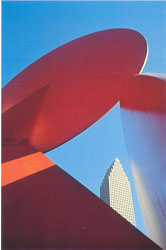 The photo exhibition of our American compatriot Valentin Herzman "Houston. Architectural Ballad" is called upon to hit and twist our heads. Herzman has long moved to the States and loved them firmly. I loved, loved and twenty years ago took up the camera, and ten years later I even began to receive some prizes. Herzman removes the jungle of glass, steel and concrete not as a tourist who translates the film to what can be bought in the souvenir shop, but as a regular of the galleries of modern art, in which something is installed, moves and projected. However, Houston himself, caught by the abstract and pop art monumental Henry Moore , Barbara Hepvort and Klaas Oldenburg, goes to meet and tells him the necessary species and angles. When the city gets tired of spinning in front of a photo lens, the fantasy and skill of the photomontage of Herzman, which creates high-quality sculptural and architectural virtualists, is used. The production of this photographic hi-telephone was and was probably expensive to cost the author.
We also know how to take cities with a lens. As done, shows in the Moscow House of Photo "Petersburger Dmitry Konradt , who became the 13th exponent of the project of architectural photography" 24 "Yuri Avvakumov. In his series" Prolets/Askins ", Conradn approaches the inspection of ordinary buildings, like an urban photo surgeon or photo-cooker: it squeezes and probes the chest cells of the houses. Openwork stairwells with elevator shafts, examines their brick or plastering skin - firewalls and facades wounded by dark windows.
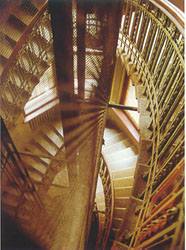 The staircases of some remind him of the kinetism of the singer and gabo, painted in the blue, yellow and red walls - "monochrome" of all stripes: from Rodchenko to American minimalists. Of course, shooting firewalls and stairs is not a new thing. But someone must continue it. Yes, and it is necessary to appreciate the amateur doctors.
The Velta gallery finally showed a serious exhibition. Elena Gerchuk composed a small sad story “All one more”, written by impassive handwriting black and white, like a medical opinion. She wrote without words - stated in a series of drawings with a pencil HB. The content of the tragic and universal, which you do not think about or do not want to think in everyday bustle: they live “he” and “she”, then “under her feet”, instead of home parquet, there is a state tile, a lot of white doors in the corridor, there are many people like “she” in line in the office, a ray of light, maybe “she” still trunks on parquet, but hardly. On the "her" place could be "he". The drawings are specially mixed and hang out of the story from the beginning to the finale. But you can’t deceive fate.
Sad news. Last week, after a serious illness, art critic Marina Bessonova died. At 56 years old.
In Pushkin’s Pushkin’s MiMI, she was engaged in French art of the late XIX - early XX centuries, was the souvenist of the famous Moscow -Paris exhibition, then Paul Gauguin and Paul Cesann and the Russian Avangard. Of all our museum workers, she was the only one who versed in contemporary art and whom contemporary artists considered their own. She has no replacement.
PS on July 3 in the Museum of the East will open the Russian-Japanese exhibition "Tanks together". Probably the exchange of experience in the art of calligraphy.
The 5th is the last exhibition in the Velta gallery this season. Vasily Alexandrov will demonstrate "compositions", made by hand and computer way. Also, probably, a “beautiful letter”.
"We fit in the Biennale without leaders"
The commissar of the exhibition, the art director of the State Center for Contemporary Art, Leonid Bazhanov, tells about the concept of the exposition in the Russian pavilion at the Venice Biennale .
Mikhail Bode: The opinions of our artists and critics about the exposition in the Russian pavilion in Venice were never so different. The range is from excessive enthusiasm to fierce criticism. Doesn't it surprise you?
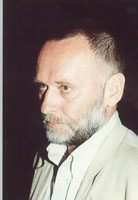 Leonid Bazhanov: Not at all. This is just unpreparedness to adequate perception of the exhibition. Artists who have just discovered Venice have too much agitation. For some, Biennale is something mythical and sacred, for others, on the contrary, irritably profane. And Venice is a constantly working huge exhibition with a well -established reputation, quite conservative (clamped by the framework of its traditions) due to its hundred -year existence. There is its own policy, and it cannot be ignored. To believe that this is a place of pure will of artists is naive. All the ambitions of the young analogues of the Venetian Biennale - “Documents” or “Manifesto” - turned out to be not so wealthy, even though the well -known shortcomings of Venice were taken into account: division into state presentations, into consolidated and individual exhibitions. Nevertheless, Venice remains the largest and most authoritative worldwide exhibition, imposing certain obligations on art projects. And then, it is naive to believe that in Venice you can take prizes every time.
M.B. : Do you mean Kabakov , who received the Grand Prix in the 93rd?
LB: Yes, but last year we received prizes at the architectural Biennale (although, it would seem, these are different exhibitions, but still these are the same Venice, only the curators are different). And to expect that this year the prize will receive a project made in two weeks naively and ridiculous - projects are not done in two weeks. Nevertheless, reviews of curators and commissars of other national expositions about our pavilion were positive. It is clear that in their statements there was a well -known share of Polits. But I have known them for ten years, and our relationships do not come down to politeness alone - there are people with whom we openly exchange impressions. However, overly enthusiastic grades sounded among them: why did Russia not receive a prize? And we (in any case, I) and did not count on the prize. It would be even funny. The presentation of the material was not high -quality enough - for this it took more time to prepare and large financial investments. But still three projects ( Shutov , Chernysheva and Sokov), which were formally connected into one project, created a certain space that satisfied different circles of the audience: one, for example, Kabakov, liked the juices (but I’m sure that if there were only one juices, then the project would have been sagged), others, like Boris Groys , said that Chernyshev was more interesting than everyone else (but I think that if Chernyshhev left the Chernyshev. One, then she would also not stand the entire pavilion). Most praised Shutov, praised those who did not know him before. Although I think that if there was one Shutovsky project - though spectacular in the presentation, even too spectacular (maybe he lacks depths, refinement in the sense of meaningfulness) - the exhibition would also sag. And so - all three projects complemented and supported each other. These are three different generations, three different strategies, three discourse.
MB: And how did they fit into the context of Biennale? Any of them hit the target?
LB: About the context. It is traditionally customary about each Biennale that it is worse than the previous one. This is a familiar, standard formula. I never agreed with her: on every Biennale, as it always seemed to me, there was something interesting. On the same Biennal there are no bright, striking, grandiose projects.
MB: That is, Biennale without leaders?
LB: Indeed, there are no leaders. And this affected the distribution of prizes. The prizes were received by the veterans. Usually, the masters were awarded separately, and the prizes were given separately to contemporary artists separately. Now Matrov was awarded "for the length of service" and nothing more. My beloved sai Touombers presented unimportant, some helpless works - the quality in them is noticeably lower than in his previous work. Richard Serra, of course, is a master, but does not open new horizons in contemporary art (Touombers and Serra became the laureates of Biennale √ mb). Both Bill Viola and exhibitions in the Swiss and Canadian pavilions - all this is good art, but averaged. There are no revelations. And in this context, our pavilion occupied its completely convincing place. It would be more difficult for us if there were really bright projects on Biennal. And so we were quite adequate to what is shown there.
MB: It is known that the money from the Ministry of Culture was received “at the last hour of sobs” for our exposition and then frantically began to look for the candidates of artists. Did the GTSI make sense in advance (more, say, in winter) to make viewing of candidates? Then some projects could be brought to mind.
LB: No one was authorized to conduct such views. The selection is done only after the appointment of the commissioner. It is he who is authorized to conduct a selection and make decisions. And the GCSI is one of the state organizations. Why, then, do not take the selection of the Pushkin Museum, the Tretyakov Gallery and the Academy of Arts or the Nizhny Tagil Art Museum?
MB: When the ministry appoints a commissar (and, accordingly, the selection begins): when finds the opportunity to allocate money for the exhibition or when he receives an invitation from the Organizing Committee of Biennale?
LB: You need to ask the ministry. Each time, all this is done incomprehensible as in an incomprehensible time. I hope that this time I, having spent all my efforts by the commissar, can somehow straighten this situation. Of course, such decisions should not be made in a month and a half, but for a year, if not two before Biennale. This is a normal practice. After all, it is known that Biennale has been going on every two years (there were only breaks for war). So there are no revelations or surprises here and cannot be.
Here, however, there is another objective complexity that the ministry has not yet coped with. The status of the pavilion is still unclear. While he belongs to the Ministry of Defense. But now the situation will change - he goes into the introduction of the presidential administration. Negotiations are already underway between the authorities.
MB: What will it be - the presidential pavilion?
LB: No, it will be the Russian pavilion. All real estate abroad passes to the presidential administration. This is a state decision. The Foreign Ministry, apparently, will also take part in interdepartmental negotiations - there is a Geneva Convention, according to which state -detrimental capacity abroad is not taxed (or enjoys benefits). And finally, the status of the Pavilion Commissioner will be prescribed: how and for how long it will be appointed, his duties and powers, whether rotation is provided. We wrote all this for a long time, even when I worked in the ministry. But this issue was not resolved then - at first there was a Czech with ministers, when they, changing one after another, did not have time to consider these problems. Now some stability has appeared if the minister does not change again.
MB: Six to seven years old, if not more, the performer of our exhibitions at the Biennale was the GTSIA. Will he be a performer in the future, and will the ministry be able to delegate these functions to someone else, say, horror, the Academy of Arts, the same Zurabu Tsereteli?
LB: It can. But this question must be asked the Ministry of Culture. In principle, it has all the rights and authorize these rights, to whom it considers it necessary - it can be a ceremonies, can “Rosiso” or someone else ... But we simply do not have many federal subordination organizations that can cope with problems that cause an enduring headache.