
Translated material
Ilya Lepikhov. That side of the ether
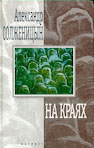 With the borial "Vagrius" is a complete collection of Solzhenitsyn's stories: eight of them were written until 1966, the other eight - from 1993 to 1998. The book is closed by a small story " Adlig Schwenkitten ", completed in the late nineties. So it turns out: on the edges, - all the prose of Alexander Solzhenitsyn to the "Gulag" and after the "Red Wheel". Curious material for observations.
I immediately admit: I can not treat Solzhenitsyn otherwise than a great man and a great writer. His civil feat will go into oblivion every year: now he does not mean for us and half of what he was a decade ago. Soon Solzhenitsyn-Borets will not be interested in anyone at all: in history for people like him, there is no place left. Who remembers Korolenko's passionate denunciations? In whose memory are the anti -Bolshevik tantrums of Gorky? There will be such eccentrics with a dozen, well, maybe a hundred. And “Thomas Gordeev”, “Lights”, “Malva” read and, God forbid, thousands and thousands will read.
Solzhenitsyn writer will forever remain in Russian literature. But in what quality? Everything testifies to the fact that “ one day of Ivan Denisovich ” and “ matrynin courtyard ” will be inscribed in the context of the sixties, nevertheless, from above, it is taken out of brackets. In fact, there are all the prerequisites for that. The Gulag Archipelago is either not quite a literary work, or not the work of Solzhenitsyn itself. In any case, it is not subject to evaluation. Talking about him in the lessons of literature and in lecture courses is wild and unusable. And what to say?
The same with some clarifications should be attributed to the "red wheel". And it is also not subject to assessment, at least the assessment of contemporaries. Of course, any of us, living at the turn of the century, has our own view of the events of Russian revolutions, like any of the educated contemporaries of Karamzin suspected the existence of Vasily Shuisky or St. Philip, Metropolitan of Moscow. Perhaps someone considers these grounds quite sufficient in order to polemnize with the author of the “wheel”, - dismiss me.
In the meantime, we are observing a rather strange picture. Rejection of concepts - often really strange - the Nobel laureate still cannot pass the level of emotional assessment and rush at least to a factual diving. The publicists of the metropolis who are accustomed to write decisively about everything and dealing with their brother with a half -drunk intellectual, is incomprehensible and therefore scary, this steady worker, a literary technologist who thoroughly knows how much Saber was a Kovtyuh detachment and how many guns were lost by the Russian Army in August fourteenth. Go with such a argument!
Strange different. Actually, the literary virtues of his prose, very unusual and thereby at least open to criticism, for a long time did not move his literary enemies to the discussion. Everything was limited to fucker over the Archai-Modern Solzhenitsyn word-making. All these "white -fingered" young ladies, "designed shirts" of hair or "wound" Russian language look not well -being from all points of view. But these are bright, but still particular. It seems that they did not want to see anything else critics. Or they could not see the epic in the strangled power.
Now, both time and “Wagrius” are favorable to try to understand Solzhenitsyn not a thinker, not a word worker, but a writer itself. Understand, perhaps for the first time.
The most vivid reader impression of the collection can be formulated as follows: over the years, Solzhenitsyn writes better. No, I do not take into account “One Day of Ivan Denisovich”, a work that was best done , perhaps in the entire domestic literature of the last fifty years . Do not argue with him. But, for example, the charming-notacked “Nastenka” (1993, 1995) is much better than gloomy-uniplocked “for the benefit of the case” (1963), and the merciless “ego” (1994) is the courageous-smart “Kalita” (1965). From the general row, except that the “right brush” (1960), the sketch of the Tashkent life of Solzhenitsyn, a brilliant cull from the “cancer corps” are knocked out. There is everything here to become a masterpiece: an excellently motivated, lexically heterogeneous hero, a standard and at the same time unexpected plot and an inconspicuous number of details - which costs one tinge trifle, thrown by visitors to the teahouse directly into empty bowls with a wound crumbs, then brown, then the yellow, in fact, in fact, converting to projeen to literature. Unless one - the general drawback of the Solzhenitsyn novelty - is the general lack of completion.
The great end of the “matrynide court”: “We all lived next to her and did not understand that there is the same righteous man, without whom, according to the proverb, there is no village. / Nor of the city. / Nor all our land” ; The no less great final of “One day ...”: “There were three thousand six hundred and fifty -three days from the call to the call to the call. / Due to the leap years, it came out for three days,” - only unprofitable stumps of other finals are not different. Perfectly, smoothly accelerated, well slowing the text, like a faulty moped, stalls in front of the stop. It is remarkable that in the whole district you can hear how it stalls in the "Easter Crowning" (1966), where the author does not reveal the slightest illusions regarding our non-Soviet future: "What will be from these main and grown our main millions? Deaf and unconvincingly, in my opinion, he dies “on the edges” (1994-1995), where the elderly Marshal Zhukov laments that he did not make it, did not dare to grab power: “Oh, it seems, the fool, dumped a fool? ..” -but equally interrupted the narrative, as if he had no other passion for some kind of invisible passage, and he has no other The way out, except to be limited by a fat final point. The reader, as a negligent rider, simply throws it through the steering wheel, and remains, looking around helplessly on the sides, to try to understand how a self -propelled array of observations and comments, always curious, places of accurate vivisector, was half -wilted in a collision with unknown power.
And what is this unknown power?
The easiest way to refuse Solzhenitsyn in the gift of the narrator. He, they say, is a master of large forms, compliance with a more idea than reality. In a meaningful life, he has been uninteresting for some time, and the story as the highest and, possibly, the only objective expression of writing skills requires more sensuality than straightforwardness, vision than reason. Everything is so, but hardly this statement will have to fit Solzhenitsyn. With his whirling, who has not disappeared, but only for years, with his photographic attentiveness, often forcing him to see a student of Grigorovich, and not Tolstoy, and in his heroes - Anton -Goremik, and not Plato Karataev, with his neat universalism, the ability to see both around him exactly as common sense requires him to see a thing in his own. whole. See and embody.
So not. Almost all the stories of the nineties are consisted of two independent stories, usually united by the main character, as in the Zhelyabug Sales (1998), or even at all other than the unity of action, as in "Anyway" (1993, 1995), not united. So it turns out that the writer seems to evade the image of reality, like a gigantic hammer, by the power of his own opinion of her belonging to her scenes and episodes. It’s not that he evades, not that he is unbearable or disgusting, but as if he does not seek to stick those blanks to a feverish blue shine, as if he was not turned to anyone. Everything is known to the reader in advance, and the writer is like a core: tears through the hidden darkness and only sniffs somewhere there, behind the zga, in a light and lively silver pair.
Perhaps Solzhenitsyn is too Russian writer and at the same time too unchang to try to extract harmony from chaos. More than a writer, Solzhenitsyn is a designer. Rather, de- or re-designer. As the struggle with the Soviet system was for him, unlike the same dissidents, the struggle with the system , the totality of heterogeneous elements glued with a single task, and literary activity in its subconscious represented something like a developmental and felt life, non-core and braid from incorrect joining, to harmless screws into the necessary grooves and deepening. The presented life should at the same time comply with at least one condition: it should be fastened with something: whether with prickly wire, whether the bandage, snot, but was sealed without fail.
It is unnecessary to say how Russian reality does not meet this simplest criterion: where is the well-fed, where is the braid, how, where it is sprinkled with earth, it resists with pliable bitterness, not succumbing to either the false key, nor the screwdriver, and every second striving to collapse in some very indecent-powerful piece, so you sit and guess: Ryazan, Ryazan, Ryazan, Ryazan, Ryazan, Ryazan, Ryazan, Ryazan. Kaluga, Yamalo-Nenets? Such a life is not like a screwdriver - not to take a soldering iron. Is ammonite? So tried once - about that everything in the "Archipelago ..." is said.
The reconstruction of being, extremely accurate, otherwise Solzhenitsyn does not have, thereby a kind of being, thereby, is difficult to make it impossible. Before the reconstruction of the literary manner itself, the games with the word he had never been a great hunter. He tried to write as he considered it correct, or really not noticing, or noblely neglecting the near continuity. With every word, rejecting Soviet literature with each letter squigging, he set himself the goal of becoming a writer simply Russian, without twisting thoughts, without sloppiness of the syllable, a simple and thorough writer. But here, in this seemingly win -win desire, he was expected by a decisive choice. The simplicity of simplicity is different. In Russian prose, there are at least three of its varieties: the simplicity of Pushkin ("Captain's daughter"), the simplicity of Tolstoy ("Hadji-Murat") and the simplicity of peasant children, the very Philips in whom Lev Nikolayevich urged the workshop to learn imagery and laconicism. In the conditions of the USSR of the fifties, Solzhenitsyn, apparently, had no choice - he moved along the third path.
Thanksgiving to God, for he actually begin to master the Tolstoy manner - the man was stubborn, sinewy, would have sorted - so he can’t see him “a new world” and a general recognition and thirty years of a happy working life. They would trample: first the intellectuals would have passed, and there, you would look, and the organs arrived. The former would have rested on the lack of nobility and the flawed knowledge of languages, the latter would have looked into the eyes and were interested in the health of his wife and babies. So on both sides would have been hidden as a cheap curd intestine.
But no, there was. Tvardovsky, already half -drunk among literary critics in civilian and regular writers, sensed his own in it and crashed . He sorely banged, in Smolensk. Until now, dust will not settle. And in Russian literature for one peasant writer, more. And there the youth arrived. Villages, then.
That's just the inconsistent came out with them. Belov, Rasputin, Abramov really are peasant children, for nothing that the latter was highly accelerated at the Philhante of Leningrad State University - so his party directed it. Solzhenitsyn is a folk intellectual who has not learned, but learned. Yes, and do not learn - it would not be enough that life in it changed: “Farily hidden, but sewed tightly,” says the proverb. There were almost no people like him: at first they picked the nobles, there are a dozen writers there, scientists who did not understand, and then these, they have a mother in God, clean, cut, in roasters. These Bolsheviks hated fiercely. They knew: where the intellectual will begin to mourn the scolded homeland, this will turn around and dashingly sits with a crunch between the eyes, and then into the pitch, so that the sparks are from the eyes, and will add to the temple with Kirzach - well, if you leave alive. It was not a pity for such bullets. Those who dodged from the bullets hid from the Soviet regime so that they could not take any special department to clean water. More and more honored people turned out: they reached the ministers, to the generals. One Peter Grigorenko was worth it.
But Russia is great, you can’t shoot everyone, you won’t chop it. So Solzhenitsyn remained, almost from the mighty root that he was accepted at the beginning of the century and was ready for doctors, roadbreakers, officers, teachers to raise their former Russian life, put it with a black fibrous furrow and drift, spray it to the last birch bark chips, because a strong and competent man rose: neither the bailiff, nor the Gorlopan-Socialist. To defeat, with the concept of a man. The Germans, the German, strangle Lenin in the spill with a hunting belt - and oh, how not sweetly had to be sweetly: both white, red, and yellow. But she did not defeat, did not strangle. And these people of the past era remained lonely communities, the specialists: doctors, engineers, military - in failed Russia. In their quarrels, they pulled the country out of all troubles in order to discover by the end of life that to leave it, in essence, and no one. So they died all the sixties and seventies: with pain, bewildered, in vain. Solzhenitsyn was their voice, belated, uneven, young, but still them. Their measure of understanding of Russian life satisfied everything: the threshing, and the steel -speed, and books. They were not somewhat special: such a share was such. One can only guess what Solzhenitsyn was for them: voice, call, meaning.
Did the writer understand this? I don’t know ... Probably, to a certain extent understood - it is impossible, in fact, to write to an imaginary addressee. Well, not quite imaginary, and yet ...
Recently, Solzhenitsyn gave oh how many reasons to make fun of himself. Later interviews make an extremely strange impression, if not more. So it’s not about us. What, if you imagine that somewhere in Russia it has been preserved from the heels, a dozen people like him, that they live and do not know: where, why, in the name of which? For them, he writes: for rural cooperators, librarians, livestock specialists who are ill for the matter, those zemstvo figures who, in his thoughts, will raise Russia. After all, there were such years ago. I remember. Talking.
Perhaps we are mistaken, only the farther, the more Solzhenitsyn’s search resembles one children's play. There, a boy and a girl travel around the world of shadows. "Blue Bird" is called, many of you have probably seen. So here. I would like to make a mistake, but the hypothetical addressees of Solzhenitsyn prose and journalism are more and more on the other side of the broadcast: who is in the country of rural cooperators, some in the shelter of the reader-commander, who are still in what fabulous habits.
But as if it were good ...
With such warmth and attention, Solzhenitsyn searched in the sixties is no longer. A new Russia may not take place at all: a stone pulling it down too heavy. So it turns out: between life and literature, between "then" and "now", without the final and to fierce it is sad.
At the edges of non -existence. To eternity.