
Translated material
Sofya Dymova. Three faces of Shostakovich
M does not seem to be inappropriate to extol the dignity of the festival and describe its significance for the capital's cultural life after my colleague Mikhail Zhirmunsky did this (see "Sensitive invitation of Vladimir Spivakov" ). I completely join his opinion - and immediately move on to what you, dear readers, expect from me.
Agree, an opening concert is perhaps the most important point in the festival program. Especially if he just was born. As you open the festival - so you will spend it. As an initiating chord, the listener was proposed by Shostakovich in the assortment - under the rather ephemeral subtitle "95 years from birth." On the birthday of the composer, Vladimir Spivakov chose three, perhaps the most unusual opus from his heritage: the second suite for jazz orchestra , vocal cycle "from Jewish folk poetry" and the fifth symphony . At the end of the concert, a person would have thought that all three works belong to different composers - but that was the wise strategy of Spivakov, who decided instead of the festive "team of the hodgepodge" to give the cat a cat in a bag.
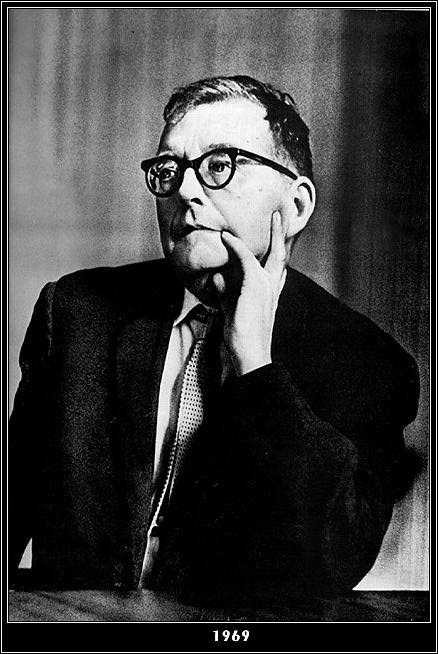 Actually, in a sense, three of the above opus are created by different people. The second suite is a cheerful child of the socialist culture, buzzing from the pink optimism of the 30s. The composer who wrote the composer’s suite was bursting with pride in his country - in it with the frequency of circus tricks, perky marches, waltzes are replaced by sentimental and noble, which played in the parks and under which dozens of happy couples circled. In this little-known opus, everything is suspiciously seriously: the slotted smile of that Shostakovich, in the symphonies of which these "mind-tsa" acquire a completely different shade-grotesque and vulgarity,-- There is no one in jazz-zyut. In the end, a fan of symphonic opus feels almost fooled - in his miraculous monument to the “Soviet country”, Shostakovich does not give any reason to “read between the lines” and leaves the conductor only a bright, unambiguous in its content the score.
From the editorial office . We use the case to make the necessary clarification. As the recent research of Manashir Yakubova shows, 1 "The second suite for jazz orchestra" Shostakovich became a victim of a rough mistake made by one of the editors of the composer's works. The eight-part suite, performed by the Russian National Orchestra on September 25, is actually a suite for a pop orchestra and "has nothing to do with the genuine suite #2 for jazz orchestra." Moreover, "it appeared no earlier than the second half of the 1950s and, in all likelihood, was not compiled by Shostakovich himself ... The suite consists of Shostakovich's ballet, theatrical and movie music, shared for decades." The genuine suite for jazz orchestra #2 was written in 1938 and consists of three plays, however, the aforementioned suite of eight parts was repeatedly recorded on the records precisely as the "second jazz-suite."
Spivakov and the Russian national national orchestra he had impeccably complied with all the author’s instructions. The smuggles neatly, the tact of the beat, measured the three -day drawings of the waltzes, often the clumsy copper studies of RNO found almost a musical -cholver lightness and frivolity of behavior - the whole team moved in a single mental impulse, creating, so to speak, a festive mood in the hall. It was all the most defenseless public before the second essay declared in the program - the contrast between the May Day aesthetics of jazz -zyites and a cycle from "Jewish folk poetry" is too great.
In eleven romances, Shostakovich reveals a completely different world - a Jewish place, with his sorrows and joys, with his peculiar provincial raid. Instead of rampant symphonism, chamber sketches here, with mean, but meaningful strokes in the orchestral texture and difficult parties of vocalists. Perhaps, only Yana Ivanilova (Soprano), who sang this cycle in chamber concerts, managed to play these subtlest sketches on the necessary half -tones of all performers. Two other vocalists - Contained Elena Novak and tenor Mikhail Gubsky - did not correspond to their parties rather acting than vocally, not being able to convey all the countless emotional colors of the cycle. Spivakov behaved too carefully - holding back the instrumental fraternity to such an extent that the orchestra periodically turned into a faceless background. The same on all eleven parts, the conductor’s method was not good for the second Shostakovich: all the dramatic corners were smoothed out, the climaxes were driven into the framework of a good taste. Such an academic interpretation somewhat surprised the audience, expecting something more colorful and cheerful.
However, in the fifth symphony - a textbook under the concert posters - Spivakov took his own. About two years ago, he already conducted the fifth in one of the subscriptions of the RNO; At that time, after the symphony made by the symphony, a sweet and offensive inappropriate BIS - Waltz Khachaturian , sounded, and the brightest impression was somewhat spoiled. This time, at the anniversary evening dedicated to Shostakovich, there were without bees, and the listener could have plenty of enjoying the professionalism of the orchestra and conductor. The emotional fuse of the two -year ago fell slightly - the conductor is clearly the coast of the Force for the upcoming concerts. The most memorable part turned out to be a slow part - with the veins of a romantic expression, well -resisted pauses - played by the orchestra in one breath. She completely killed the memory of Shostakovich #1, who seemed to threaten to crush her followers.
Note
 1 See: Manashir Yakubov. Suite for a pop orchestra or suite for jazz orchestra #2? // Shostakovich: between the moment and eternity. SPb., 2000.