
Translated material
Mikhail Bode. Diary-15
The OSKOVA Summer Exhibition Panorama is similar to a huge, but monstrously neglected summer cottage: garden crops scores to dough and other green-useed “green”, buttercups and flowers stall among a friendly burial and valve ORA, something accidentally rises, without knowing the weeding, something grows “not enough joy” (but this is not enough). Of course, the owners leaned "to the south", having handed over their hundreds to non -working posters. And as if the lazy garden Ikuban is going on by itself.
Two tenants met on Nikitsky Boulevard, or rather in the Museum of the East. Both came to bask in Moscow from the Far East: Japanese Makino MIECO from Toyama, our compatriot Svetlana Makovetskaya from Vladivostok. They are separately artistic, that is, they are supposedly engaged in contemporary art, for a long time. In the capital, they decided to make it eating together, calling the whole thing "Tanks together." The Japanese woman, of course, leads the first chip or a second-hander-she knows how to skillfully slam the small room of the museum with all kinds of branches, straws, lamps, mats, gravel, how to bandage it all with bandages with hieroglyphs, how to let the eastern aroma, which, together with the trio of the detached Japanese flute, should aesthetically take the visitors aesthetically.
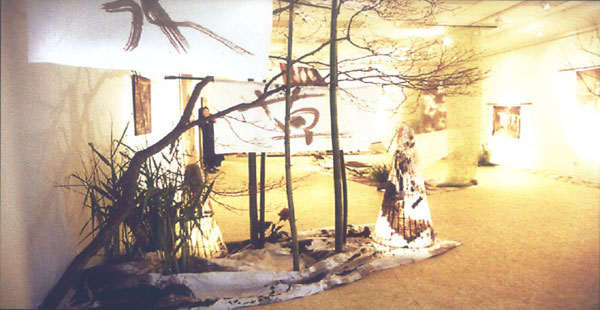
Svetlana Makovetskaya is more modest than the "Flyer coordinator" Makino MIECO. She is content with a kind of "impressions" - blurry photographs of Japan and Japanese. Simply put, these are ordinary icon (picturesque) photographs, known for the years and a half. But in the current Moscow heat, these unsteady pictures look quite organic - you can refer to a thermal blow. In general, the “Tanks of the Two” resemble our youth exhibitions almost fifteen years ago, when the trash assembled in the house of artists claimed “Art” and “Concept”, when Garik Vinogradov and Buddhidy Musical on the drain pipes, Slava Ponomarev, among the cores and copper basins. It is a pity that they did not come to the exhibition, to meet with their youth.
Igor Snegur arrived at the Fayn Art Gallery from the cottage. I brought from there "love, sails and apples", of course, drawn and written. He brought love for himself, for his art, for his country life, to himself, engaged in this art in his beloved dacha. Sails are a picturesque Arabesque, a beloved by the author, almost a module, with the help of which the Snowman can portray everything: figures, clouds, waves and even completely abstract sensations. Even his ever -present magnificent calligraphic signature is akin to the spinning sail. And apples are just apples. Green.
What the Snow Maid is working on painstakingly, Vasily Alexandrov makes Vasily Alexandrov without any intake with the help of a computer: he drives a drawing into it and sees from there already colored in acid tint. Actually, the plots of his opuses are also some kind of acid-cosmic, fantastic-surgery type of Vizborovsky "on missiles and anti-discord anti-anti-Antiracrates rushed, five divisions fought in the blue glare on the Moon ...". In former times, such a graphics were published in "science and technology", "knowledge - power" and in the anthologies of foreign fiction to the joy of enlightened albums, Miro and Tangi ITROV. Now they show in the Gallery "Velta", which, incidentally, "compositions" by Alexandrov completes his summer exhibition marathon.
In the summer gallery siesta, the antiques are not asleep - long before the opening of the trading season, the audience is treated with artistic and giving aperitives of different fortresses. If the Stalinist socialism ("Alexander Gerasimov and Sergey Gerasimov. Russian impressionists"), served in the Gallery of Leonid Shishkin, can be compared with bread wine that was not figurative and sketches of pompous Orsin - then the Rosali Konstantin Gorbatov in the Gallery "New Hermitage -1" resembles the Central Military District Ash: Sweetly, weak, does not hide on the brain, they consume such a thing abroad (on Sotheby's for 9-16 thousand pounds for the average format) and it is always decent to treat friends and acquaintances. That is, the pictures are moderately colorful, written by a stuffed hand, not afraid of printbee, and the plots are recognizable - Pskov, Novgorod, Lavra, Vologda, Volga region ... In a word, where there is water and domes.

In the "New Hermitage" they do not allow to take the discharge, you can only tast, because the Gorbatovs were brought from the Novo-Jerusalem Museum (Istra). In the museum, the paintings found themselves thanks to the restoration act, which was completely disinterested by Soviet tankman in the artist’s Berlin apartment in May 1945. How Konstantin Ivanovich Gorbatov (b.1876) ended up in Berlin, more or less known; How he managed to survive during the Reich, history is silent. It is known that a student of Kiselev and Dubovsky immediately after the end of the Academy of Arts received a foreign retirement and was awarded a gold medal in Munich. Since then, the Germans loved him: 1) for a wide, fat German smear and 2) for exotic lyricism ("... for deep calm, gently penetrating the heart of urban silence, when life seems sweet and easy ..."). After the revolution, Konstantin Ivanovich tried for a long time to find his place in a new life: he wrote a picture “Red ships” for the Museum of the Revolution (although he could have called it as his first work - “sailed”), A. I. Kuindzhi joined the society, and then for some reason he signed up for the Jewish society of encouraging art. In 1924, he realized that he was enough to wear out, and left for Italy, and from there he had already moved to Berlin.
Surprisingly, he lived on the sale of his work. Igor Grabar, who included him in the field Soviet exhibition in Cologne, wrote down: “Academician, 55 years old, working“ Russian landscapes ”, exclusively with churches, the abyss of churches ... He has a success with the German public, did exhibitions everywhere, sold a lot (most together) and still continues to sell.” Gorbatov continues to trade now: from time to time, something appears on our "antique salons". We must wait for autumn and then let's see if the “new Hermitage” will get from the bins of his hunchbacks. After all, it is not just that in the summer to be covered with an aperitiv?
PS On July 10, in the James store, Rosiso will present an exhibition of photographer Nikolai Bakharev, well known in New York and Rotterdam, but not particularly valued in his native Novokuznetsk, which he does not want to leave. The photographer will show the pictures "Russians", which his lens lodged in dormitories, at family celebrations and even in his own apartment.
On the 10th, in the gallery of Marat Gelman, a presentation of Nemirov’s book, dedicated to the visible Mitka Alexander Florensky , will be held.
The Moscow Museum of Contemporary Art Zurab Cereneteli is preparing to change the hung Latino American to modern Bavarian artists. The days of Bavaria in Moscow are coming. With the help of photography, painting, drawing and acoustic installations, nine Bavarians will demonstrate how “a person sounds” and how he perceives space. Details on the page www.bayern.ru .