
Translated material
Sergey Kuznetsov. The spirit of places
Bruce Sterling. Zeitgeist (spirit of time). U-Factoria, Yekaterinburg, 2003
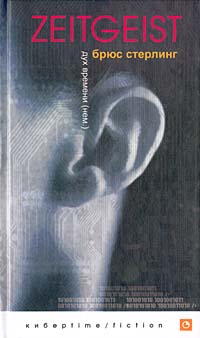 I would not have written a review of this book, but I should have given a brief announcement, I would write literally the following: "One of the founders of the Cyberpank style made with a novel that the Late Vasily Aksenov could write if he was born in America in 1954 and was one of the founders of the Cyberpank style." The announcement could be completed on this, the reader was not modern and at the same time leaving him in some bewilderment: what other Aksenov in the style of cyberpunk?
However, judge for yourself: the novel begins with the fact that the old man, an adventurer and entrepreneur, will produces the Great Seven group, composed of seven cute and mediocre girls from the seven countries of the Big Seven. The group should cease to exist with the onset of a new millennium, and before that there is not so much as a real group, but as a pure media-phenomenon and an object of advertising. At the time of the beginning of the novel, Leggia is in Turkey, where he has some problems with Turkish partners who would like to use a group for their political purposes. The reader is firmly convinced to the hundredth pages that he reads a novel about show business and other simulacons ( Bodriyar is not just implied, but even mentioned) - and then everything changes sharply: the eleven -year -old daughter is brought to the hero, he gives the group to the Turks, leaves for Mexico to look for his father, then - to the island of Kauai - to visit the Japanese Pop star - and so on. In other words, the last two -thirds of the novel resemble exactly what the Aksenovsky carnival: the reader guesses that in fact he - no more or less - talk about the end of the century. Style is a phantasmagoria: let's say, the hero’s father once wanted to steal a uranium core in Los Alamos and hit the epicenter of a nuclear explosion. From this, he turned out to be de -calamized in time - but for some reason only within the 20th century. The best way to find it is to arrange Christmas. And the legends are arranged by Christmas in the middle of summer, gathering twelve Mexicans, seduced by ghoul tequila-at some point the thirteenth appears among them, this is the old old man. He says goodbye to his granddaughter - and the narrative continues.
It’s quite nice to read this, although, having reached the end, the reader remains at a loss - so what? What next? What was the story about? Sterling is closing the narrative with some storyline - but this is clearly not enough. Vasily Aksenov once told the author of this note that the American reader is not very buying his books - because advertising is not enough, and because he was spoiled by the requirement of the plot narrative, clearly told by Story. The average American reader does not like phantasmagoria - and critics too. One of the reviews on the " new sweet style " was called: "Stop the Carnaval!" Stop, like, music.
In this sense, the appearance of Roman Bruce Sterling is doubly curious. The American prose writer decided on a defiantly non -American gesture: a novel in a slightly different cultural tradition. You can only say so rather rudely, because Sterling in the coffin saw a intelligible story, even when he wrote a more or less classic cyberpunk type of "shiizmotrika". However, the orientation towards the non -American tradition in Zeitgeist is evident: it is no coincidence that the novel is called a German word that the Americans, of course, know, but not everyone.
Another funny evidence of sterling orientation is his thorough acquaintance with non -American cultures - primarily Turkish, but also Russian. Sterling was several times in Russia and even said something like the fact that the predictions of Cyberpan came true in Russia of the nineties (given that it was not about the level of technology development, I would suggest that this is still a compliment). Acquaintance with local material can be explained by the numerous and appropriate mention of Russian intellectual realities such as Necrorealists and Pelevin - however, it is curious that in addition to Pelevin, they are mentioned in the novel - and at the same time quite expanded - Orhan Pamamuk and Haruki Murakami : the first in connection with Turkey, the second - due to Japanese.
The Russian reader can be happy: he loves exactly what people love "his type" around the world. It is much more important, however, that the mention of all three authors indicates that Sterling deliberately focuses on the tradition of exotic literature from an American point of view. Talking about multiculturalism, the novel itself turns out to be its vivid certificate. And therefore - a very good monument to the era of the frontier of centuries - the one about which it is written.