
Translated material
Ivan Grigoryev. The second pancake
 X Orochu when the book has a short name.
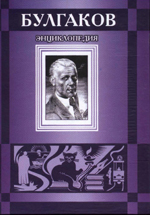
Now, if the brevity was still not to the detriment of informativeness. And then, so far, people who know that the famous Bulgakovs were preserved at least two; And, by the way, for many such people, a philosopher, theologian and economist Sergei Bulgakov is much “larger” than the writer Bulgakov Mikhail . However, the picture on the cover (the word “portrait” somehow does not go to the tongue), containing a male face, part of a jacket and a tie, suggests that the priest Sergius Bulgakov would hardly be presented in such a popular form; So Mikhail remains. And the Black Cat present immediately (albeit without a primus) and allows you to make it possible: he.
However, what to find fault with the title! In the first edition ( 1996 ), the book was even cooler - " Bulgakov Encyclopedia " (as if in foreign, but in Russian); So the current option is clearly progressive. The annotation about the first edition says that it " was warmly met by the widest circle of readers ." Maybe the “wide circle” was then excited, but judging by five to six years ago the reviews and other printed reviews (some were directly scandalous) did not cause much delight among specialists . Therefore, when reading the second edition, it was curious: whether the author took into account criticism, whether he changed anything in his text, and if so, then what exactly.
An important drawback of the book was originally - and, alas, remained - the explicit "roll" towards only one work: " Masters and Margarita ." No words, the romance is great and popular; But why should he be devoted to 70 percent of the encyclopedia, which claims the title of "general Bulgakov"? After all, Bulgakov is not Griboedov, who has “ grief from the mind ” immeasurably higher than all other texts (and these texts can be counted on the fingers); In the total volume of Bulgakov’s works, his last novel occupies a tenth of his strength. And in the "Encyclopedia" B. Sokolov it turns out: there are articles dedicated to all significant (and even third -story, like Nikanor Ivanovich Bosogo) characters "Master and Margarita" - and not a single article about one character of some other Bulgakov work. Why? Yes, because the author-consumer so wants. In the second edition, compared to the first, five articles have been added: Abadonna, Nietzsche, Continuation of the ⌠ Master and Margarita ■, "Jubilee meeting" (this is the text of the "Kaputnik", written by Bulgakov for the 40th anniversary of the Moscow Art Theater) and "Language and Style" (Bulgakova, for granting); But about the characters of plays, stories, stories - nothing. Yes, and the "magazine -gas" Bulgakov texts are characterized very poorly: there are articles about thirty feuilletons and essays - but about one hundred and fifty of them turned out to be "overboard."
B. Sokolov believes that this is in the order of things - for, as he writes, many of these feuilletons and reports " are now of interest only for Bulgakov experts " (p. 6). However, the information has its own laws: the encyclopedia is a reference one, and in the “personal” encyclopedia (unless, of course, it is seriously treated), you cannot do without the presentation (at least brief) of all texts belonging to the “main character”; And someone has interest in them or not - this is an abstract question. Not to mention the fact that in these supposedly “unnecessary” feuilletons and essays there are many characters and situations that later moved into the “big” works of the writer (in the same novel “Master and Margarita”): so in the general creative process and they are important in their own way.
In general, the composition of the book is amazing more than once. For example, there are no articles about illustrations and illustrators of Bulgakov works, about their staging, film adaptations, etc. "reincarnations" into other types of art. It is mentioned the theatrical productions of Bulgakov’s plays - but exclusively lifetime; About the performances of the 1950-2000s (almost half a century, and around the world!)-not a word. And most of all it is amazing that the Bulgakov encyclopedia never found a place for the article "Bulgakov Mikhail Afanasevich" (by the way, the article "Bulgakov Sergey Nikolayevich" is available here). For some reason, B. Sokolov preferred not to give a holistic, systematic view of the biography, the personality and work of his “protagonist”: either he believed that the fate of the writer was also interested only in “Bulgakovo specialists”, or he decided that the “wide” reader would have enough naked biographical chronicle (as in the first edition, the section “ Mikhail Bulgakov: deeds and days ” was placed.
So there is no need to evaluate the book according to the generally accepted criteria of the "genre". Here the main criterion is the taste of the owner: what he wants about, and writes about that. Statistics, of course, are not an indicator, but, for example, what articles in the Encyclopedia are the largest in volume: “Master and Margarita” (25 pages), “Freemasonry” (22) “Christianity” (21), “Great Ball at Satan” (17), “Woland” (12), “Florence” (12) and “Meyrink” (11). These seven articles make up 20 percent of the text of the Encyclopedia.
The order of the location of the articles is also nothing other than a kind of taste. It seems that there can be no discrepancies here: in dictionaries, reference books, encyclopedias, articles always go through the alphabet. In this case - so it seems to be; However, where, in your opinion, you should look for an article, for example, about Step Likhodeev? The one who answers is mistaken: to "l". The article is called "Stepan Bogdanovich Lyudyev" and STO , respectively, "C." Georges Bengalsky - on "f", Ivan the Bezdomny - on "and". Why? Because. But the buffet Sokov Andrey Fokich is placed on the letter "C". And why? Yes, that's why. And, by the way, real persons are also placed in accordance with the surnames: let's say, members of the Bulgakov family - on “B” and in the names of names, Saltykov -Shchedrin and Stalin - “C”. Etc.
Compared to the first edition, the list of literature on the life and work of Bulgakov has clearly been expanded. There are also many interesting things here. Here, for example, is a list of Bulgakovo articles. What do you think the researcher is presented here the most? If anyone did not guess, I will tell you: this is B.V. Sokolov, a modest author -compiler: the list is made up so that his work takes one third of the section. There are articles in foreign languages - English and Polish in the list; There are six of them - this despite the fact that, perhaps, a whole library has been written about Bulgakov for several decades.
It is even more interesting - as the author of the "Encyclopedia" treats the sources included in the bibliography: B. Sokolov’s manner has long been caused, to put it mildly, amazement in philological circles, and it is gratifying that in this case the scientist did not change himself again. It has no way to give links to the sources used. At the same time, thoughtfully reports: “ In the text of the encyclopedia, taking into account its popular character, the surnames of the researchers of the life and work of Bulgakov are given only in cases of direct quotes from their work ” (p. 5-6). However, there are units in the book of such "surnames near" direct quotes "in the book; But even “offhand” can easily find dozens of “swarmed” borrowings, about the authors of which B. Sokolov prefers to remain silent, giving out for a product of individual creativity.
Now about individual creativity. It is difficult, of course, briefly characterize the whole rich content of a large book; Therefore, we pay attention only to the fundamental principles of the author, set forth by himself. Here is how B. Sokolov formulates the task: “ We tried first to bring that interpretation of Bulgakov’s works, which seems to us the closest to the truth. By truth, we mean the actual intentions of the writer when working on the work ” (p. 5-6). In truth, the last thesis causes the image of a caricature "teacher" asking unfortunate schools: "So what the author still wanted to say about his work?" But this is not limited to this - after another five lines, the author -compiler “develops” his thought: “ The author’s intentions change during the creative process and are very difficult. Sometimes the writer cannot definitely realize them ” (p. 6). And who then can "realize" them? The conclusion suggests itself: since Bulgakov did not understand his own intentions, B. Sokolov has to do this. And the one, in addition to the presentation of the facts (which, mostly, were known to him), pays the main attention to the prototypes of the Bulgakov characters. And although (in accordance with his informal logic) he first stated: “ To unequivocally prove whether one or another person was the prototype of the literary hero, and this or that book was almost impossible, ” (p. 6), he later speaks of prototypes (or those whom he considers that) is quite confident.
The avant-garde philological “advanced” of the author-compiler of the encyclopedia can be judged by this, for example, to the passage: “ ... the action of the Yershalaim scenes“ Masters and Margarita ”occurs within one day, which satisfies the requirements of classicism <...> We can say with confidence that in the Bulgakov novel, almost organically, almost all the genres existing in the world and the novel Literary directions "(p. 324). Moreover, this is “ a satirical, philosophical novel, and in the Yershalaim chapters it is also epic. At the same time, this is a city novel ” (p. 342). Well, and so on.
Even working in the "popular" genre for the "general public", it is not necessary to allow multiple inaccuracies. On the contrary: it should be especially attentive, because the “inexperienced” reader of the thick book is inclined to take everything that is printed in it for a pure coin. And in the "encyclopedia" inaccuracies is plenty of. So, recalling Koroviev’s famous phrase “Maestro, cut off the march!”, B. Sokolov writes for some reason that Koroviev Fagot makes “ cut (italics ours.-I. G. ) A vaudevil song” (p. 46). In the final of the "Master and Margarita", it turns out, " it is not quite clear whether the prosecutor of Jews committed suicide, rushing into the abyss " (p. 51); Where B. Sokolov got this idea - it is incomprehensible. The hero of the White Guard Alexei Turbin, according to the author -compiler, “ is incapable of violence ” (p. 67), although it is enough to re -read the novel to remember: the turbine shoots from the revolver in the Petliovers pursuing him and one of them kills (or maybe not such violence is meant?). " Woland fulfills the instructions of Yeshua Ga -Notsri " (p. 182) - although Bulgakov’s novel clearly says that Levi Matvey passes to Woland the request of Yeshua. "After the great ball, Satan Woland (ours. - I. G. ) gives a pack of Chervontsev <...> Annushka" (p. 495): Or maybe Azazello is still? Chekhov , as it turns out on p. 419, born in 1864 ... could continue, but the trend is clear.
And - again returning to the first edition: for the second time, B. Sokolov’s book, as specifically indicated, is “ printed in the author’s version ”. Why? Either the next publisher did not find an editor to overpower this scientific work, or the author-compiler jealously protects the brainchild from outsiders. But in any case, it is regrettable, for the “alien eye”, by golly, would have brought a lot of benefits. For example, it would be nice to reduce the number of repetitions (there are frequent cases when pieces of 1-2 pages are almost literally repeated). It would not hurt to edit the peculiar style of B. Sokolov. Here are just some examples: “ The love of Adam Krasovsky for Eve is akin to an anatomical scalpel, capable of laying out the object of adoration, rationally, like Pushkin Salieri, to check the algebra of the reason for the harmony of feelings ” (p. 12). " A more complicated genealogy of the commander of the Araps Ricky-Ty-Tavi. His name is the name of the story of the English writer and poet, the Nobel laureate of Rudyard Kipling (1856-1936), where the name is the pretty animal of the mangust " (p. 36). The "Shaitan" word in the vocabulary of the Red Commander emphasizes the Asian origin of Baev, as his surname serves as a hint "(p. 57). L. Belozerskaya, stated, “ left the memoirs dedicated to Bulgakov ” (p. 75), and in terms of meaning, these memoirs are about Bulgakov . Regarding the Bulgakov reporting on farewell to Lenin: “ There are still flattering epithets to the deceased leader ” (p. 153). The spectators of the black magic session " appear before others in negligence " (p. 332). Bulgakov " dined at the Comorian for free " (p. 384). " Lyudmila Silvestrovna, Pryakhina, waving the lace, can not play " (p. 497). And - about one of the episodes of the novel " Fatal Eggs ": " Here are the eggs of reptiles in the red ray of life saw the eyes of ordinary Smolensk peasants, and not a biologist " (p. 564).
Whose eyes the work of Bulgakov is seen in the book - we do not know; But we flatter ourselves with a weak hope that someday, with the third (or at least fourth) publication, hands will reach the style.