
Translated material
The system of classes
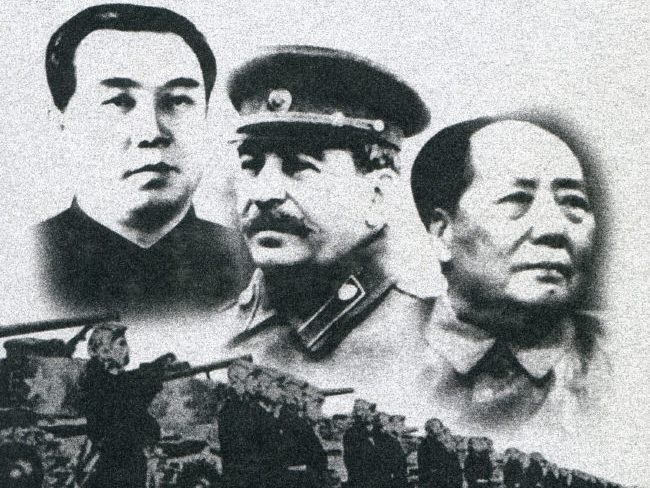
We continue to publish a cycle of articles of a wonderful mother -in -law, Associated Professor University of Kukmin (Seoul) Andrei Lankov about how North Korea lived under Kim Il Sena when she was the most contrary society in world history.
See also:
 Andrey Lankov
It is well known that North Korea, sometimes called the "communist monarchy", is controlled by a hereditary regime. However, it is less known that since the late 1950s, the principle of hereditary privileges (as well as hereditary discrimination) has become one of the organizational foundations of the “Kimirsen model” of society.
The Special Bun system, which began to form in 1957 and took a more or less finished view by the mid-sixties. Formally, like most of the instructions of the time of Kim Il Sen, the Sonbun system acts to this day, although in practice its significance has significantly decreased.
The word Sonbun (more precisely, Cholsinsinsonon) can be translated into Russian as “origin” with some stretch, although, as we will see next, the archaic term “estate” would be quite accurate. During the time of Kim Il Sen, the Sonbun of the DPRK citizen determined where this person will live and study, where he will be taken to work and even, most likely, with whom he could marry.
In most cases, Sonbun is based on one single circumstance - on what the ancestors of this person in the male line were doing at the end of the colonial period and shortly after the liberation of the country, that is, relatively speaking, between 1935 and 1953.
In many countries of “real socialism” there was a habit of classifying people according to the level of trustworthiness associated with their origin - it is enough to recall Mayakovsky’s very frank remark about how to act with Dantes in the USSR: “We would ask him: // - And your parents? // What did you do // until the 17th year? // Only this Dantes would have seen. "
However, in practice, both in the Soviet Union, and even in China (where at the time of Mao this principle was carried out with a special sequence), much less attention was paid to the origin than in North Korea under Kim Il Sen. The DPRK did not rely on the revolutionary instant personnel officers. Instead, a formalized system was created there, which divided people into hereditary groups, depending on the deeds of their ancestors.
In accordance with the Sonbun system, the entire population of the country was divided into four classes, which would be more accurately called classes. True, one of these classes was very small - so small that it became not known about its very existence outside the DPRK. This class (it was called Thyks, that is, “special”) included direct descendants of those who played a special role in establishing the Kimov family - primarily the descendants of the partisans, who in the thirties fought in the detachment of the field commander Kim Il Sen.
The other three classes included at least 99 percent of the total population of the country. The most privileged was the so -called “main class”, which included people whose ancestors had noticeable merits before the regime. In particular, the descendants of those who died in the Korean war were included there, as well as the descendants of the participants in the anti -colonial resistance. The descendants of the heroes of the war, party workers and other respected (power) people belonged to the same class. Since the late 1960s, only members of the “main class” had the right to live in Pyongyang. They also reserved the exclusive right to enter universities of an ideological and political nature (in techies, they also adopted with a questionnaire).
The second grade, the so -called “oscillating”, included representatives of groups, which, from the point of view of the new government, looked somewhat suspicious, but were not perceived as directly hostile. Members of this group plunged certain discrimination. For example, they, as a rule, could well enter good technical universities (if abilities, of course, allowed), but they were closed to access to such educational institutions of a humanitarian or socio-political nature as, say, the Faculty of University of Kim Il Sen or the Institute of Foreign Languages or the Institute of Foreign Languages. As a rule, people of this origin had problems with Pyongyang registration, although an exception was made from this rule for especially valuable specialists.
The third, “hostile”, the class included the descendants of those who at one time committed politically reprehensible acts and were guilty of something to the authorities. Members of the hostile class were, for example, the descendants of the clergymen of all faiths, the descendants of the employees of the Japanese colonial administration, as well as the descendants of those who during the Korean War somehow collaborated with Korean "white", that is, the Lysynmanovites. In most cases, representatives of these groups were subjected to lifelong discrimination, not having the opportunity to live in prestigious cities and having very limited access to education. Their children inherited their status - and, accordingly, discrimination. It was almost impossible to change the Sonbun.
Sometimes this led to sad conflicts. For example, I know a family that arose in the 70s in the results of an unequal marriage. Not only did the groom were more than 10 years older than the bride (an almost indecent break for North Korea of those times) - he was also a man with a bad Sonbun (grandson of a small landowner). His wife, on the contrary, had an exceptionally good sleepboon, descended from the “main class” (granddaughter of a member of anti -nziapan resistance).
In practice, this family did not experience any problems for the time being. The spouses lived together and gave birth to three children. The husband worked at the mine - the work is hard and dangerous, but decently paid, while the wife was a small official in the local administration. However, the situation acquired an unexpected turn, when the spouses were belatedly realized that their children inherited his father's Sonbun. In practice, this meant that the road to good universities was closed to them, and everything was not easy with employment.
Until the beginning of the 90s, Sonbun remained almost a defining factor in a person’s life. However, the turbulent events of the last decade have led to the fact that attention is now removed much less. Situations began to arise when the personnel officers were ready to ignore the frankly bad USBUN and take a person for prestigious work, in that, of course, if this person was considered a necessary specialist.