
Translated material
Not one at home
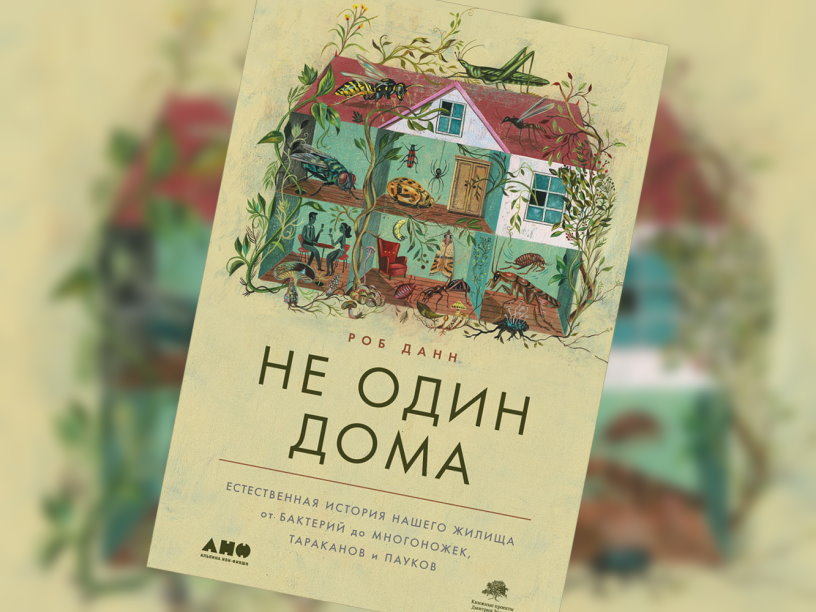
The Alpina Non-Fixes Publishing House represents the book of American Biologist Rob Dann “Not one at home. The natural story of our dwelling from bacteria to multi -leafs, cockroaches and spiders ”(translation of Maxim Vinarsky).
Several projects that Professor of the University of North Carolina Rob Dann worked are associated with the study of the biodiversity of human dwellings: from the huts of Australia Aborigines to the houses of wealthy Americans. Scientists pay attention to all living organisms living in the neighborhood of a person. They determine the composition of “home” bacteria and calculate the number of types of arthropods, imperceptibly living next to us. In particular, during the Arthropods of Oour Homes project, it was found that people live side by side with five hundred species of arthropods, among which there are insects, spider -shaped, ticks and millipedes. Stories about research results in the book are adjacent to vivid descriptions of the field work of biologists. It applies to Rob Dunn and the question of whether we should bother us with such a close neighborhood with a diverse fauna.
We offer to read an excerpt from the chapter dedicated to cockroaches.
The modern struggle against insects is based on the use of chemical weapons. But, deciding on a chemical war, keep in mind: the battle may never end. For each insecticide we have developed, the attacked insects find an evolutionary response using natural selection. The more fierce the attack, the higher the pace of evolution. Insects evolve faster than we can understand how this happens, not to mention counteracting. And this is repeated over and over again, especially with those views against which we throw all our forces, such as Blattella Germanica .
Chlorudan, the first insecticide to combat home cockroaches, was used in 1948. This miraculous drug was so toxic that it was considered reliable. And yet, already in 1951, cockroaches, resistant to chlorudan, appeared in the city of Christie Corps in Texas. It turned out that these insects are 100 times more resistant to pesticide than their laboratory brothers. By 1966, some Prusaki developed immunity to Malation, Diazinon and Fention. A few years later, cockroaches were discovered, resistant to DDT. As soon as a new insecticide appeared, as for several years, and sometimes months, some Prusakov populations acquired immunity to it. Sometimes resistance to the old drug only increased resistance to the new. In such cases, the battle was lost without having time to begin. Once arising, the stable lines of the Prusakov began to spread and breed, despite the pesticides.
For each new deadly invention of the chemical industry, cockroaches gave a mirror - and very effective - the answer. There were new lines of insects that not only managed to successfully avoid the action of poisons, but even as if they benefited from them. But these evolutionary answers are nothing in comparison with the fact that not so long ago it was open very close to me, in the neighboring building of our university campus. The history of this discovery began more than 20 years ago, at the other end of the country, in California, and two main characters participated in it - the entomologist Jules Silverman and the Prusakov family, who received the conditional designation “T 164”.
Jules studied cockroaches on duty. He worked in the technical center of Clorox in the California town of Plezanton. This company was no different from other high -tech industries, only chocolates were left from its conveyor, but a variety of devices and chemicals for the destruction of animals. Jules specialized in the fight against cockroaches, first of all, Tarakans-Prusaks. The Prusaki are only one of the synanthropic types of cockroaches. As one expert on cockroaches, with whom I once met at a scientific conference, put it, “you gathered your American cockroaches, as well as oriental cockroaches, Japanese cockroaches, smoky-brown cockroaches, brown cockroaches, Australian cockroaches, furniture cockroaches, and several other other species.” However, most of these thousands of cockroach species living on Earth are not found in houses, and in principle they could not survive there. Only some “dirty dozen” species, as it turned out, has the necessary preadaptations to penetrate human dwellings and work out safely there. For example, some of them are capable of parthenogenetic reproduction. This means that females are able to give offspring without any participation of the male. Any of the synanthropic cockroaches has certain devices for existence in closed rooms, but a cockroach-prusak is endowed with them in the largest quantity.
The Prusak, who is in nature, is practically doomed. He will be eaten quickly, or he will die of hunger. If he manages to leave offspring, it will be weak, painful and not suitable for anything. That is why you will not find “wild” populations of this species anywhere in the world. Only we, at our side, Prusak becomes strong and prolific, for which we do not love him so. The cockroach prefers the same conditions as we: so that the house is warm, not very dry, but not too wet. He loves the same food as us. Like us, cockroaches can even suffer from loneliness. However, with all our dislike of the Prusaks, there is no reason to be afraid of their reasons. Of course, cockroaches can spread pathogenic microbes, but no more than your children or neighbors. Until now, not a single case has been documented when the disease would be caused by microbes spread by cockroaches, while every minute one of us gets sick, infected with another person. The most serious problem associated with the Prusaks is that, accumulating in large quantities, they become a source of allergens. In response to this real and other imaginary troubles, we spend huge funds on the destruction of cockroaches.
It is difficult to say when exactly the great war of a man with cockroaches began. Their remnants are very poorly preserved and rarely find them during archaeological excavations (at least compared to beetles). In addition, the main efforts of researchers are aimed at finding ways to combat cockroaches, and not at studying their lifestyle. The closest relatives of Prusakov are two types of oriental cockroaches, which are almost not found in residential premises. These insects fly well, eat leaves from forest litter, and in some areas, scientists and farmers consider them useful to agriculture. Initially, the Prusaki probably looked like wild cockroaches, but then adapted to existence next to a person. As a result, they lost the ability to fly, began to multiply faster and form more dense clusters, which, along with other adaptations, allowed them to exist more successfully in conditions preferred by people. Then they began their resettlement.
It is believed that the Prusaki spread widely in Europe during the Seven Years War (1756–1763), when large masses of people moved along the continent, carrying personal belongings with them in which cockroaches could hide. What kind of nation is “responsible” for the transportation of cockroaches is unknown to the end. Karl Linnaeus, the father of modern systematics, believed that the Germans were to blame for everything. Linnaeus was Shrek, and Sweden in the Seven Years War fought with Prussia, so Linnaeus decided [1] that the name “Prussian cockroach” is quite suitable for this repulsive insect. By 1854, the Prusaki reached New York. Now they live throughout the Earth, from Alaska to Antarctica, accompany people of all nationalities and travel on our ships, cars and aircraft. It is strange that they still have not entered orbital space stations.
In those areas where the temperature and humidity in human housing and vehicles are highly dependent on the time of year, Prusaki coexists in houses along with other types of cockroaches, some of them (for example, American cockroach) may accompany a person since the times when we lived in the caves. But in houses where there is central heating and air ventilation, red cockroaches definitely dominate, displacing everyone else. For example, until recently, Prusak was relatively rare throughout China. When in the northern, rather cool, parts of this country began to use heated trucks, the cockroaches were able to advance with them to the north. On the contrary, in the hot south of China, they spread along with trucks equipped with air conditioners. Both in China and around the world, as there are more and more houses for central heating and air conditioning, Prusaki become more and more numerous and ubiquitous.
Twenty -five years ago, when Jules Silverman entered the service in Clorox, the number of Prusakov was on the rise. Jules's task was to develop new chemicals to combat them. At that time, the best remedy against them on the market was toxic baits, which you are probably familiar with. This is a sweet treat for cockroaches, which contains insecticide. This method helps to poison cockroaches without spraying the poison throughout the house. Theoretically, the bait can be made on the basis of any carbohydrate that attracts cockroaches: fructose, glucose, sucrose or maltotriosis. In practice, glucose has traditionally used in the United States, thanks to its cheapness and high attractiveness for insects. American cockroaches are used to eating it. Up to half of their diet consists of carbohydrates, and most of the glucose falls. We also use it in huge quantities, for example, in the form of corn syrup. We promise the child a dessert to feed him dinner, seducing the same substance that is contained in a deadly bait for cockroaches.
Quite soon after the start of work in Clorox, Jules realized that in the room where his friend, the field entomologist Don Biman, placed sweet traps for cockroaches, something strange is happening. It was an apartment T 164. In this apartment, the cockroaches did not die when Don left a bait there. Over and over again, he increased the number of baits, but the cockroaches did not think to die. When traps using the poison (hydraulic) used at that time were put in the laboratory, cockroaches from the apartment T 164 died. The poison killed them in the laboratory, but not in the apartment. Don told Julia that it looks like something averts cockroaches from the bait. In the laboratory, Jules studied the attractiveness of individual substances contained in the bait, for cockroaches from colony T 164. The first and most obvious explanation was that the Prusaki avoid an insecticide hidden in the bait. However, the experiments set by Jules showed that it was not a pesticide. Other substances did not cause insects in the bait, including emulsifiers, thickeners and preservatives. It remained to check only sugar in the bait - glucose, that is, syrup. It seemed almost incredible so that the Prusaki began to avoid exactly the fact that they, like most other species of animals, eat for many millions of years. But so it actually happened. Cockroaches refused glucose; They not just neglected it, but avoided it. Shied. At the same time, fructose retained its attractiveness for insects. It may have been thinking, this particular population of red cockroaches (which was called - T 164) took out the lessons. I acquired a kind of superpower. In a word, “Furia in hell is nothing” [2] in comparison with smart Prusak (not to mention billions of smart Prusaks).
[1] Linnaeus published a scientific description of Prusak (aka red cockroach) in 1767. He gave him the name Blatta Germanica . Interestingly, in the countries of Central Europe, in the same Germany, the spread of cockroaches is attributed to the movements of Russian troops during the Seven Years War. Accordingly, red cockroaches are called "Russians." The real homeland of this species is located in South Asia. - approx. scientific. Ed.
[2] A reference to the quote from the play of Congrive “Bride in the mourning” (1697): “Furia in hell is nothing in comparison with the abandoned woman.” - approx. Ed.