
Translated material
The wrong ones came
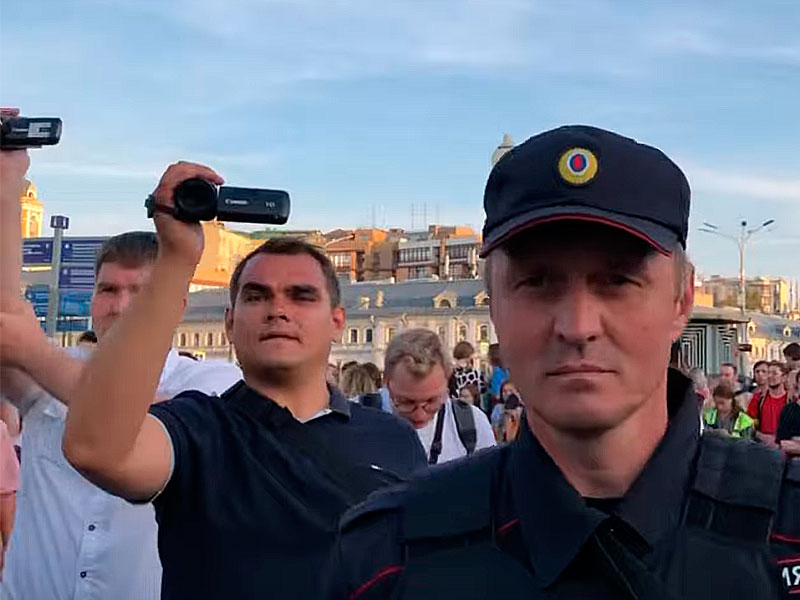
Almost immediately after the end of the Saturday, the police said that among the detainees "more than 600 offenders are not residents of the city of Moscow." Considering that, according to the OVD Info, 1373 people were detained (and according to the official - 1074 people), the Ministry of Internal Affairs, and after it the “loyalists” began to say that Muscovites were not angered by the violation of their electoral rights, but not related to the elections to the Moscow City Duma, residents of other regions. It is implied, apparently, that they were paid for it.
The choice of such an attack on the demonstrators looks rather strange, because here in a vulnerable position it turns out, rather, the position of the authorities.
You can start with the fact that both the mayor of Moscow Sergei Sobyanin, and a significant part of the police officers who “guarded” the capital of Muscovites on Saturday are not guilty of this - but no one puts it on them, including the leaders of the opposition.
Further, if we assume that really half of the protesters came to Moscow from other regions, you will have to agree that this is even worse for the current government. Everyone has long been accustomed to the fact that United Russia became a party of less educated and urbanized regions of the country, it is there, with an honest calculation, he receives a large share of votes. The protest of the rich inhabitants of the center of Moscow is normal. The protest of the inhabitants is less prosperous, or even poor cities - a bad signal.
 Overlap st. Tverskaya July 27, 2019
Participation in the Moscow rally of visitors from other cities means that the opposition has achieved its goal: people go outside not against violations of the law by Moscow election commissions, but against the current political order.
Finally, where did this figure come from? During the detention, the police find out the name of the person, the date of birth and the place of registration. From the names you can’t compile any statistics, a comparison of the dates of birth can give an interesting picture, but for this you need to think, but information about the registration (that is, registration at the place of residence or stay, “constant” or “temporary”) is understandable to everyone: Moscow or other region of the country.
But a residence permit is an obsolete instrument of accounting for the population, which has grown out of the desire of the Soviet government to keep people in their place of residence (some, not without reason, call this invention to be fixed). Naturally, not only in Russia the state wants to know exactly where citizens live, but usually much less bureaucratized procedures are enough for this - for example, you can bring to the city hall a spine of payment of utility payments with a name, sometimes a simple statement is enough.
In Russia, registration is a heavy tool, the meaning of which is incomprehensible to many citizens. A recent study of the Institute of Law Problems showed that a quarter of the country's population younger than 30 years lives not at the place of permanent or temporary registration - that is, the state does not even represent where exactly. The institution of registration is not only harmful, it is also ineffective.
 The situation at the place of detention of protesters on July 27, 2019
If we assume the most incredible - the participants of the action were brought to Moscow centralized and for money - then questions arise to the FSB, how did state security be able to overlap such a powerful, well -coordinated and deeply conspiratorial structure?
It turns out that the thesis that on the Tverskaya Square, and then on neighboring streets and squares, were not residents of Moscow, or rather, not only the inhabitants of Moscow - plays against the position of the city hall, up or even the Kremlin, depending on who we consider the initiator of the power scenario of the promotion. What to do with this is another question.