
Translated material
DNA aged a million years
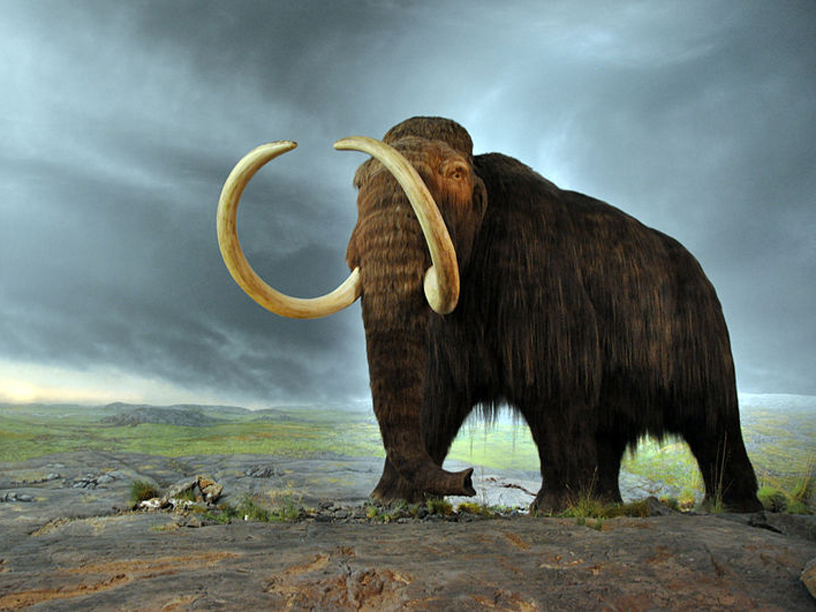
The mammoth’s teeth, preserved in the eternal permafrost of Eastern Siberia, allowed us to isolate a record ancient DNA - the age of a million years, which is almost at the limit of the method. DNA, extracted from three examples, excavated in the 1970s, allowed to identify a new type of mammoth, which became the ancestor of a later North American species. An article by a team of scientists from Sweden, Denmark, Great Britain, Germany, Turkey, China, Russia, Norway and the USA published in Nature magazine.
Over time, DNA molecules are degraded, and it becomes impossible to determine the sequence of nucleotides in ancient DNA. The previous record of the antiquity of the genome, which was partially sequenced, was 560,000–780,000 years. Thus, the age of the horse’s bones, found in the Canadian province of Yukon, was evaluated. The work to extract this DNA was led by Louis Orlando from the Center for Anthropobiology and Genomics in Toulouse. At the same time, scientists concluded that the remains up to a million years old, persisting in the constant cold of permafrost, slowing down the fragmentation of DNA, should also contain suitable DNA fragments suitable for reading. It remained only to find suitable samples.
One of the leaders of the current study, Professor Love Dalén, evolutionary geneticist from the Swedish Museum of Natural History in Stockholm, was carried away by the idea of sequencing the remains of mammoths since 2007. Dalen hoped that DNA could shed light on the evolution of mammoths and other species, but he was skeptical because of previous unsuccessful experiments with much younger remains discovered in eternal permafrost. “Not everything that was stored in permafrost is always working. The vast majority of samples contain bad DNA, ”he says.
Dalen even admits that two of the three molars of mammoth, found by Russian paleontologist Andrei Sheru in deposits for more than one million years in the Yano-Kolyma lowland, contained so little DNA that he would have thrown them away if they were younger. But thanks to modern achievements in the technology of sequencing and bioinformatics, his team managed to get 49 million pairs of bases of nuclear DNA from the oldest sample found by the Krestovka River, and 884 million pairs of foundations from another tooth from the Adych River. DNA analysis showed that the sample from the cross was 1.65 million years old, and about 1.3 million from Adychi. The third sample, a tooth of a woolly mammoth from the village of Chukochya , who was 600 thousand years old, retained almost 3.7 billion pairs of DNA bases.
Outwardly, the two most ancient teeth looked like they belonged to the steppe mammoths ( Mammuthus Trogontherii ), which, according to researchers, preceded wool mammoths ( Mammuths Primigenius ) and the North American species - Mammoth Columbi. But their genomes painted a more complex picture. A sample from Adychi belonged to the line from which woolly mammoths occurred, and the sample from the cross was clearly not.
Louve Dalen and his colleagues found that the mammoth from the cross belonged to a completely different line. “It cannot be said that this is a different species, but it seems that this is still so,” says Dalen. Although the sample from the cross was found in Eastern Siberia, Dalen suspects that this line stood out from the steppe mammoths of North America. The team discovered that the mammoths of Columbus come from both “cross mammoths” and from woolly mammoths. According to Dalen, these two lines mixed more than 420,000 years ago. Thus, the studied samples also became a rare evidence of hybrid species obtained from ancient DNA. Commenting on this conclusion, an ancient DNA specialist from the University of McMaster Hendrik Poinar, says that different types of mammoths probably formed hybrids when the glacial cover brought them together. He and his colleagues found evidence that later woolly mammoths and mammoths of Columbus sometimes crossed.
Although the researchers have long expected that the study of an ancient DNA would overcome the threshold of a million years, this was an important event. “There is a difference between what we consider possible, and when we actually demonstrate it,” says Paleogenetic Viviane Slon from Tel Aviv University. One of the first authors of the current work, the bio -format at the University of Upsalus, Tom Van Der Valk) hopes that this will contribute to the development of other research: “This is a symbolic barrier that I hope can inspire and motivate other groups that have ideas of relatively deep sequencing.” According to Louve Dalen, having overcome the threshold of a million years, researchers of ancient DNA will be able to access the early history of other mammals. DNA samples of sheepskin, moose and lemmings from permafrost are now in the field of view of his laboratory.
According to the researchers, the chances of finding the remains of ancient relatives of man for a million years in eternal permafrost are very low. But Dalen believes that a suitable environment - such as a deep cave - can give samples of such an ancient age. The remains of the early Neanderthals from the Spanish cave with a age of 430,000 years ago are the oldest DNA of an ancient relative of a person discovered to date. “To find hominin in such an ideal context for preservation as an eternal permafrost would be a dream,” Vivian Elephant admits.
As for the probable limit of the age of an ancient DNA, according to Louve Daline, it is easy to determine. “2.6 million years. This is the limit of permafrost. Before that, it was too warm, ”he says.