
Translated material
The house of the goddess Pele
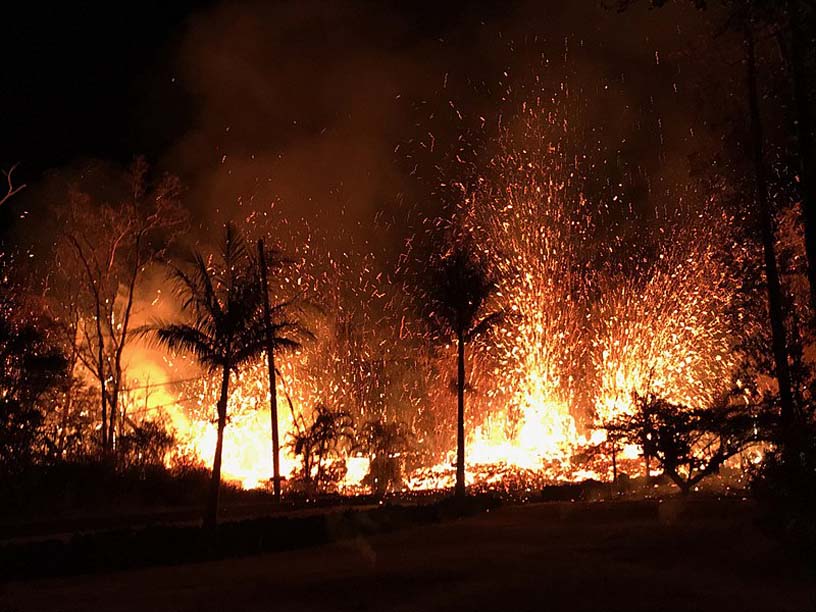
Since May 3, the eruption of the Kilauea volcano continues on Hawaii. Due to the threat of lava flows, residents of nearby areas were evacuated. On May 17, the explosion of gas in the volcano caused the appearance of a column of volcanic ash with a height of more than nine kilometers.
Strictly speaking, Kilauea began to erupt on January 3, 1983, and since then the eruption has not stopped, only periods of increased activity were replaced by times of relative lull. The events of May of this year were the 62nd activation of Kilawell in thirty-five years. In general, this volcano is clearly located in the forefront of applicants for the title of the most active volcano. In the XX century, only once a break between its two eruptions exceeded ten years (1934 - 1952).
Verging Kilauea volcano in 1983
Kilauea activity in two centuries (until 1823, incomplete data)
Kuliauaa belongs to the so -called shield volcanoes, volcanoes of this type occur when the lava of low viscosity spreads over long distances and, freezing, forms a “shield”. The next eruption gives a new layer of frozen lava, and so the shield volcano gradually grows. The base of such volcanoes is very wide, for Mauna Kaa, for example, it has a size of about 120 kilometers (in the surface, in the underwater even larger). But their slopes are very gentle, the slope is only about eight degrees.
Five shield volcanoes forming the island of Hawaii. Three of them are active: Mauna Loa, Kilauea and Hualalai.
The shield volcanoes are divided into two subtypes: Icelandic and Hawaiian. Hawaiian volcanoes are larger, and side cones are found on their slopes. Icelandic relatively small and side cones usually do not have. The extensive shield of the Kilauea volcano has many side craters and cones, the current eruption occurs through the crater of the puu-oo (Puʻu ʻōʻō).
Puu-Ooo crater
For some time, geographers even considered Kilauea a side branch of the neighboring larger Mauna LoA volcano, but now it is established that Kilauea has a separate magmatic chamber. Scientists were able to confirm this using a chemical analysis of lava of each of the volcanoes. This is also evidenced by the activity of Mauna Loa in 1934-1952, when Kilauea took a break in work. The opposite situation: Mauna-Loa fell silent, and Kilauea erupted-was observed in 1952-1974. However, between volcanoes, some interaction is sometimes manifested, possibly associated with the fact that the accumulation of magma in one of them leads to an increase in pressure in the neighboring one.
The vertex Kalder Kilauea has a size of 4 by 3.2 kilometers and the height of the walls up to 120 meters. Her main crater Halemaumau with a diameter of 920 meters and a depth of 85 meters. He last erupted in 1974. Kilauea has two rift zones going to the east and southwest of the main Caldere. The length of the eastern is about 125 kilometers, southwest-35 kilometers.
In the mythology of the Hawaiians, the Volcano Kilauea was considered the house of the goddess Pel and the place where her rapid relations developed with the hero of Kamupua, associated in Hawaiian legends with the rain. It was said that once Kamupua, he appeared in the house to Pele and her sisters and tried to impress them. He managed to charm the sisters, but Pele did not succumb to his charm and called his pig. Here she was right, since Kamupuaʻa had some pork features (his name Kamapuaʻa means “Svini Man”), which, however, did not prevent him from being a lover hero. However, Kamupuaua was offended, between him and Pele began a crush. When Kamupuaʻa tried to approach the pele, she let him fire, but her sister Pele Macahanaloa saved the hero, who let fog and rain on fire. Pele recognized her defeat. When the fire went out, sticks remained, the friction of which Hawaiians mined fire. And Kamupuaʻa divided the island of Hawaii, taking a moist, wrecked north-east side and yielding to dry and covered with a frozen lava leeward. And the ridges of the clouds at the tops of the volcanoes of the Hawaiians began to be called pigs (Puaʻa).
Wooden Statue of Kamupuaʻa from the Bailey House Museum on the island of Maui
There is an option in which Kamupuaʻa coped with Pele without outside help, closing her home in a volcano with fern leaves. Although Pele was furious, she had to come to terms. A peace agreement was concluded between Kamupua and Pele with the separation of the island. As a result of this battle, the fern ʻamaʻumaʻu ( Sadleria Cyatheoides ) appeared, whose young leaves are painted red. And one of the craters of the Kilaulea volcano was called Halemaumau ( halemaʻumaʻu “Burnature House”). There are also legends where Pele eventually falls in love with Kamupuaʻa and with the help of the spell calls for him to return to the island, they become lovers and give birth to a daughter. Kamupuaʻa turns the frozen lava pele into fertile soil.
Red fern ʻamaʻumaʻu
Lavoy Lake in Khalemaumau crater, June 2012
Let us return from the mythological past to the present. The first signs of a new increase in Kilauea's activity was a number of underground shocks on May 3. Soon after, several sources of lava opened along the eastern crack. Her streams forced the authorities to give an order to evacuate 1,700 people from the settlement of Leilani-Estits. 37 buildings were destroyed by lava.
Streams of lava of the Kilauea volcano
The exit of volcanic gases from the crater on May 9, 2018
Lava’s exit sharply dropped the pressure in the network of underground channels of Kilauea, connected to its magmatic camera. As a result, the level of lava in the crater of the volcano quickly fell by 30 meters. “As if someone had pulled out a cork from the bath,” says Michael Poland, a volcanologist at the US Geological Service. Because of this, the walls of the crater fell inside, creating a layer of stone on the surface of the remaining lava. The level of lava continued to decline. As soon as the lava in the crater sank below the groundwater level, water began to seep into the crater. She turned into steam, creating high pressure under the fragers of the crater. From this moment, the explosion has become inevitable.
It occurred on May 17 at 16:15 local time. Kilauea threw a train of volcanic ash and steam to a height of more than 9100 meters. Now volcanologists continue to monitor the volcano. They say that new explosions are not excluded. For example, under similar conditions in 1924, Kilauea issued a series of more than fifty steam explosions within two weeks.
The volcanologist of the state of Hawaii Brughton says that the current event seems to be a complex eruption that happens once every 50 - 80 years. It is still impossible to say when people can return to abandoned houses and how many of these houses will survive to their return.