
Translated material
What is an epitranscriptomic?
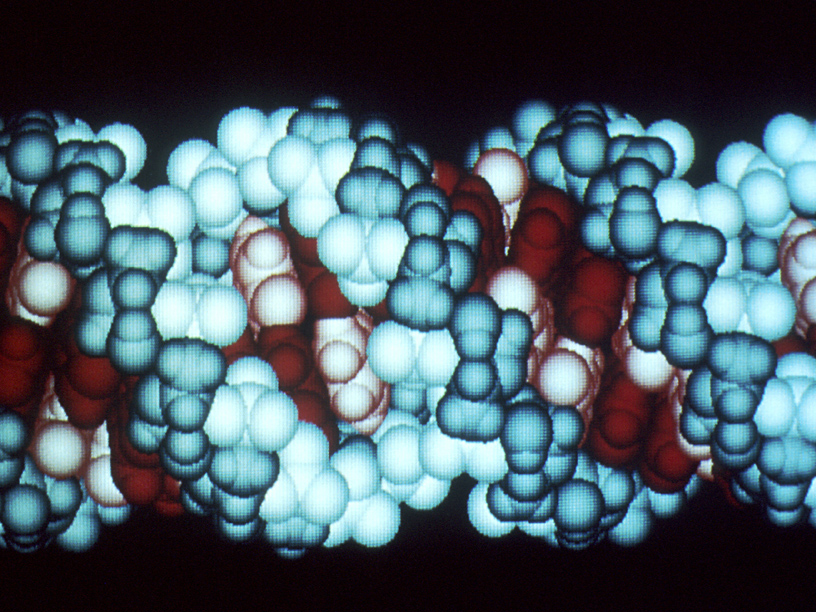
Now scientists are increasingly talking about the existence of another mechanism that regulates the work of genes - modifications of RNA molecules. For this sphere of research, a new term has already appeared - epitranscriptomy. In the second half of June, an international conference on epitranscriptomics was held at the University of Chicago. The editors of the SCIENCE magazine website told briefly.
The classical scheme of the work of genetic mechanisms consists of three links: DNA → RNA → proteins . Information is read from the gene located in the DNA chain, while the molecule of information (or matrix) RNA is synthesized by the principle of complementarity. Further, matrix RNA enters the ribosoma, where it serves as a scheme according to which the protein corresponding to this gene is built. The synthesis of RNA molecules according to the DNA model is called transcription , protein synthesis according to the RNA - broadcast . In this case, genes recorded in DNA are an unchanged standard and can change only as a result of a mutation: when replacing nucleotide in a DNA chain, loss or insert of a chain site.
This scheme is certainly true, but a number of existing factors are not taken into account in it. And the body of the body actually does not work as a template for stamping of unchanged details and not as a casting form in which identical products are cast one after another. Rather, the genome can be compared with the literary scenario, according to which different directors will shoot similar, but still different films. Or with an orchestra party, which, under the leadership of different conductor, will sound differently. The fact is that in a living cell there are a number of mechanisms that affect the functioning of the genome. They can turn on a certain gene by activating its transcription, or turn off, suppressing this transcription. The function of the cell in this case changes, although the sequence of nucleotides in the DNA remains the same. All methods that regulate the work of genes without changing DNA are called epigenetic mechanisms .
There are several such mechanisms, and one of the most important among them is DNA methylation . The methyl group (CH3) joins the cytosine - one of the nitrogenous bases in the DNA. If there are many such methylated areas in some genus, then the DNA polymerase enzyme that is busy reading information from the gene cannot process it. Accordingly, the corresponding RNA chain will not be built (the broadcast does not occur) and the protein that this gene is responsible for. The methylation of DNA areas, thus, serves as the method of turning off certain genes. For the proper operation of many body systems, it is necessary that certain areas of the chromosomes have the desired “methylation profile”, that is, so that the methyl groups are attached in the right places. Even diseases associated with a violation of methylation profiles of certain genes are known.
Later, scientists drew attention to methylation not DNA, but information RNA. For the first time, RNA methylation was noticed back in the 1970s, but then they did not pay attention to him, as they mainly worked on the study of DNA. Now, thanks to the methods developed in the last decade under the leadership of Chuan He from the University of Chicago, Samie Jaffrey from Cornell University and Gideon Rechavi from Tel Aviv University, it was possible to find the methy RNA molecules. It was found that a variety of RNA molecules are subject to methylation: transport, ribosomal, informational, small, long non -leading and microrm.
DNA methylation and RNA methylation differ in that DNA is metered, as already mentioned, cytosine, and in RNA, a methyl group in 80 % of cases is attached not to cytosine, but to adenosine. But, as with DNA methylation, it interferes with the reading of information and blocks the activity of the gene, but not at the stage of transcription, but at the broadcast stage. Hence the name of the epitranscriptomic .
In 2012, Gideon Rehavi and his colleagues described one of the varieties of RNA methylation, which is indicated by the M6A, where the number indicates the position number in the adenosine molecule, to which the methyl group joins. This is carried out by a special enzyme M6A methyltransferase. Now this type of RNA methylation is found in a variety of organisms: mammals, insects, plants, fungi, bacteria, even in viruses. At the same time, in yeast and in bacteria, M6A-methylated nucleotides were found from similar areas of ribosomal RNA.
In Chicago, Chuan He and his colleagues discovered that there is also a protein that produces the opposite effect, that is, removing the M6A tags from the RNA molecule. It turned out to be FTO protein, encoded by the genome located in the sixteenth chromosome.
Formula N6-Metladenosin
In 2016, a joint article by researchers from the USA and Israel, dedicated to another of the types of RNA methylation, was published in Nature. This time, a methyl group joins the adenosine in position number 1 (M1A). In general, scientists came to the conclusion that the number of methylated nucleotides in RNA is about ten times more than in DNA. Therefore, the role of RNA methylation can be very important.
Now several modifications of the work of specific genes carried out using RNA methylation have been studied. For example, it increases the expression of genes necessary for the correct differentiation of embryonic stem cells in cells of different types. Sometimes RNA methylation is harmful. There is a type of RNA methylation associated with an increased risk of diabetes. With myeloblastic leukemia, the addition of a methyl group into RNA of blood cells prevents the transformation of blood stem cells (myeloblasts) into various types of leukocytes. In 2017, three groups of scientists independently showed that the removal of the enzyme, which adds a methyl group to information RNA, kills tumor cells in acute myeloblastic leukemia. Experimental drugs for the treatment of leukemia, based on this effect, are already being developed. At the current conference, Tony Kouzarides from the John Gerdon Institute in Cambridge spoke about the other case of the RNA modification associated with the occurrence of leukemia. He shared his suspicions that there would be even more such phenomena.
In the new experiments of the Chuan HE group, it was shown that the M6A methylation is critically important for the development of the brain. Through proteins that read information from RNA, it is associated with the control of the exact time of the formation of new neurons in the brain of mice embryos, and also affects the restoration of axons after damage to the nerve. In one of the experiments, HE and his employees found that the M6A methylation is also associated with memory mechanisms. When the gene is disconnected, which is responsible for the protein that reads the M6A tags with RNA, the mice had defects in memory, but after the introduction of the virus that carries the functional version of the gene, these defects disappeared. When the researchers chemically stimulated neurons to simulate the memorization of new information, they observed a sharp surge in the synthesis of protein associated with the M6A.
It turns out that the modification of information RNA is not limited to methylation. In a study of Shalini Oberdoerffer, it was found that in addition to methylation, there is Acetylation of RNA, in which the CH3Co group is attached to cytosine. Such a modification stabilizes the molecule of information RNA and, possibly, helps it connect with the molecules of transport RNA.