
Translated material
Women of the ninth street
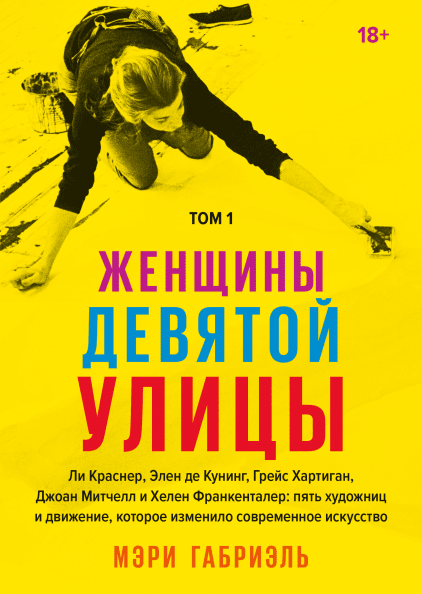
The publishing house Mann, Ivanov and Ferber is published by the first volume of Mary Gabriel’s book “Women of the Ninth Street. Lee Krasner, Helen de Cunga, Grace Hartigan, Joan Mitchell and Helen Frankentalr: five artists and the movement that changed modern art ”(translation of Oksana Bear).
Mary Gabriel illuminates the evolution of abstractionism from the 1920s to the early 1960s through the prism of the biography of the five art stars: Lee Krasner, Helen de Cungal, Grace Hartigan, Joan Mitchell and Helen Frankentalr. The Second World War, cultural and economic shocks, the exchange of ideas with refugee artists from Europe-all influenced the minds and work of New York artists. And in the center of this vortex there were five extraordinary women and their outstanding paintings. They dared to enter the world of male abstract painting of the 20th century not as a muse, but as artists. Of the studios with cold water where they worked, drank, fought and loved, they opened the door to the world of art for themselves and countless other women creators.
The New York of the early 40s, the artists who fled from the European War, as well as the efforts of those who helped them, began to come to the city.
Bug artists
New York artists, longing for news, could hear them in a cafe, on the Washington Square and on the corner of any street from Chelsea to the fourth Avenue. But in cold winter days, the Lonard Bochar Painted Shop on 15th Street was considered the best place for this. While Leonard rubbed the paint and made up the desired colors, the masters were warmed up by powerful batteries, exchanging rumors and gossip. Once in early October 1940, we were talking about Mondrian. This was their colleague-Nizerlander, who had to flee to America from Paris, where he lived and worked. It was Bokur who informed New York artists that Mondrian was in the city. “This news was akin to reading about a sudden large reinforcement, who arrived in time for the help of the allies at the front,” recalled sculptor Philip Pavia. Mondrian was one of the many European masters who have recently been looking for refuge in New York, but at the same time one of the most famous and significant.
Among the artists living in Dauntown, he was considered a legend. However, his work was very difficult to see, and the majority knew them only on low -quality magazine reproductions. As for Mondrian himself, it was a mystery man. He settled on the 34th street, and some who were lucky enough to see him to see him that he was small and incredibly thin. The artist looked like “modest and not at all heroic”, according to Pavia. This made his image even more mysterious and intriguing.
In 1933, Alfred Barr and his wife Marga Skolari-Barr lived in Germany. Barr was then on long -term leave on mental health. It was restored after the stress experienced during the management of the Museum of Contemporary Art in New York. The couple found the moment when Hitler grown to the chancellor. They also witnessed large -scale repressions, which began soon after that. Marga said: “We saw the first yellow stars on the clothes of Jews. The first department stores closed before our eyes. ” This was the beginning of the Nazi campaign against the business belonging to Jews. The woman added: "Seeing all this, we quickly became convinced anti -fascists." And Barrah became eyewitnesses to how Hitler's followers closed the Bauhaus revolutionary art academy and how they had all the most tightly oppressed the artists of the avant-garde. Fury from dangerous cultural nationalism, which the Nazis promoted, Barr wrote nine articles under the general name “Hitler and nine muses”. In them, Alfred spoke of the immediate threat that artists and intellectuals in Germany faced after Hitler came to power. But no one in the United States published these articles, as Marga recalled. Even after many decades, she could not but be affected by the voluntary blindness of the Americans. And then Barr did everything that was in the power of an ordinary person who decided to prevent the Nazi regime at all costs to destroy modern art. He turned as many picturesque canvases as possible into the phone and secretly removed from Germany in the umbrella.
In a word, no one in all New York was better than Alfred Barra prepared to help artists who were in danger in Europe. And no one knew better than him how difficult the situation was there. When the artists who intended to escape from France raised noise and demanded help, Barra's reaction was lightning fast. Also quickly he responded to the requests of various European museums, which asked for his museum of contemporary art, while the continent plunged into chaos, accepted the priceless works of Titian, Michelangelo, Donatello and many works in the style of avant -garde. Among the first paintings sent to the United States was then, Gertinik. But how Picasso himself coped with difficulties in France, all that remained was to be guessed. “We didn’t know anything about anyone ...” said Marga. -We were not in the know where they were, what happened to them ... We constantly thought: maybe Picasso also wants to move to New York? ”
In order to coordinate efforts to save the brothers-artists who flee to Europe, Barr and Marga opened the office in their house on Bikman Street. In this case, they were actively supported by a classmate Barra by Harvard version of Fry. Armed with a list of surnames, which was made up of a barre with Thomas Mann, Fry took over the management of a specially created Extraordinary Committee on Salvation from Marseille. He was not disdained by any accessible methods (including falsification of documents, theft and bribery). If only they allowed to take out artists and intellectuals from France, who were most threatened with the persecution of the Nazis. Secret activity was given to Fraya quite difficult. According to him, everything that he knew about fraud and tricks on such a large scale, he gathered from the films. But Fry fulfilled his task with brilliance. It would even seem like a miracle to someone, especially considering the constant surveillance and the great danger that threatened him in case of failure. Fry hid the fugitives in houses and on the villas on the hills surrounding the port city of the Mediterranean, from the Gestapo and the Wichists. At the same time, Marga, Barr and others lay over the officials from the US State Department, knocking out entry visas for the fugitives. For each foreigner who in this way in the United States, guarantors had to make a deposit of $ 3,000 - about three average annual salaries in the United States as of 1940, this also lay on the shoulders of barres and their friends.
Ultimately, more than a thousand artists and other representatives of the intelligentsia were transported through the Fry network to a safe place. “For the creative mind, these refugees embodied everything valuable in modern civilization. And this treasure was in the threat of physical destruction, ”said Robert Mazervell. “It has never been so obvious to everything that a contemporary artist was advancing for civilization.” The artist El Leslie once called colleagues-refugees "thin maestro."
The worst of them was 68-year-old Pete Mondrian. Bypassing the Marcelsky route Fry, the poor fellow in search of a safe life fled from Paris to London - only in order to please the bombing in the midst of German raids. He had to escape from there, this time on a steamer walking in the United States. For a month, Mondrian wore a single costume and a life jacket for a month. He arrived in New York broken and injured. And immediately fell in love with this very vertical of all cities in the world. “Mondrian looked at New York with the same eyes as Gauguin looked at Tahiti once,” said his friend Karl Holty. Pete terribly liked even the ongoing noise of the metropolis.