
Translated material
Old scores
Ancient Lviv joke: A visiting one asks a passerby how to get to a certain street. They say to him: go to the market square! “But I do not need to go to the market square,” says the newcomer, “I need such and such a street, in a completely different place.” - So I say: go to the market square! “No, you don’t understand,” the visitor is annoyed. - Pan, I understood you perfectly. Go to the market square, there there will be such an elderly pan with a dog under the clock, so you will approach him, he knows how to go to this street. - And if Pan is not there? - How long is it now? Five hours? So the pan will be there. He always walks his dog at exactly five under the clock in a market square.
A joke told me by Kiev woman Tatyana Kokhanovskaya, editor of the Vinnitsa publishing house "Thesa". She assured that the strange man who feeds the pigeons on the boulevard in front of the opera theater (they, scaring them, raising on the wing, photographed the poet Oleg Chukhontsev), has been feeding them there for twenty years.
This is not to say that nothing changes in Lviv. On the contrary, few people managed to change citizenship so many times for such a historically short period of time. Perhaps the desire for stability, for a measured schedule and has become a way of maintaining its uniqueness. Whatever happens, Lviv remains Lviv. The image of the “provincial capital” of several powers - a little of Vienna, a little Bratislava, a little more - Krakow, quite a bit of Prague - became a sly tourist mask for Lviv, who grew up to his true face, which is no longer to make out where the mask is, where the face is.
Tourists photographing half -erased Polish signs, painted on a peeling plaster, or courtyards, with crossing ropes extended above the balconies on which linen is dried, believe that this is the true appearance of Lviv. How right are they? Don't know. These courtyards are very similar to the scenery. But people really live there. And hang underwear.
From the window of the hotel where we lived, one such courtyard was visible. Every morning, a black and white dog went to a wide balcony-gallery and, hanging his face, looked down, where a man was sleeping on the painting goats, wrapped in a plastic film-either a homeless person or the owner of the house ... The film was matte due to the settling dew. Then the man disappeared somewhere, and the dog went into the house. From another, which was no longer visible to us, this yellow plastered wall was finished, on it, at the height of the gaze with black fat lines, the window was painted - how the children draw. Such an eternal theater, he is a everyday Lviv life.
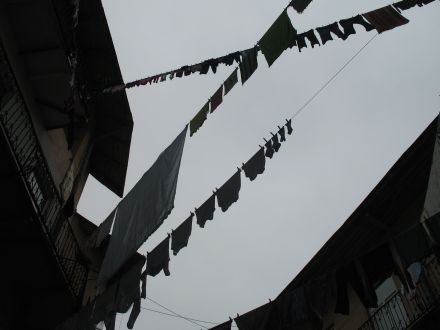
Lviv neorealism
The international forum of publishers, held in Lviv in mid -September, has existed for seventeen years, and adjoining the literary festival - five and, like all the prosperous forums and festivals of this kind, reached the state where prosperity and excess turn out with a terrifying lack of time - the event (“Cuties” in Ukrainian) were superimposed on each other, intersected, as a result of the same author, the same author turned out to be the same author A simultaneous participant in several programs at different sites, and a few listeners, stunned by such an abundance, were bewildered at the door, leading to three rooms at once, where several presentations were at the same time. Or not presentations-but something very literary.
In the end, the participants themselves joyfully waved his hand at the countless “climbers” and sat in a cafe, joyfully moving chairs, or wandered around the city, now and then colliding with each other in the vicinity of a small market square where there are full restaurants, coffee houses, antique shops and museums, and even in a market for souvenirs near the Opera Theater, where, like all Ukrainian Markets of this kind, in addition to eternal tourist pops, you can buy and really good things - for example, manual embroidery or old ceramics.
Or, for example, they sat in a cafe on four tables “under a blue flask”, where they boil “with a twinkle”, filling the burning rum of a cava from the Turkish, and sell a “drinking” honey of a forty -degree fortress. This coffee shop, which seems to be intended for tourists, is a favorite vacation spot for the Lviv themselves, who are sitting at the tables for a long time, playing with candles in a “fool” or just spending time in lazy pleasure, drinking coffee and perching in hot chocolate.
Another fashionable place, also designed for tourists, but willingly visited by the Lviv, is the surrounding restaurant "Kriyvka", in other words, a cacket, like those where the UPA fighters hid at one time. There are no signs here (this is a secret place!), But there is in the entrance a door with a window that opens from time to time and is a severe unshaven forest guard. Sounds deliberately gloomy: "Say Gaslo!" If you say the right gas (slogan) - “Glory to Ukraine!”, The door will open, and you will be let into the room, impregnated with very tasty smells (the kitchen in Kriyvka is simple but very good, and the food is served in aluminum soldiers' bowls), but at the same time they ask “Moskali?” (They do not ask tactfully about the Jews). Being Muscovites, we answered "Yak!" - But, nevertheless, they received honey in a cup, however, we were warned that for Muscovites this was a bran (poison).
It was not without reason that I devoted such a solid paragraph to Kriyivka, although the kitchen deserves it. However, this is not about food. Most themselves perceive the mosquitoes themselves to perceive what is happening as a game, as an adventure (it is clear that they will feed and do not offend). As an opportunity to join a frivolous danger. Those who are firing from this attraction - they most likely do not go to Kriyivka. And yet, probably, we must ask myself: how am I myself - Moskalka and Zhidovka - I relate to this?
If the story is not too long and still painful - they turn into an attraction - is it good or bad?
With the exception of some extreme cases that everyone understands, to the best of a difficult soar tact (I would not have conquered the restaurant in Hitler’s bunker, but would have shook - not only that would have deeply offended - in Mauthausen or Buchenwald), the transformation of history into an attraction seems rather pretty. And symptomatic. Creative guys from Kriyvka (the same concept covers a network of establishments, among which “Masonic”, also “secret”, without a sign, “Galichina restaurant” with a completely stunning toilet, on the sides of which two thick candles of blue flame are burning) in this way-fun and not without profit-a severe national injury.
Comedy, carnival, circus always rely on traumatic topics, travesting them (death - the most eternal of them), making them less traumatic, transferred, but the outcome of concrete, local injuries is obvious and not always intelligible laws. So in the culture of the USSR it was possible to make a musical on the theme of the twelfth year, ridicurating the stupid lieutenant of Rzhevsky, who later became the hero of folk jokes, inadvertently to take the commander of the commander Chapaev to the semi -comic heroes. But the carnivalization of the injuries of the Civil War neither in Soviet art, nor, moreover, in the Soviet catering, did not take place, although individual attempts took place - the film “Intervention”, for example. Or the Superbore “The White Sun of the Desert”, which is in many ways owed in many ways a powerful carnival beginning in the script and directing. But the request “from below” for this kind of carnivalization has always existed, and it was not without reason in the mass perception of films about the civil war “correct” heroes completely overshadowed by such characters as Old Man Makhno performed by Boris Chirkov or anarchist played by Erast Garin. With closer, and, therefore, painful events, the situation is more complicated. An anecdotic (literally) popularity of Stirlitz is precisely caused on the one hand by the need for such discharge, on the other, its relative psychological “security”, since Stirlitz himself was still almost a stranger, werewolf.
The actual result of the injuries of the Great Patriotic War began much later, when two generations have changed since its end. What would seem to blasphemy another and a half years ago, it becomes quite appropriate now - the comedy “Hitler Kaput!” For example. The topic, however, is still too painful - the “blockade” poem by Vitaly Pyukhanov, which caused such a violent controversy, caused it precisely because it became the first in this row. Five to ten years later, he would be perceived more calmly. Roman Ivan Turgenev (Vyacheslav Kuritsyn) “sleep and believe” with his intended distortions of the blocked factology, it turned out, perhaps, paradoxically, not enough radical - although the very intention to replace Zhdanov Kirov, thereby designating the blockade as a field not of historiography, but of historiosophy (what is the difference to us, who was the mayor of Paris, say, Daneton?). The blockade injury will be aged when it becomes - like the fate of the UPA Army - a product of commerce, when novels about Ktulhu appear on the shelves in the waters of the blockade Neva or the glamorous vampires, wandering along the black streets of Leningrad. Such novels are usually written by people who have a fair amount of cynicism, but the carnival by definition does not imply conscience and reflection.
"Kriyvka" is fashionable among a cheerful, relaxed, colorful dressed Lviv youth. Therefore, it is not always easy to break there, and the stranger warns just in case - what to wait for him. As well as the fact that in the Jewish restaurant on Staroevreskaya Street, prices are not indicated on the menu, you need to bargain until you convince the waiter that the stuffed Fish fish is actually much worse than what your grandmother was cooked. And, therefore, it is not worth the transcendental price that he impudently requests for her ...
To do a business on a bloody history is still better than turning a business into a bloody history (as almost all wars begin). The national flavor, playing as a surroundings, makes any pathos funny and ridiculous.
As for the forum itself ... The forum was a good forum. I even contributed to him to the best of strength on a round table in teenage literature, synchronously translating two pretty representatives of the Russian children's publisher of their Ukrainian colleagues. Ukrainian colleagues did not need such assistance. They all perfectly understand Russian.