
Translated material
Points: five atypical Soviet buildings

Points: five atypical Soviet buildings
Along with typical eight-story buildings, kindergartens and glass shops, Soviet architects developed several unique projects of public buildings. "Paper" found an unusual school, several university corps, the house of political education and the district council, which go beyond the standardized Soviet architecture. 
 Krasnoselsky district council
 Partizan Herman Street, 3 in 1973, the southern part of the city developed rapidly. This led to the appearance of the Krasnoselsky district, as well as a new portion of officials who had to be provided with housing. One of the authors of the Zmei House , architect Yevgeny Poltoratsky, took up the case, and in 1981 the building of the executive committee was completed. By the way, twenty years later, the same Poltoratsky will engage in the construction of a residential complex on Leninsky Prospekt, similar to a pile of apartments .
 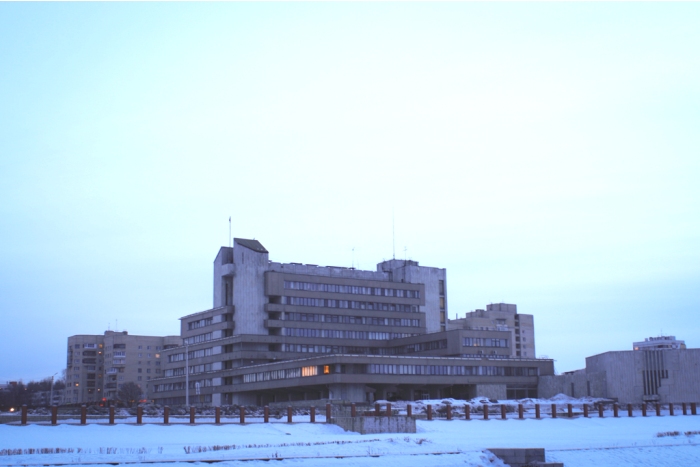 Photo: Nikita Granko / "Paper"
Krasnoselsky Executive Committee is located in an open area at the intersection of Partisan Herman and Chekistov streets. The building on the banks of the Duderhof Canal surrounded the park on both sides, and the decorated terrace descended to the water. The building that did not have an obvious facade looked favorably from any angle due to its incorrect shape and variable altitude. It still looks good, despite the fact that because of the ensemble that appeared around the fence, it lost its former homogeneity. However, it can still change when a new shopping complex will be built on the site of the running park along the channel.  School No. 345
Red Zor Boulevard, 6, Corps 2, together with the Khrushchev struggle with excesses to architecture, gradually began to return constructivist ideas, which were confinced by the new requirements of the authorities. They were used with varying success, but more often not very successful. Although then there were exceptions. For example, a school near the 122th quarter , which would have become an excellent example of constructivism if it had not been built in 1968. 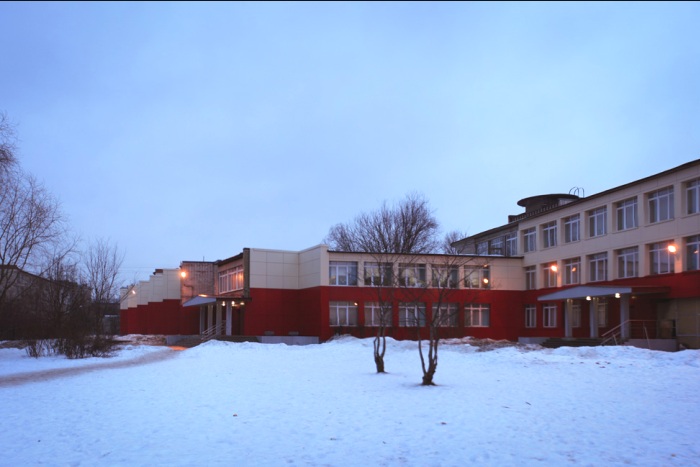 It was designed by the team of authors under the leadership of Sergei Evdokimov, who, among other things, developed the same typical project of the Soviet school. The building of the irregular shape consisted of four buildings: two training (separately for high and elementary grades), sports (with a gym and pool) and club (it contained a dining room and amphitheater). Each of the blocks interconnected had a separate entrance. Moreover: for primary schools, a separate exit with a wardrobe from each office was provided. In addition, a winter garden was defeated in one of the crossings, and the school worked in the school, not preserved to this day. The references to constructivism were in the external design of the building. There is a semicircular volume, on which, in fact, the observatory was located before, and pseudo-elastic glazing, so beloved by architects of the 20-30s. The abundance of the windows, by the way, played a cruel joke with the school: in winter it was banal cold inside. Therefore, part of the openings was laid with bricks, which solved the problem, although it spoiled the appearance of the building.
  SPbGMTU (Leningrad Shipbuilding Institute)
Leninsky Prospekt, 101 Leningrad Shipbuilding Institute begins its history in 1930, when the former faculty of the Polytechnic Institute was allocated into an independent educational institution. By the 60s, the need for expansion has rushed. For the construction of new buildings, a promising Ulyanka was chosen in those days, and the development of the project was given to Naum Matusevich-another author of the Zmei House. He proposed to create on the territory a full -fledged town with educational buildings, dormitories, a student center, a sports complex and even an experimental basin . But in reality, everything turned out completely wrong. 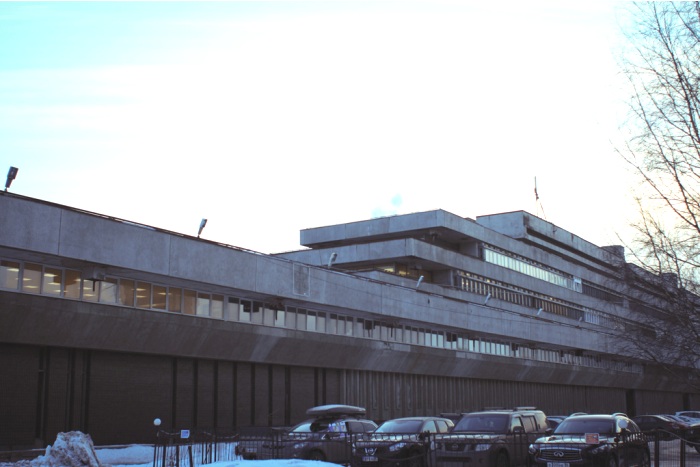 First of all, the educational corps, which resembles the ocean liner, was completed in 1978. Then three dormitories were put into operation, located a little at a distance - at the intersection with Stachek Avenue. In the 80s, the construction of a student center and a sports complex began, but the country collapsed and the construction ended prematurely. In the early 90s, one of the hostels was resettled: it began to settle and crackled (although there is a version that students are to blame for everything). By the end of the 90s, the second phase of the educational building was handed over, and since then they have no longer returned to the construction. About the new educational building, another block of hostels, and even more so about the experienced pool, seems to be no one.
  Tower of the Central Executive Committee of the RTK
Tikhoretsky Prospekt, 21 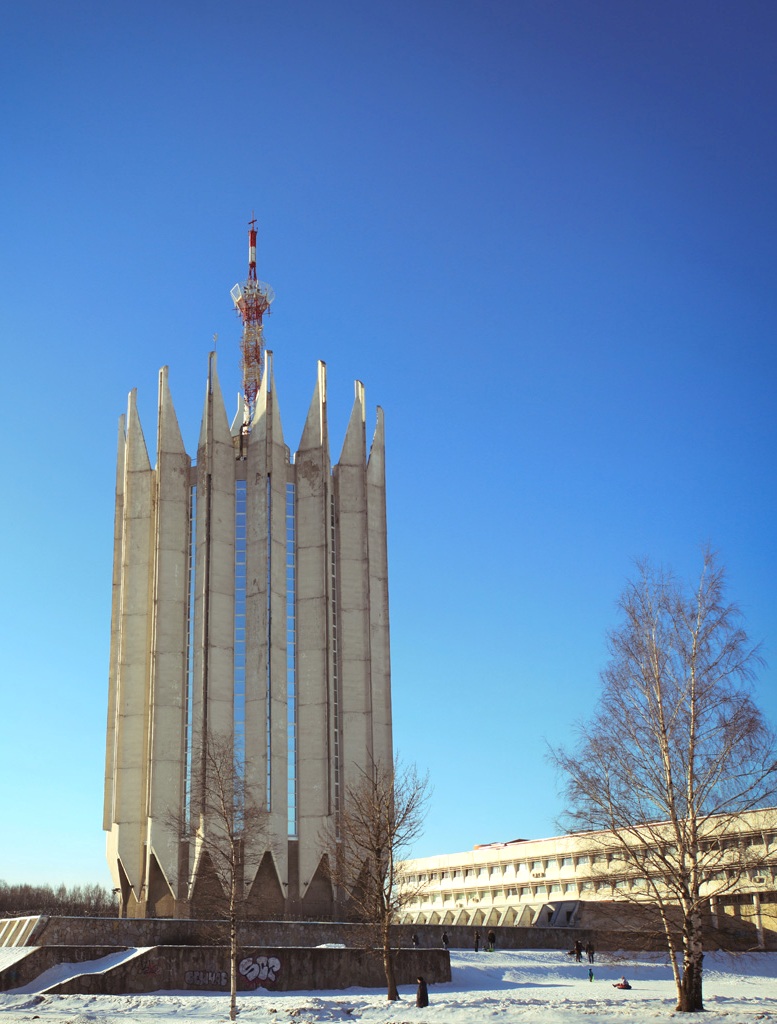 In the mid-70s on Tikhoretsky Prospekt, opposite the Sosnovka forest park, the construction of a building for the Central Research Institute of the RTK, which was then just a development bureau at the Polytechnic Institute, began. The project of architects of Artyushin and Savin consisted of a horizontal case and a 77-meter tower. Inside, it was absolutely hollow and was intended for testing: at that time the Central Research Institute worked on soft landing systems of spacecraft. The basis was the metal frame. The construction stretched for a decade, but in the end the project was completely completed. True, the planned tests in the tower did not conduct: in the open space it turned out to be much more convenient. The tower also did not remain idle either, becoming a platform for testing the Buran spacecraft manipulator. In the 90s, the appearance of the tower changed: the 11th channel, which rented several premises in the TsNIA building, installed an antenna on it. She still stayed there, and with a height in which the manipulator is still installed, many city legends are connected.
  International Center for Business Cooperation (House of Political Education of the Leningrad Regional Committee of the CPSU)
The street of the Proletarskaya dictatorship, 6 in the second half of the 20th century, Leningrad architects began to implement the idea of the socio-political center of the city near Smolny. Among other things, the House of Political Education was built on the site of the Hospital of St. Olga. The authors of the project were Georgy Vasiliev and David Goldgor. Work on the building, during which old houses were also demolished along the street of the Proletarsky dictatorship, ended in 1974. 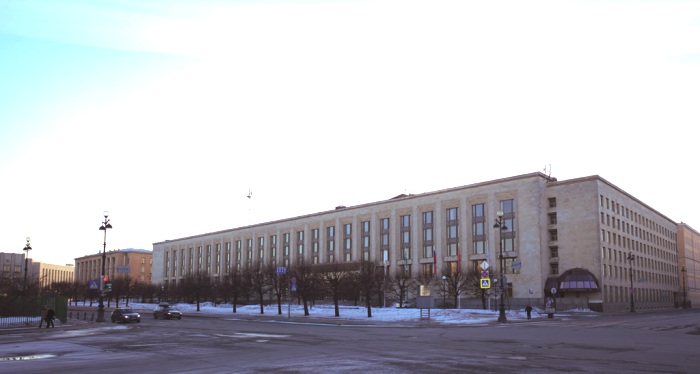 Despite the sonorous name, the function of the house of political education was quite simple - a group of officials who had met there was responsible for propaganda. The house lost this function before the collapse of the country: in 1990, the building bought Baltinvestbank and turned it into an international center of business cooperation (in practice-a regular business center). And in 2007, the building was sold again, this time-for demolition and construction in its place, a new business center according to the Norman Foster project. But the latest news on this topic date back to 2009. Judging by the problems of the owners who planned for the same purpose to demolish the Frunze department store, the implementation of these plans will not take place.