
Translated material
Diplomats got into the network
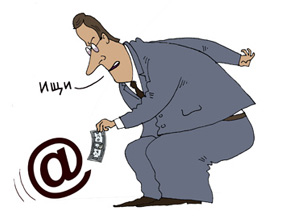
The Foreign Ministry pays more and more attention to information technologies. It is understandable: “Twitter-revolution” in Iran, Wikileaks, “Arab Spring”. However, the authorities again confuse external manifestations and causes. Indeed, without strong internal discontent, no Internet will be shook the Russian regime. Even with the help of the State Department.
The significance of new technologies is gradually understanding even the most conservative and bureaucratic structures. According to Kommersant, a special “internet curator” appeared in the Foreign Ministry: a special designer for political use of information and communication technologies in the rank of ambassador on special assignments. This position was taken by Andrei Krotsky, until recently - the deputy head of the Department of New Challenges and Threats. The Department was created in 2001 and the spheres of its responsibility include terrorism, international crime, drug trafficking and the Internet.
Now the Internet is spared from the controversial in the symbolic plan of the neighborhood and an increased priority is given to it.The need to do something with communication technologies on the Midovskaya line was proposed from the series "Technology can be used to destabilize the international situation." “If you do not adapt international law under the latest technologies, they will devour us. And if you do not establish international cooperation, all the former wars will seem flowers, ”said Andrei Krotsky at one of the information security conferences last year.
How unpleasant in the point of view of diplomacy, degrees and the world have undoubtedly demonstrated, undoubtedly Wikileaks. Thousands of diplomatic dispatch, suddenly laid out onto the network, were seriously alarmed by diplomats and politicians of almost the whole world. The Americans were more worried about more than others, but for, say, the jokes of Russian politicians saw serious concern. The degree and the world clearly demonstrated what the information security experts had been talking about for a long time: cyberspace can be dangerous in a relevant political plan.
Publicly, of course, it is said more that conditioned terrorists and other radical elements can coordinate their activities through the network, and therefore it is necessary to take preventive measures. For example, Russia has been advocated for the adoption of international cybercode for several years, and experts of the same Foreign Ministry compare the information space with the cosmos, according to which a number of UN documents have been adopted. According to the Russian version, in these rules there should be a ban on the use of the network for military purposes, as well as for overthrowing regimes in other countries.
However, Wikileaks and Julian Assange excited politicians much more than abstract terrorists. To imagine that two clickers mouse can give a person access to secrets, to put it mildly, not for widespread - this is really a revolution of consciousness and a coup in politics. That's really a new challenge and a new threat.
In addition to the “terrible wikiliks” of concerns and concern to the Russian diplomats, the Iranian Twitter-Revolution, and then the “Arab Spring” added to the Russian diplomats. During mass performances, protesters effectively coordinated their actions via the Internet.
However, attempts to protect yourself from the threat of "cyber -revolution" is a largely vain undertaking. Moreover, by creating another bureaucratic structure. Firstly, the revolution, regardless of the country and the degree of “velvet”, still happen in offline.
Secondly, the network is only a way of self-organization of protest and the mechanism for overcoming the authorities monopoly on information and the organization of citizens.The network itself in this sense is sterile: if there is no dissatisfaction with power, then any, the most insidious and sophisticated "State Department", even armed with the Internet, will be powerless. If the authorities are already breathing in the incense - as it was in North Africa, then it is more difficult to save it and the regimes would most likely fall without modern technologies.
However, this is a universal means of bureaucracy of all time - to deal with external manifestations, not causes.Any new phenomenon under these conditions is accepted for a challenge and a desire is born immediately, if not completely banned, then somehow limit its distribution. In the most radical form, it is also known from the Griboedovskoy Skalozub: “If you stop the evil - to collect all the books, but burn it.” In this sense, the attention of the Russian Foreign Ministry or the FSB to the Internet is inevitable. Exactly as inevitable and attempts to somehow dump citizens from the use of "harmful" information technologies.