
Translated material
Russian Bond. Eurobond
The Ministry of Finance of Russia can by the end of 2016 place bonds by another 1.25 billion dollars. In any case, Bloomberg announced this by the director of the Department of State debt and state financial assets of the Ministry of Finance Konstantin Vyshkovsky.
 Konstantin Vyshkovsky. Photo: minfin.ru
Recall that on Tuesday the Ministry of Finance completed the placement of Eurobonds, the volume of papers sold amounted to $ 1.75 billion, although the budget law allows you to take up to $ 3 billion in foreign markets in 2016. The Minister of Finance said that the demand for placing twice the supply, and the volume of the book of applications amounted to about $ 7 billion.
“We went out to confirm our presence in the market - the issuer is harmful to the long -term absence - and to probe the mood of investors, and generally understand our possibilities,” he said, noting that the rest of $ 1.25 billion “can be placed potentially before the end of the year.”
At the same time, according to Vyshkovsky, there was no “financial necessity” to place papers.
The Russian government is really now, despite the shortage, it makes no sense to replenish the budget at the expense of borrowed funds, especially $ 3 billion - this is only about 1% of the budget expenditure.
At the same time, few doubt that the Ministry of Finance entered the correctly, entering international financial markets.
Firstly, if in the future it becomes necessary to place much larger bond issues, then buyers will have a price landmark. Beginners in the market, as a rule, are forced to pay more.
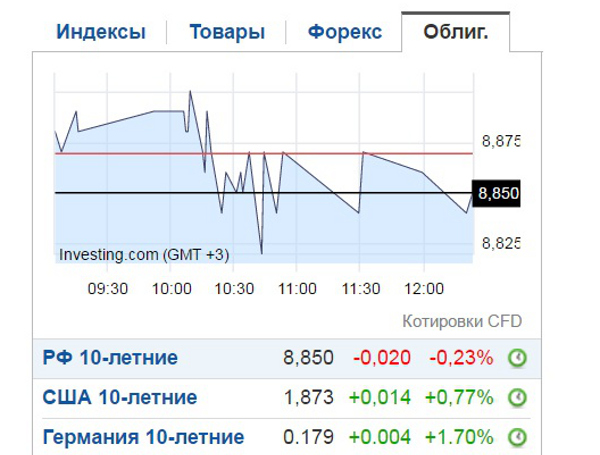 Real -time bond quotes. Source: ru.investing.com
Secondly, such actions of the Ministry of Finance can help private Russian borrowers. The cost of bonds, which logically, accurately reflects the market expectations of the borrower default. As a rule, if the national government is not capable of paying their debts, then private corporations feel no better - therefore, it is easier to place commercial companies if it is known that their government is a reliable borrower.
Moreover, with the placement of bonds from Russian companies and, as it turned out, the government has well -known problems - sanctions have been imposed against the country. As expected, the Ministry of Finance proposed to become the organizers of the placement of Western investment banks, but they, listening to the advice of their government, abandoned it. As a result, the organizer became the Bank of VTB, and the Russian national settlement depository will serve the papers.
The Avenue of the issue indicates that the clients of the two largest European depositories, EuroClear and Clearstream, will not be able to buy Russian papers until appropriate special agreements are concluded. Earlier, EuroClear and Clearstream refused to provide their services to the Russian Ministry of Finance directly, fearing to deal with the country that sanctions are in effect.
It is also indicated in the avenue that "the funds raised will not be aimed at activities that would be prohibited for citizens and companies in the United States or the European Union within the framework of relevant sanctions laws or directives." It is believed that this reservation will allow you to buy Russian papers to foreign investors, but so far it is not clear whether they are engaged in investing money in Russia or not.
So, market participants, with whom we managed to talk to Vedomosti correspondents, suggested that the demand was a “stuffy”. Companies could apply for large amounts than they expected to buy. And a person close to one of the participants in the transaction said that Russian companies showed the main demand that simply spent their money through Europe and America. In favor of this option, it may say that on Monday, the ruble on the Moscow Exchange was not strengthened despite the increase in oil prices.