
Translated material
Progressive conservatism
For the first time since the time of Kabakov, the Russian pavilion in Venice was so close to getting the Golden Leo, the Grand Prix of Biennale. But Angola received the Angola pavilion - good, but not brilliant, they joked that they gave “for Boticelli”, bearing in mind that the chosen room played a significant role for the impression of the exposition - the Palazzo with an extraordinary collection of the Renaissance and medieval art, usually closed for visiting. But it would be strange to think that the jury will not be able to distinguish where Pierrot della Francesca ends and the installation begins. Rather, they gave “for political reasons”, although Kommersant’s observer Anna Tolstova does not agree with this: “What exactly these political considerations are when the most awards for national pavilions were received by Germany, France, the USA and Italy, it is difficult to understand.” But it’s not difficult to imagine why they will not give us - the current Russian regime does not cause sympathy among creative people in the West, and Zakharov has nothing to do with it. He made an international thing for the Pavilion - which is natural for him, since he has been living in Germany for a long time and is successfully exhibited abroad.
As a plot, he takes the Greek myth of Danae, and this in itself is supranational - respect for the culture of the Hellenes has united Europe for many hundreds of years. In the story of how a thunderer Zeus penetrated to the beauty of Danae, hidden by his father from male encroachments in a cave, turning into golden rain, Zakharov focuses on the circulation of coins. In the upper hall of the two -story Russian pavilion stands a man in a suit, he raises money in a bucket through a hole in the floor, pours them out onto the tape of a metal conveyor.
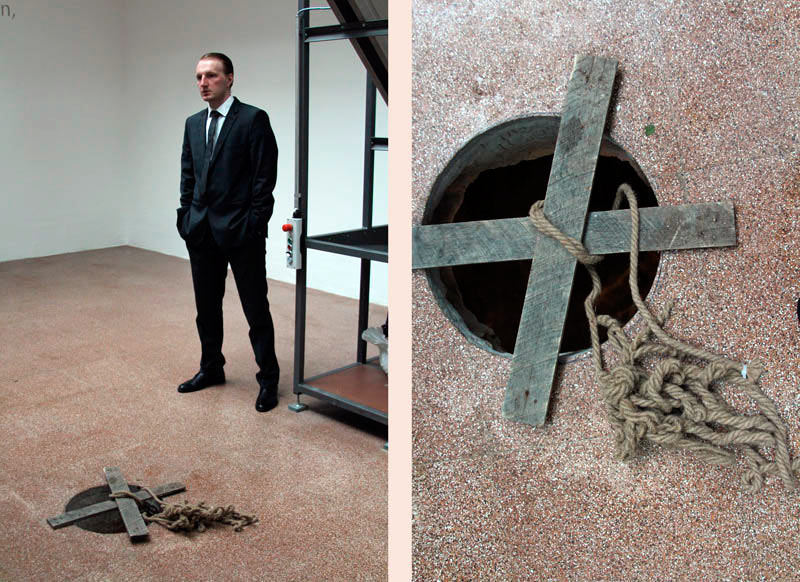 A gentleman at the conveyor and a hole made in the Pavilion Pavilion to the lifting of money from the first floor.
On it, the coins rise to the ceiling and spilled over the “cloud” - a kind of metal colander on the ceiling of the second hall, fly through a hole in the floor and fall in a pile in the basement -piner. Only women are allowed into the cave, and necessarily with a transparent umbrella that a lady at the entrance gives to protect against a random blow by a coin. Women are asked to take out several coins from the cave and leave in a bucket - the same one that will then be upstanded. Gentlemen in costumes in a performance-installation-two: a man-consumer who sits in a saddle on a beam under the ceiling and there is arachis, and a man who loads nuts-a servant. They periodically change roles, parodizing the folk wisdom “do not reduce from the prison”, especially relevant for Russia with the current number of successful businessmen in prison, who are taught to be a seamstress or someone else.
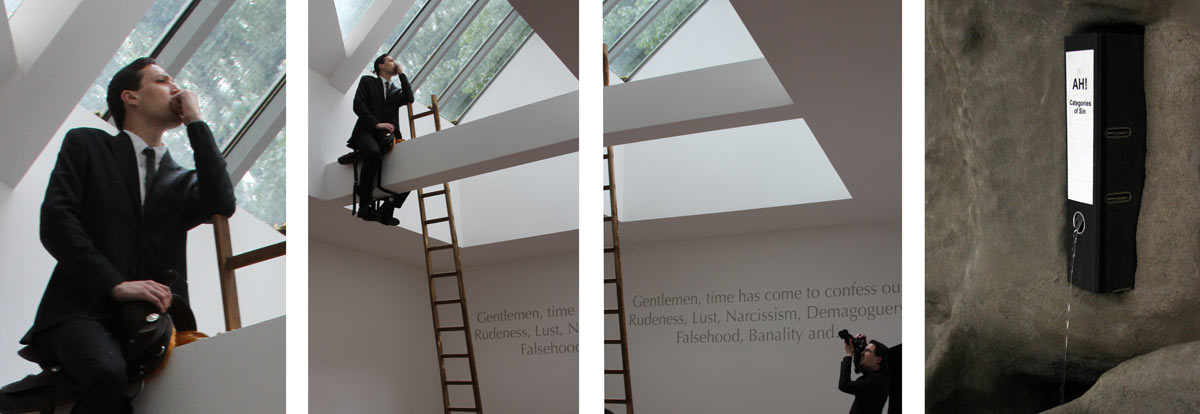 A gentleman in the saddle and a fountain in the form of a stationery folder with a list of sins in a cave on the ground floor.
This cycle of money to the Bulgarian artist Luchezar Boyajiev recalled the association of “horns and hooves” from the “golden calf”. But in this circulation of coins there is not only an image of an economic scheme. The conveyor with coins causes a school “water circulation in nature” in memory - evaporation, condensation, filtration. The water has three states, money in the modern world is mainly “gaseous”: invisible billions, by pressing the keyboard buttons moving from account to the account, enclosed in a weightless rectangle of the plastic card. There is, of course, “liquid gold” - oil. Zakharov returns the money to the archaic state - “solid”, representing it in the form of coins, which rich people do not care about at all, only those who earn a penny earning in a wallet are known.
It’s not that Zakharov became a socialist, although he recently made a “ideological definition” according to Brecht’s prose - there he rethought the Brechtovsky representation of the key politicians and thinkers, Lenin, Hitler, Stalin, Hegel and Marx with Engels in the form of ancient Chinese sages not as a restoration for the closest perception, but, opposite the suspension thinker, creative person from current events. Zakharov is a conservative, but this is his resistance. In the world of tolerance, where it is indecent to focus on the gender of the person where feminists become hives from the epithet “beautiful”, Zakharov makes the room “only for women”. In a world where money is virtual, he returns weight, view and sound to them.
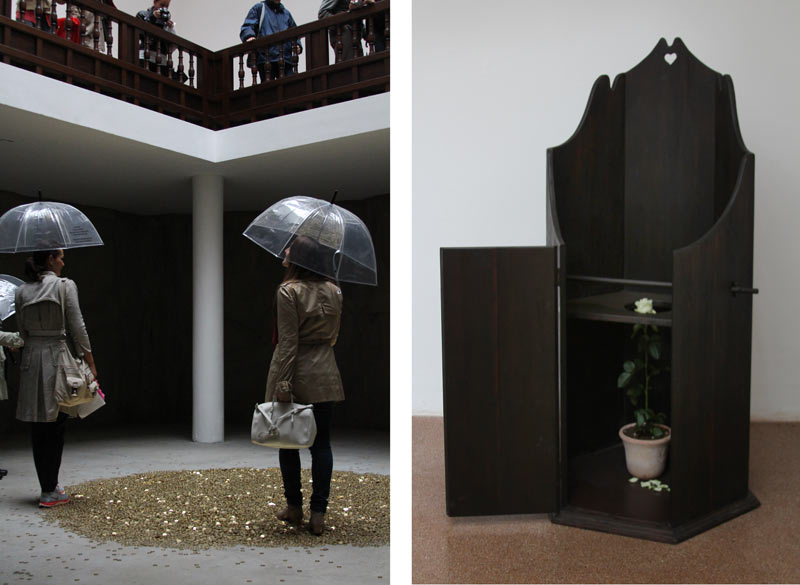 Girls under the golden rain and “a chair of punishment with love”, a “two -story” object that can be considered a sketch of Zakharov to work on a pavilion
Another obvious contender for the Grand Prix was the British pavilion with the Jeremy Deller project, which is largely consonant with the Russian pavilion, but appealing not to ancient myths, but to fresh newspaper headlines. The first and a noticeable parallel is “horns and experience”, and it is on Russian material: one of the halls is a collection of our “cores” of the last 30 years, with privatization vouchers and guarantees from MMM. We do not even mention many of the presented "valuable" Russian papers, so burnt hopes for the Russians have become the norm. Another parallel between the pavilions is a violation of conventional silence. Zakharov recalls that women are different from men. And Deller calls the Pavilion “English magic”, which is extremely tactless - thus, the Scots crossed out of the pavilion of the United Kingdom this year. Well, in general, now it is indecent to mention your nation if your ancestors were colonialists, and not injured.
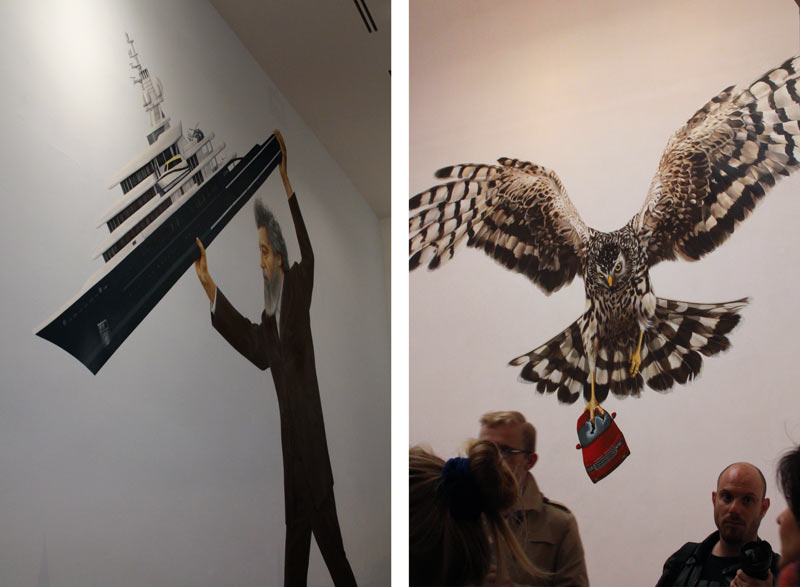 The British pavilion is designer William Morris throws the yacht of Roman Abramovich from Venice, and the British owl takes away the car in claws. Nature is against the industry.
The embodiment of the incorrect device for the life of Deller is Russia-on one of the frescoes in the pavilion, the yacht of Roman Abramovich, who obscures Venice, is thrown from the city of Giant William Morris, a Victorian designer-socialist, who preached a return to manual labor in the era of industrialization. Even then, people began to be afraid that they would enslave the flow of things and happened - Zakharov has people along with things as part of the financial conveyor. So that we would not be offended, I note that the neighboring fresco of the Deller criticizes England - on it is an owl from the Red Book, which in the world only 20 individuals in the wild, and this is one of the characters of Britain. And Prince Harry, for the sake of joke, shot 2 pieces on the hunt, and there was nothing for him for that. It turns out that the British in the same way as ours, the law is not for everyone - but this does not calm down. The difference is that the British can criticize the aiming, and we - through the Greek myth and at once the whole system, “we will not call names,” and the fable is not about us. Conceptualism with his experience of Soviet speaking by metaphors is now very helpful, and for the second time in a row the artist of this direction represents the Federal Penitentiary Service.
Unlike Deller, Zakharov is not a publicist, and many meanings are transmitted in his project with plastic methods - perspectives from above and below, verified casting for the role of men, the mass and texture of the pile of gold and the ringing of the fall of coins, justified by the calculation on beautiful women -spokes as part of the work. Zakharov also involves souvenir impulses that flare up in Venice in all - provokes the viewer to carry a brilliant coin with him. And then you can already consider what is written on it.
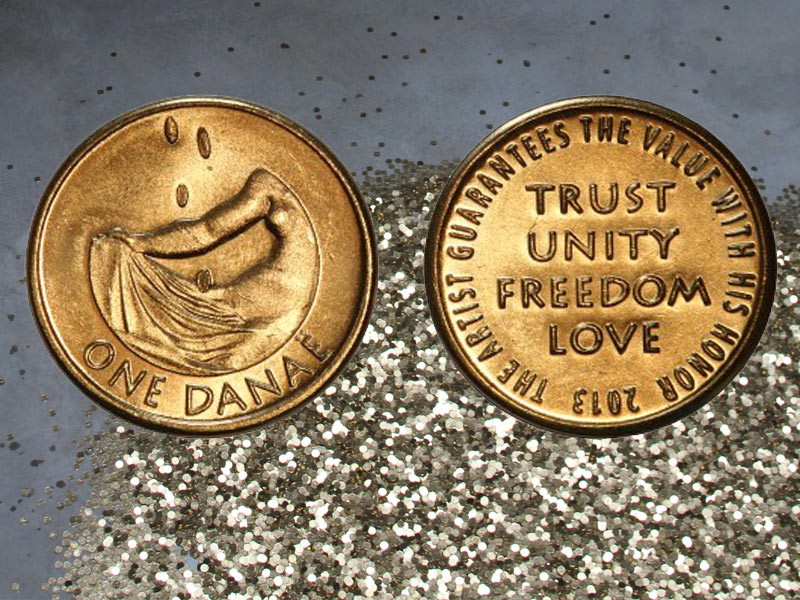
At first, they planned to use Euro for the installation, but Zakharov checked the coins for ricochet, and it turned out that “Euro” was too jumping and for security reasons they could not be discarded from such a height to visitors. So I had to come up with the design of the coin and print by ourselves. The advantage of coins is only one, “one given”, and therefore a million Danai will weigh a lot and take up a lot of space. Coins are difficult to inflate, remember our perestroika film "Channel". There are no numbers to the “Danae” at all that can be added to zeros, on the one hand - giving a fragment, without arms, without legs, only a torso in drapery, a cash bag. On the other hand, in a column: “Trust, unity, freedom, love”, and around it is written that the value guarantees the value of this. Art critic Irina Kulik proposed a performance - to launch Danai into the real world: a woman who visited the exposition has the right to take one coin with her - she could, for example, submit it to the beggar. I suspect that he will throw her out later, and will swear that he was deceived - they slipped confidence and unity, but you can’t buy bread on them.
Where a coin with such security could have an appeal, where the dignity of the artist is a value - a world is needed, arranged in a completely different way. The individualism of Zakharov, his tendency to autonomy, is expressed in everything - from his interpretation of Brecht to his own mint. “Danai” remind of the project E Dutchman Jupa Van Lishaut, who, like Zakharov, is loved by influential institutions, but he is an anarchist. Lishaut organized a small state for creative people in Rotterdam, in which, in addition to all other joys like autonomous energy, agriculture, the possibility of building its own home according to its project in the absence of a general plan and 16 sleeping beds in the denial of monogamy, there was its own currency. Its constant material equivalent was a bottle of beer - and correlation with other world currencies on the exchange. Zakharov builds utopia in which "trust, unity, freedom, love" will be equivalent. " Alas, these concepts are quoted in relations between individuals, but not in politics or economics.
Interview with the artist of the Russian pavilion in Venice Vadim Zakharov