
Translated material
Humaner than euthanasia
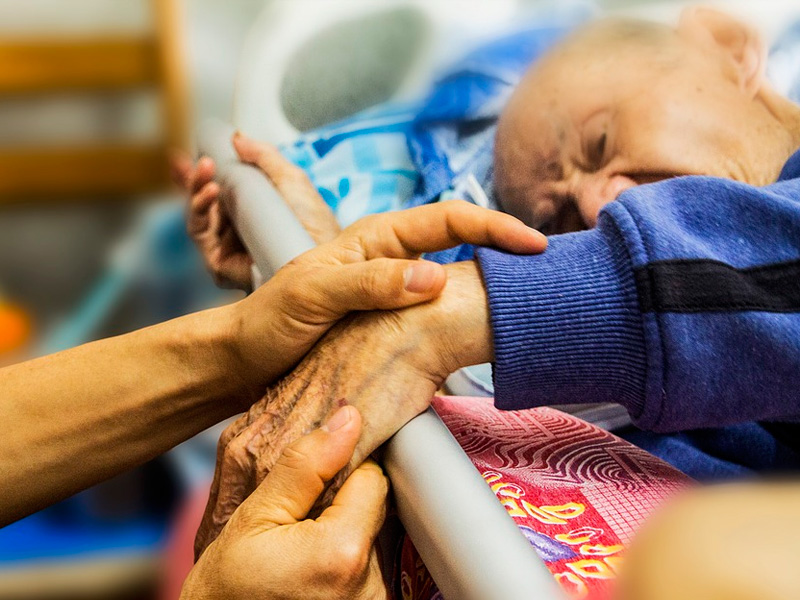
This week, the State Duma approved in the first reading amendments to the Federal Law “On the Basics of Protection of the Health of Citizens of the Russian Federation”, governing the provision of palliative medical care and social services by inconspicuously patients. The bill was developed on behalf of Vladimir Putin since the summer of 2017, when the president met with volunteer organizations that help seriously ill people. But according to representatives of the same organizations, this order was not fully fulfilled: the document does not correspond to the scale of the problem and still needs serious improvements. Deputies claim that the project is among the priority for the State Duma and can be adopted until the end of the spring session.
The new edition enshrines the right of patients to relieve pain, including with the help of potent drugs and psychotropic drugs. If it is approved, incurable patients will be able to receive free drugs in this group in daytime hospitals at the place of residence, and not just in hospitals, as is happening now. The bill is trying to resolve the issue comprehensively, assuming the right of such patients not only to receive medical procedures, but also to psychological assistance and care.
“For the first time, we legislatively introduce the division of palliative assistance into primary and specialized so that patients can receive it both in medical hospitals and at home,” said the Chairman of the State Duma Vyacheslav Volodin. - It is important that medical workers who have undergone special training in interaction with social services will be engaged in seriously ill patients. After all, palliative help is not only medicines and procedures, but also psychological support for patients and their families. ”
True, the deputy chairman of the State Duma Committee on Health, Leonid Ogul believes that in Russia there are practically no specialists who possess the necessary knowledge and skills in this field at the present level. “She is provided by everyone who has to be in positions: therapists, oncologists, social workers who care for the sick at home, and even vulture students,” the deputy said . And he sent Tatyana Golikova to Deputy Prime Minister with a proposal to introduce training in Russian universities in Russian universities-a palliative care doctor.
In January, the deputies adopted another bill, which seriously (up to criminal) increases responsibility for independent search and sale on the Internet of falsified and counterfeit drugs, as well as biologically active additives (dietary supplements).
The bill caused criticism of experts even before adoption in the first reading. On the night before the meeting, the head of the Palliative Medicine Center of the Moscow Department of Health and the founder of the Vera Hospice Fund Nyuta Federmeser published an indignant post on her Facebook page, which caused a great resonance.
She asked to send the State Duma deputies on vacation - “ well paid, forever” - and focused on the three recently made decisions. Federmeser did not like the Duma approach to the decriminalization of the responsibility of doctors under Article 228.2 of the Criminal Code. Instead of the exclusion from the legislation, criminal punishment for doctors who prescribe narcotic painkillers to patients were only amended by the Administrative Code. “ This is completely not changing the position of doctors who do not want to work with drugs today ...” writes the founder of the Vera Foundation. “And they can be understood: more than 50 normative acts, the risk of prison, and the need to prove all the time that you are not a camel.”
Her even greater indignation caused a package of bills tightening the punishment for unauthorized circulation of drugs and bioactive additives. “ The ban on the same unregistered drugs, buying which to their dying children, in order to reduce their already inevitable suffering before death, mothers are already almost completely ready to go to prison, from four to eight years old,” says the head of the center, emphasizing the importance of well -developed formulations. “And if this word“ unregistered ”will not be removed, then there will be seams ... And the Duma will have to be urgently, in three readings, to introduce a law on euthanasia, because it will be more humane than forcing the inhabitants of their own country to die without a drug that relieves cramps, even if this drug is imported into the country illegally.”
She simply called the bill adopted the next day “kutsy” and “ragged”. Recall that largely thanks to Federmeser, Vladimir Putin paid close attention to the problem of palliative assistance. Visiting one of the hospice on Christmas Eve, the president announced the good news: “ Since 2019, there will be regularly allocation of funds from the federal budget for this type of assistance. This year - about 5 billion, and then regularly until 2024 - 5 billion per year. "
The anger of Federmeser is shared by other colleagues. “Instead of establishing the state system of legal support of patients with epilepsy and palliative care of patients with diazepam in microclisms, vital drugs that are not registered in the Russian Federation, to block the only illegal way to get the drugs for children? A worthy decision of the officials, ” wrote Lidia Moniava, deputy director of the children's hospice“ House with a Lighthouse ”children's hospice.
“The Ministry of Health and the Government say that there is a mechanism for issuing such drugs, and it seems to be on paper, but it does not work, because the very first link, doctors who should prescribe unregistered drugs are afraid to do this because they are scolded for it. And now they are still strengthening responsibility, ” says Natalia Savva, director of the methodological work of the House with a Lighthouse charitable foundation. - Responsibility just for the appointment and use of unregistered funds. This, it seems to me, will increase the unwillingness of doctors to prescribe unregistered drugs. And it turns out that the parents are now again in the war with the state for their child. ”
Ekaterina Ovsyannikova, head of the Advita Foundation, writes about the need to train specialists working now in healthcare: “ A nightmare, that no one informs you about the signs of pain. A nightmare that will be misinformed, what they say "what do you want with such a diagnosis", "Are you crazy, morphine? Do you want to kill him?" It is nightmare that therapists of the clinic for the most part do not know how to diagnose chronic pain syndrome and do not know how to treat it. It is nightmare that no one teaches them. It is nightmare that anesthesia on the ambulance has to be achieved with battle and pass through rudeness. ”
“I hope that the direct contacts that the Federmeser with the highest leadership of the country will really provoke changes that have long been related and had to happen in this segment a long time ago,” says Oncologist Andrei Pollev, the head physician of the European clinic.