
Translated material
Manuscript from Melford Hall
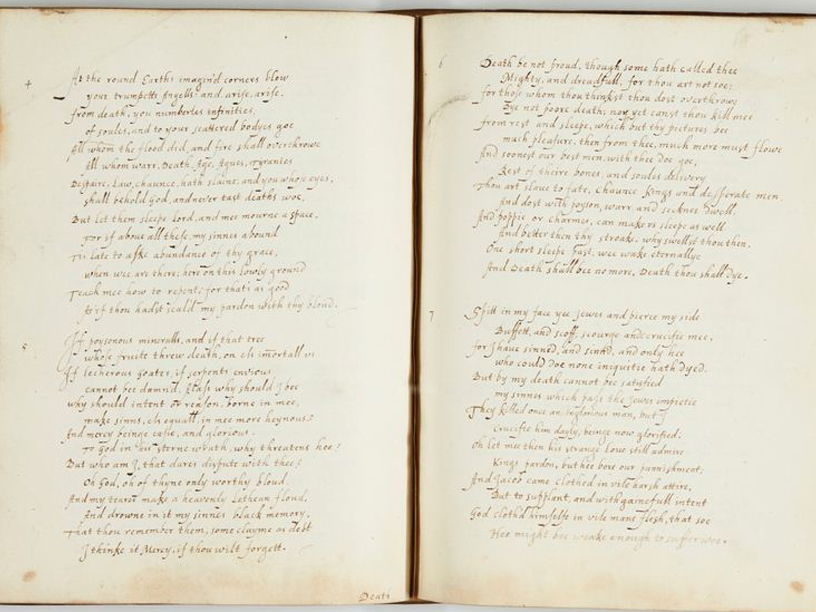
In the estate of Melford Hall, located in the county of Suffolk, a manuscript book containing an extensive collection of works of the outstanding English poet John Donna was found.
The manuscript was discovered by the expert of the Auction House Sotheby's Gabriel Heaton, who examined the private archive of Melford Hall. In one of the boxes, along with other documents, there was a volume in the binding of calf leather. Having revealed it, Hiton discovered the texts of poems, rewritten by the same elegant handwriting. The first poem read turned out to be famous - these were the poems of John Donna. Judging by the paper with a water sign of the peacock and another sign, the manuscript was made in the 1620s or early 1630s, that is, during the life of the author. Neither the owners of the mansion, nor the researchers knew about such a manuscript.
The great English poet John Donn was born in 1572 in London in a wealthy Catholic family. He was brought up, apparently in a Catholic spirit, and, studying later in Oxford and Cambridge, he avoided swearing in the Anglican church, so he was not ordained priests. Then he began to study the law at the London Law School of Lincolns-Inn. A contemporary reports that John Donn at that time was “a brilliant young gentleman, greedy for entertainment, but not unrequited, but quite decent, a big fan of ladies (a Great Visiter of Ladies), an avid theatrical and writer of very sophisticated poems.”
Young John Donn in the picture of an unknown author around 1595. The Latin inscription Illumina tenebr [as] nostras domina means "osari our darkness, mistress."
With what you want, we compare our love;
Say: she, like a candle, is short
And the fate of one-day motle
In the prophecies of our own, we are pleasing to us.
Yes, we will burn to the ground - but do not die,
Like Phoenix, we will rebel above the fire!
Now call us in one name, -
After all, we have become a single creature
Thanks to love.
Without fear, we will die for love;
And if our story is not considered
Decent life - we will find a shelter
In sonnets, stans - and resurrect again.
Beloved, we will always live
Relics will expire, fly years -
You are inspired by new minstrels!
And we will be canonize then
For the devotion of love.
Fragment of the poem "Canonization" translated by Grigory Kruzhkov
John Donn made a long journey to Europe, which little is known about, it is not very clear when it occurred, before entering Lincolns-Inn or after. It is very likely that the trip was associated with English emigrants who lived on the continent, and with the completion of Catholic education. A possible option for the future fate of John Donna, after returning to England, was a difficult fate of the underground Catholic priest. In 1593, the younger brother of John Donna Henry was thrown into prison for hiding such a priest. But John Donn, apparently, did not seek to become a martyr for faith.
I will open you as America,
I am humble - and I will populate one by it.
About my trophy, award from awards,
My empire, invaluable treasure!
I am free only in captivity of your embrace.
And you are subject only to my print.
Be in my nakedness to my eyes:
Both souls - the burden of bodies and bodies
It is necessary to drop the load of clothes,
In order to taste bliss. Only ignoramuses
Peck on silk, on a brooch, on a fringe -
Pagans in their spirit!
Fragment of the elegy "to undress the beloved" translated by Grigory Kurzhkov
He returns to England, takes part in two military expeditions against the Spaniards and, finally, becomes secretary of Sir Thomas Edrton, the keeper of the royal press. For admission to the service, he officially accepts Anglicanism around 1596. A few years later, John Donn, who fell in love with Sir Edarton, Anna Mor, secretly marries her. The angry lord kicked him out and even achieved a temporary imprisonment. John Donn and his wife settled with her relatives. Only in 1609, Sir Edgerton agreed to recognize their marriage. John Donn worked as a lawyer, then became an assistant to the bishop. At this time, he studied theology intensively and since 1610 became an active anti -senior publicist. Very quickly, his fame as a poet gave way to the glory of the theologian and a brilliant preacher.
In the marriage of John Donna and Anna Mor, 12 children were born, but the two died at birth, and three more - without living up to ten years. Perhaps the death of two of them in 1614 pushed John Donna to accept the dignity of a Catholic priest. He preached in several London churches, and in 1621 he received the position of rector of St. Paul from King Jacob I. He died on March 31, 1631.
John Donn on the portrait of Isaac Oliver (1616)
The poetic heritage of John Donna is made up of love elements, songs, sonnets, satires, messages, epitalams, the poem “The Way of the Soul”, epigrams, funeral elegy, two philosophical poems, known as “anniversary” and spiritual poems. During the life of John Donna, his poems were never printed, the exception is the poem “The Last kiss”, which was published in the collection “Songs” (Ayres) in 1609 along with the music of the composer Alfons Ferransko.
Interrupt this bitter kiss, interrupt,
Until the soul has flown out of the mouth!
We’ll forgive: there is no love without separation,
Bright day - without a black limit.
Do not be afraid to take a step, stepping to the edge;
No death is easier than saying “goodbye!”.
From the poem "Last Kiss" translated by Grigory Kruzhkov
Only one poem by John Donna in the author’s manuscript was preserved - a poetic message from 1612. The first edition of the verses of John Donna took place only posthumously, in 1633, it was followed by publications of 1635 and 1639. But the poems were widely known during the author’s life thanks to the spreading manuscript lists, although this did not please Donna himself, who at the end of his life condemned his sins of stormy youth and his love poems.
Such collections include manuscript from Melford Hall. Gabriel Hiton discovered that an unknown scribbler included 139 poems by John Donna, presenting all the genres of his poetry, including the poem “The Way of the Soul”. Unfortunately, nothing is known about the compiler of the manuscript collection. Hiton suggests that he was a lawyer or a person of a similar profession, with a very clear handwriting that is easy to make out to the modern reader. Later, with the other hand, amendments were made to the text of many poems, which consisted in replacing individual words or their order. As Hiton notes, these edits diverge from the canonical publications of Donna's poems.
The poems of John Donna filled the manuscript from Melford Hall about half. On the remaining pages, the owners of the book added works by other authors. The first scribe, the one with a beautiful handwriting, recorded several poems by Thomas Overberi , John Rowe, and Francis Bomont . Later owners added to them ten anonymous poems of the mid-17th century, including six previously unknown, sermons of the 1670s-80s and twelve songs of popular in the middle of the 18th century.
Apparently, the collection in the 18th century was brought to Melford-Hall Sir William Parker, the seventh baronet Parker (1769-1830). The estate was acquired in 1736 by his father Sir Henry Parker. And on the book itself there is an emergency sign of William Parker, who used it before receiving the Baronet title in 1812. It is known that it was Sir William, who was distinguished by education, becoming the owner of Melford Hall, who arranged a library in one of the premises. In the future, the collection was stored in Melford Hall until the family forgot about its existence. He happily escaped the death when, in February 1942, one wing of the mansion burned down due to the German bombardment. Since 1960, the Melford Hall estimate has been managed by the National Fund and served on certain days a public museum, while remaining the dwelling of the Hyde-Parker family.
According to experts, a collection from Melford Hall is the only manuscript collection of poems by John Donna, which is now in private property. It is set by Sotheby's for the next auction dedicated to objects related to English literature, science and history, the intake of online bets continues until December 10. Its expected price is from 200 to 300 thousand pounds.