
Translated material
Long -term "salute"
On April 19, 1971, at 04 hours 39 minutes of Moscow time from the Baikonur cosmodrome, the Proton-K missile with the DOS-1 station (long-term orbital station number one) with the inscription “Zarya” on board. In the open press, it received the name "salute".
So, as the Cosmonautics News wrote, the flight of the world's first long -term manned orbital station began. In the creation of these stations, the Soviet Union overtook the United States for two years and one month.
At the end of the first round, it turned out that the cover of the scientific equipment compartment did not open, which questioned the possibility of fulfilling the scientific part of the flight program. The next day, judging by telemetry, two fans also refused, but this still did not affect the decision to launch a manned ship.
On April 22, from Baikonur, the Soyuz-10 (7K-T index) with the crew as part of the military cosmonaut Vladimir Shatalov and the civilian sides of Aleksey Eliseev and Nikolai Rukavishnikov started to the station. Unfortunately, the first expedition of visiting the first orbital station has undergone failure - the docking took place, but there was no sealed connection with the station and the transition to the station was not carried out. The ships were stripped out and the Soyuz-10 landed.
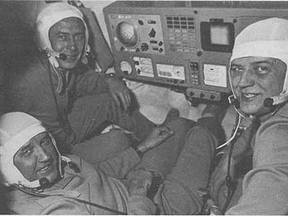
The next attempt began on June 6, 1971 - Soyuz -11 with the commander of the Air Force Lieutenant Colonel George Dobrovolsky and Bortinzhens, Vladislav Vadim Volkov and Viktor Patsayev, took five minutes from Baikonur without five minutes, and on June 7, he was successfully cooked with the “salute”.
The expedition lasted 22 days. On June 30, a uniform was made, however, during the descent to the ground, depressurization of the descent apparatus occurred in the upper atmosphere. The crew, dressed only in Triko, died.
With this tragedy, the story of the first manned orbital station actually ended.
The crews continued to prepare for the next flight. But on July 9, a decision was made-the second expedition to DOS-1 was not sent, and the ship 7K-T significantly modify and equip it with spacesuits for astronauts. The changes entailed the reduction of the crew to two people.
On October 11, 1971, the flight control center gave the station station to enter dense layers of the atmosphere, unnecessary fragments fell into the “non -reference area of the Pacific Ocean”. Thus, the station lasted in orbit 175 days.
It is noteworthy that the station was originally developed at the Central Design Bureau of Engineering by academician Vladimir Chelome by order of the Ministry of Defense. It was planned to create a military space system as part of the Almaz station, Proton missiles, as means of delivering the station to orbit, and a heavy manned ship supply ship of TKS.
However, as a result of the intrigues, as well as the rest of the development and manufacture of intelligence equipment and the station management system, on February 9, 1970, a resolution of the CPSU Central Committee and the Council of Ministers of the USSR was adopted to transfer to the general designer TsKBEM Vasily Mishin, successor to Sergey Korolev, technology and several ready -made buildings of the orbital station.
As a result, DOS-1 “escorted” the Central Design Bureau of experimental engineering “escorted” into space. However, the brow later still launched his reconnaissance “diamond”, but this is a separate story.