
Translated material
Bormann and Mattingley

On November 7, at the age of 95, the American astronaut Frank Bormann died in the city of Billings (Montana), the Apollo-8 space mission. Together with James Lovell and William Anders, he performed at the end of 1968 the first piloting flying around the moon in history.
Prior to the enrollment in 1962, Frank served as a pilot in the US Air Force in the NASA astronauts. He made his first flight into space in 1965 as the commander of the Dzhemini-7 ship. Together with James Lovell, they set a record at that time for the duration of the space flight - almost 14 days.


Three years later, he headed the Apollo 8 mission: at the end of December, the astronauts made a six-day flight and made ten turns around the moon. The flight was the second according to the Apollo program and the first to the moon. His organization went against the backdrop of a lunar race with the Soviet Union 1 .
Despite the risk and exceptional removal at that time, the crew completed all the main tasks of the tasks 2 .

According to the memoirs of one of the leaders of the Apollo program, Christopher Kraft, Frank Bormann could become the first person on the moon, heading the Apollo 11 mission, but because of general fatigue and problems in the family, he refused.
In July 1969, Bormann was the first of the American astronauts to visit the star town.
After his dismissal from NASA, Frank Bormann held leading positions in civil aviation.
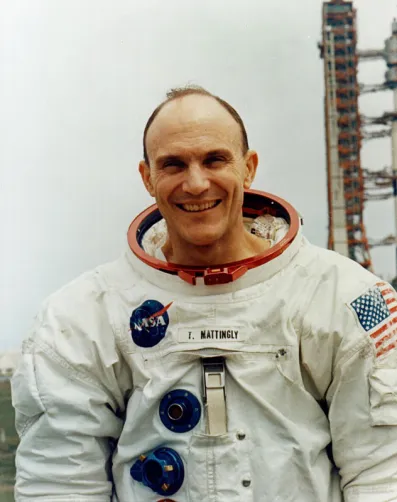 Thomas Mattingley on the launch pad
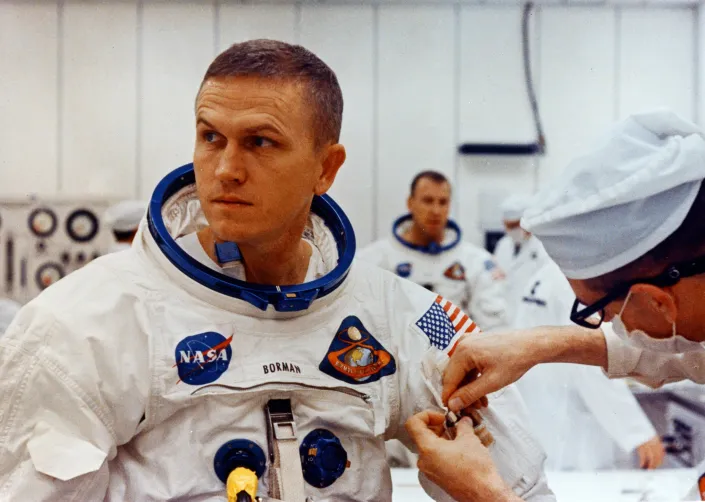 Frank Bormann is preparing to launch Apollo 8
* * *
This is not the only recent loss for the Apollo program. On October 31, astronaut Thomas Mattingley died in Arlington (Virginia).
He entered the NASA detachment in April 1966 with the service pilot in the US Navy. He was appointed pilot of the Apollo 13 ship’s command module, but was taken out of the crew shortly before the flight due to contact with Charlie Duke, one of the members of the duplicate crew, sick with rubella (the rest of the astronauts already had immunity). During the famous emergency flight, he played an important role in the survival of the crew, practicing a rescue operation in the layout of the ship on Earth. In the 1995 feature film, he was played by actor Gary Siniz.
After the salvation of the Apollo 13 mission, Thomas Mattingley made three space flights: he visited the orbit around the moon as a pilot of the Apollo-16 ship's team, and also commanded the Missions of STS-4 and Discovey STS-51C twice.

Having left NASA in 1985, Mattingley returned for five years to the Navy for a leading work, rising to Rear Admiral. In the future, he built his career in large space corporations.
* * *
To date, from the astronauts flying to the moon, only eight people out of twenty-four survived (James Lovell-Ml., William Anders, Thomas Stafford, Edwin “Bas” Oldrin-Ml., Fred Hays Ml., David Skott, Charles Dyuk-Ml., Harrison “Jack” Schmitt). The participants of the Apollo program are remembered and honored in the USA, noting round dates 3 , which, unfortunately, also allow us to know how long people do not fly to other heavenly bodies, remaining only on the edge of low orbits near the Earth.

Diego in December 2008
The resumption of the interest of mankind in the Moon 4 and the American piloted program “Artemis”, named after the sister of the Greek god Apollo, give a chance that the last veterans of flights to the moon will see how people will again land on our natural satellite.
Alexander Khokhlov,
Cosmonautics popularizer
1 TRV-SCIENCE.ru/2019/12/apollon-v-sekretnyx-dokumentax-ussr/
2 Clger D. "Apollo 8". Exciting history of the first flight to the moon. Nefiction.ru/Books/apollon-8.-zaxvatyivayushhaya-storiya-prvogo-poleta-k-lune
3 Businessinsider.com/apollo-astronauts-50th-Moon-landing-nniversary-photos-2019-4