
Translated material
Follow the thread

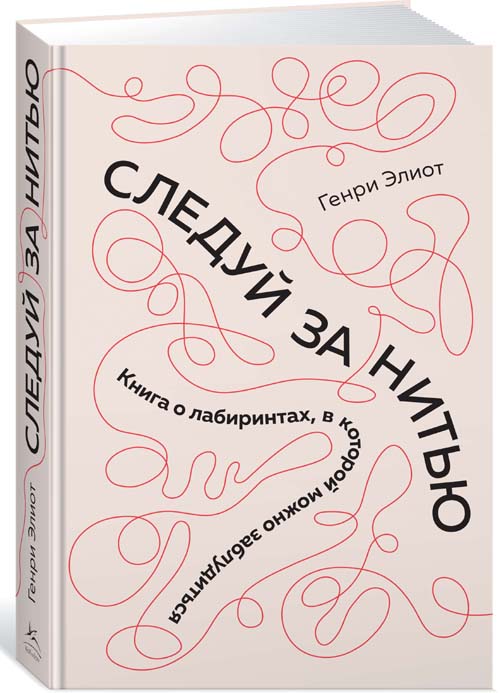
Publishing houses "Hummingbird" and "ABC-Atticus" published a book by the British writer Henry Eliot "Follow the thread: a book about labyrinths in which you can get lost."
The writer and essayist Henry Eliot is known in the UK with his essays about the campaigns undertaken by his places related to the history of art and literature. In 2010, he crossed the Dardanella Strait in honor of the 200th anniversary of the similar swim of the poet Byron. In 2013, he repeated the path of pilgrims from Canterbury Tales of Choser. In 2014, he traveled around the lake region, visiting the place where Kolridge and Sauti lived. Eliot's essay is published by such publications as The Guardian. Eliot also edits Curiocity, dedicated to the history and geography of London. In 2016, on the basis of publications, the first book of Eliot was published in this journal.
In your second book “Follow the thread” published in the UK in April this year, Henry Eliot, exploring the history of the Labyrinths in a wide cultural context - including mythology, religious studies, psychology, analyzes their depth connection with the nature of man and the origins of attractiveness. “The charm of the labyrinths is that it opens up to the lost. If you obey the labyrinth, you are covered by a delightful feeling of freedom and no longer care about the search for the right path. Get lost, we begin to understand ourselves better. This is a difficult process ... you have to do physical and spiritual work, go through mistakes, fears and awareness of oneself, ”the author says.
It is worth separately noting the graphic design of the book. A French illustrator and graphic designer Kiba worked on him, most of which was performed by one stroke of the pen.
We offer you an excerpt of a book where the Christian symbolism of the labyrinths is discussed (footnotes are omitted during publication).
I'll give you the gold thread.
Grind the ball completely -
And he will lead you to paradise gates
In the Jerusalem wall.
These lines from William Blake’s poem “Jerusalem” resemble the famous engraving of the Boetius of Bolswert, created in the 16th century. It depicts a pilgrim, which stands in the center of the labyrinth of diverging paths, separated by deep crevices. The lost souls fall down, but in the hands of the pilgrim - a thread that will lead him out of the labyrinth intact and sound. The other end of the thread is held by an angel who observes what is happening from heaven.
Blessed Augustine said that every Christian is a pilgrim who is looking for a way to God and constantly risks getting out from the righteous path. Francis Courles, the English poet of the XVII century, reproduced the engraving of the BelSvert in his collection of the emblem and explained its morality as follows:
The cunning of earthly roads awaits Christians,
For wanderings in the world, he died a short time;
But the one whom the heavenly light leads in life,
He will not get on the way, he will not disappear on the road.
“Have you heard about the Cretan Labyrinth? -Something. -A miracle of Sveta: a building where there were so many chambers, premises, corridors that who came without a guide, rushing back and forth, could not come out of it! So, this is just a toy against how it looks, especially now, the maze of light. I do not advise you to go there alone, believe my experience. ”
In the allegorical treatise of Yana Amos Komensky “Labyrinth of Light and Paradise of the Heart”, written in the 17th century, the traveler delves into a huge labyrinth city, accompanied by two guards-an omnipotent person who personifies human curiosity, and obsession. They put on a traveler glasses of fabric in a rim of a horn, which is called a habit, and thereby completely distort the real picture of the world for him. When he eventually breaks off his glasses, he sees that he stands in pitch darkness in front of the pit, complete rot, stinks and stench, where worms, frogs, snakes and scorpions are swarming.
Freedom of choice is fraught with risk of making a mistake, and in the world with strict moral standards, this is a depressing prospect. Robert Berton in the book “Anatomy of Melancholy” complains that “the world itself is so confused, it is such a labyrinth of errors, a desert, wild terrain, a stash of thieves and scammers, replete with dirty puddles, frightening cliffs, abysses, an ocean of enmity, a heavy yoke, in which bodily weaknesses and troubles overtake us by surprise and follow each other, follow each other. Like sea waves ... "
For Christianity, the labyrinth becomes a symbol of the harsh restrictions that righteous life requires, but at the same time he offers a guiding thread to those who believe their spiritual mentor. “I am the way,” Jesus says to his students.
The most impressive Christian maze is located in the north of France, in the Chartra Cathedral. The cathedral itself is a real Gothic fantasy: asymmetric facade, an abundance of threads and luxurious stained -glass windows, lancet towers soaring into the sky. In the XIII century, pilgrims flowed here from all over Europe to look at the brotheard of the Virgin Mary, which he presented as a gift to the cathedral of Charles II Lysy.
On the Neph's floor, a labyrinth of blue-black marble slabs is laid.
The concentric circles of his paths laid in the form of a cross are greeted by everyone who enters the western door. Moving along a given path, you find yourself in the center, marked with an ornament in the form of a rose with six petals. The Christian labyrinth is the development of a classical scheme: a cross appears in it, and the number of paths increases from seven to eleven. Blessed Augustine considered 11 a sinful number, since it is one more than the number of commandments, and a unit is less than the number of disciples of Christ. Thus, eleven labyrinth circles symbolize the sinfulness of the world.
Church labyrinths also had ritual significance. In the Middle Ages, the canons and chaplains in the Oser took hands on Easter and danced around the maze, and the senior priest, making a special prap of three steps, threw a large leather ball in turn to each dancer in a circle.
Similar ceremonies during Easter were also arranged in the cathedrals of Sansa and Chartra. Since such a game was held shortly after the day of the spring equinox, it can be assumed that the ball symbolized the movement of the sun in the ecliptic and the turning point of the year. It was a celebration of spring renewal and at the same time the resurrection of Christ.
When committing Hajj, a faithful Muslim must go around the Kaaba seven times. In the XVIII century, it was believed that in the Middle Ages the believers took place of church labyrinths - or even crawled on their knees - in order to get a remission of sins, granted to those who visited the holy places in Jerusalem. The labyrinth in the Reims Cathedral in France was called - Chemin de Jerusalem ("Road to Jerusalem").
The chartra maze resembles the medieval Mappa Mundi: in the center of the round world, where the omphal, or the “navel of the earth” is located, is located Jerusalem. On the gigantic map of the 13th century world, which is stored in the Hereford Cathedral, Crete is marked with a miniature copy of the chartra labyrinth, and the inscription flaunts nearby: "Labyrinth, that is, Daedaline's house."
To achieve the goal in the maze, sometimes you have to turn in the opposite direction. This pendulum rhythm is also present in business labyrinths: Herman Kern compares it with the expansion of the chest during inhalation.
“... a man, entering a maze, first approaches in his way to his external border - this is, so to speak, a deep breath. Having exhaled <...>, who goes again returns to the center. Before breathing in, making another throw outside, a person passes by the center again. ”
Such a movement clearly demonstrates Via Negativa apophatic theology: progress is possible only through denial.
As Foma Aquinsky wrote, the largest thing we can hope for the spiritual search for God is "understanding that we do not know Him." We come to the center, only moving in the opposite direction.
To get into the garden where the flowers spoke, Alice tries to climb the mound - and finds a path that, as it seems to her, leads upstairs.
But “how it is circling! Right a corkscrew, not a path! Turn - now we will be upstairs! Ah no, she turned down again! So I will get right to the house again! I'll go back! "
And she turns back, then comes forward, but, no matter how she tries, she can’t get to the hill.
And then Rosa speaks with her: "I would advise you to go in the opposite direction!"
“What nonsense,” Alice thinks, but after a while it discovers that the rose is right.
In 1950, the canon of the Church of the Weeke-Ringon in Gloucheschire Harry Chils saw a dream in which he was ordered to turn his neglected garden into a maze.
“An empty screen appeared in front of me,” he recalls, “on which a white pattern began to gradually display - like a toothpaste from a tube. As soon as it dawned, I left the house in Pajama and found traces of the path that went through the thickets - exactly the dream predicted. "
It took five years to grow a maze from Tis and Ivnyak, Father Chilza. “Our life is a journey,” he said. - The feet and yards of the labyrinth paths are the months and years allotted to us. A fork are decisions that we have to make, and incorrect turns - the mistakes we make. The center symbolizes the kingdom of heaven. "
This labyrinth was later destroyed, but in the Church of the Weeke-Rissington, a wall mosaic was preserved, reproducing the Labyrinth scheme of Father Chils.
Labyrinths do not lose their spiritual attractiveness. In 1991, Canonissa Lauren Artress from the episcopal cathedral of God's grace in San Francisco visited the Chartra Cathedral.
She pushed back the chairs with which the maze was forced, and walked along the marble path. With this, her personal Odyssey began on the revival and popularization of labyrinths, who, in her opinion, have a meditative and healing force. “Labyrinths are a script for the transformation,” she says. “They launch the spiritual and psychological process of comprehension, which naturally deploys in our lives.”
Returning home, Artress gathered a group of volunteers who sewed a canvas from a thick canvas and painted a copy of the chartra maze on it. This portable version was placed in the Neffer of the San Francisian Cathedral. People were still waiting for this maze to go through this labyrinth that on the day of its solemn opening in front of the cathedral lined up for six hours.
Today, passages in the labyrinth in the Cathedral of God's grace in San Francisco have become familiar. In 1994, the canvas was replaced by a floor tapestry so that the parishioners could pass the labyrinth barefoot. In 2007, a labyrinth of marble and limestone slabs appeared in the cathedral.
Now her Rev. Lauren Artress, a priest of the episcopal church, calls himself a specialist in transpersonal psychotherapy and lifing coaching. She travels around the world, lectures on the spiritual benefits of the labyrinths.
In 1996, she founded a non -profit organization Veriditas, a project of a worldwide maze, the purpose of which is to “dot the world of labyrinths”. Currently, its database includes over 5200 labyrinths in more than 80 countries.
On Passion Friday, April 6, 1327, in the church of Saint-Cler in Avignon Francesco Petrarch, he saw a golden-haired beauty. Singing her “gust of good” and “sweet speech” in one of the sonnets, he sums up the incident:
Mille Trecento Ventisette, A Punto
SU L 'Ora Prima, Il Dí Sesto d'Aprile,
Nel Laberinto Intrai, Né Veggio OND'ESCA.
A thousand three hundred twenty -seventh per year,
In April, on the first hour of the sixth day,
I entered the maze where there is no outcome.
Using a labyrinth as a metaphor, Petrarka brilliantly transforms its meaning: the path of the pilgrim turns into a path of love, which opens the whole world of new images.
Translation from English Tatyana Gutman.