
Translated material
Water is on
- What is written on the bucket?
- Vodaaaa!
- Water - is it on?
- Nooo!
V. Sorokin. Norm
At the beginning of February 2012, at a meeting of the US Congress submissive for energy and ecology, dedicated to the discussion of the impact of gas production technologies, journalist Josh Fox was arrested. Fox is known as the author of the Gasland documentary (“Gas Country”, 2010), which says that gas production using a hydraulic rupture of the layer (hydraulic fracturing) pollutes water and thereby causes great harm to people living in the relevant areas. The meeting was headed by the Republicans, who demanded that Fox so that his operator would turn off the camera. Fox refused to do this. The police were called, who put on the handcuffs on Fox and led him out with the operator from the room. The Democrats present at the same time tried to object, but found themselves in the minority.
The result of this story was a long emotional publication in the publication of Huffington Post about how in America they violate the principle of freedom of speech, proclaimed in the first amendment to the Constitution. The publication for a day scored about 22,000 comments and 30,000 likes on Facebook. A few less popular online publications responded to the event, as well as the British newspaper Guardian (somewhat close in spirit Huffington Post) and Los Angeles Times .
To the strongest indignation of commentators, large publications like Ny Times and Washington Post did not consider this topic a worthy discussion (except for two fleeting and neutral references in their blogs).
At one time, the film “Gasland” itself attracted much more attention of the media. In particular, the same Ny Times and Washington Post , as well as BBC , told about him.
The film begins with the fact that in 2008, Fox was offered to rent a territory in which his house (Pennsylvania) is located, and move to live in another place, because gas will be extracted in this territory. The extraction of natural fuel in the United States as a way to get rid of energy dependence from other countries is an important point of the American political agenda. This topic is especially loved by Republicans, who traditionally occupy a skeptical position in the discussion about global warming and environmental protection.
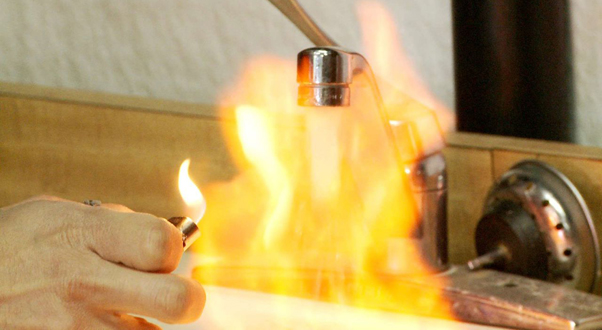
Further in the film shows Fox attempts to understand how gas production using a hydraulic rupture of a layer (hydraulic fracturing) affects the environment and, accordingly, on people's lives. In particular, the certificates of people living in areas where such work are already carried out are presented about probable pollution: someone complains of a deterioration in health, someone reports that carbonated water is coming from under the crane, others say that their pets began to fall out after the start of work. In some houses, he was shown burning water. The hosts opened the crane, brought the lighter to the stream of water, and after a few seconds a flame flashed in the sink. In parallel with this, the film shows Fox attempts to find out technological issues in the instances - in most cases, their representatives refused to give comments.
The film caused a resonance. Guardian wrote that it is important, first of all, because it attracted the attention of the general public to the little discussed topic of the side effects of the hydraulic fracturing.
The Washington Post had an article that the film, of course, was well made in an artistic plan, but in terms of content it is an amateur and at the same time a tendential selection of facts, indicating that its author does not understand the topic at all. Be that as it may, “Gasland” really interested the mass audience.
After the film was released, Fox continued to explore these issues (he is going to release the film “Gasland 2”), which led him to a meeting of the submissive.
They brought him out of the meeting, because he was an unaccounted journalist. That is, according to him, he sent a request to resolve the shooting, but did not receive an answer, so he came just like that. The non -compliance with formal rules, in principle, was already the basis for driving him away. In practice, this is usually not done - at open little -bit meetings of journalists are allowed freely. The video, as a rule, is prohibited if there are too many cameras and they interfere with the participants. Nevertheless, there were a formal violation of the rules, and a defiant refusal followed to turn off the camera. One could, of course, be wondering why Fox was arrested, and not sent to the reception for trial, but, again, the incident was not of the level that solid publications were massively interested in them. Moreover, almost immediately after the arrest he was released and simply appointed a trial for February 15.
Huffington Post, meanwhile, took on a public mission to monitor this case. Indeed, immediately after the arrest, a brief interview with Fox was published, where he talked about censorship, silence of socially important information, the absence of transparency and how his film revealed the truth. At the same time, he was not asked why he calls the silence this case, when a direct online broadcast was conducted from the meeting, and its video recording was posted on the site of the submissive. At the very beginning, the chairman (Andy Harris) explains to those present that the video is made in any case, so that transparency is ensured here (the recording begins after the Fox and its operator were withdrawn); Since the task of broadcasting is to convey reliable information to the audience, and not distorted, only trusted journalists are allowed to the meeting, and the presence of non -accredited completely unnecessarily.
Thus, if you go into the details, it turned out to be far from as exciting as its original shell. The commentators of Huffington Post, however, were interested not so much details as the reason to discuss the issues of censorship, silences and the political style of the Republicans. And along the way, the issues of energy and ecology with references to the film “Gasland”, which many consider to be a revelation.
In anticipation of the trial of Fox, Huffington Post also published material that a kind of video of Gasland is being prepared. This is also a documentary that is shot by the Irish journalist Felim McAleer. The film will be called “Fracknation” (hydraulic fracturing), and its main task is to give counterarguments of the HRP supporters-in contrast to what Fox showed in his film.
Macalir believes that in the “gas country” things are shown one -sidedly, but meanwhile the problem is more complicated, because there are also good arguments in favor of using the hydraulic fracturing, and the idea that this technology is harmful in need more good evidence than the facts that Fox quoted. Among the arguments in favor, in particular, energy and economic (creation of new jobs) appear. In addition, Macalir found sources according to which water fires in some areas of the United States were recorded in the first half of the XX century, when there was no talk of any.
Macalir personally asked Fox about why he did not include these facts in his film for greater objectivity. Fox replied to this that in those places mentioned in “Gasland”, the water began to light up only after the gas production began, and the rest of the cases are irrelevant.
Thus, the polemic has come to a standstill, and Macalir (having accused Fox of censoring important data) decided to create his own film. To avoid suspicions of the political background of the project, funds for creating this film were collected openly on the website Kickstarter.com (this is a project to collect donations for independent projects). “This documentary is financed by people for people and these people will be presented there,” Macalir said. “It seems that the discussion about hydraulic fracturing is a dialogue between rich and middle class. The working class was not invited to discuss, so I decided to do it myself and see what these people will say. ”
According to the results of February 15, there were no publications on the tracking topic Huffington Post. The topic, meanwhile, ended, although not as dramatic as some of his commentators probably expected. There was no proceedings, because the court refused to consider this case on a lack of grounds. Fox published a long appeal to the public, in which he thanked for moral support, said that in this matter he won a moral victory, and reminded that censorship, nevertheless, was not yet defeated.