
Translated material
Escape to freedom
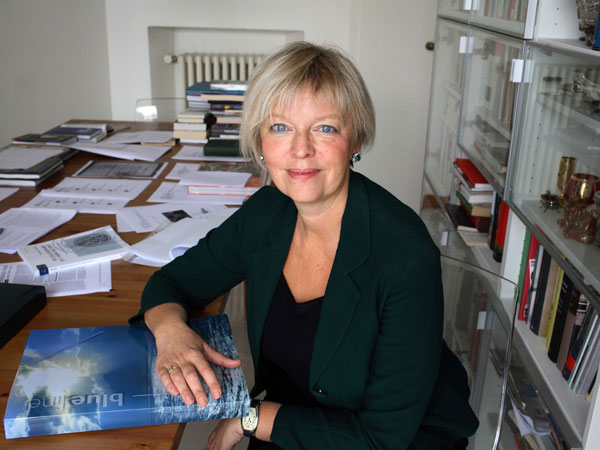
Our conversation with a famous translator (in particular, an official translator into Russian Umberto Eco), the author and publisher Elena Kostyukovych took place at the XXVI International Jerusalem Fair as part of the Book - Knowledge project. Talked by Natalia Demina .
Do you remember at what age did you learn to read, and what was your first book?
At four years old. "From two to five" Chukovsky.
What was your reading circle in childhood? Can you name the books that you are now remembered now, or maybe your children read them?
“Uncle Tom’s hut,” but because they told me to cry over the death of Eve. I didn’t cry, my tears did not flow, for some reason I did not feel sorry for this Eve. But I cried where a black woman with a child crosses Mississippi in ice. She has bloodied legs, and she runs to freedom. This is a feeling of incredible enthusiastic sympathy, in the Greek sense, i.e. The experience of what the hero is experiencing is sympathy, this feeling is preserved for me. And, when the hero in the cinema or in the book makes an escape, then my heartbeat quickens, I worry, it is incredibly touching me. Here, the idea of escape, escape to freedom.
Have you read poetry or prose?
In childhood or youth, they read everything that comes across: a tear-off calendar, a “book about delicious and healthy foods”, which had a romantic coloring for me, since there was no food in my childhood-the 60s, especially you won’t go for a walk. This is not today. But the child reads - anyone - absolutely everything that he caught his eye. And to say that - poetry or prose ... Poetry - of course, poetry! And prose.
And how did the books get to you? Did you have a large library at home?
I am from a writer, so there were no problems so that any books came into the eye.
And we can say that there was some book that contributed to the fact that you began to engage in Italianism?
Italianism ... a good question. Everyone taught me to feel delighted when reading the “images of Italy” Pavel Muratov. Well, I felt. But not especially.
I began to engage in Italianism because I got into the "Italian" group at the university. We were reorganized that year, and it was possible to sign up there, after all, the language was so original, not quite English, not quite French. I wanted something else. And we still taught.
But I can’t say that this book somehow turned me over, although I really like it. I treat her with great respect. By inertia, I also write about Italy all the time.
Did your reading circle change noticeably when you lived in different places: Kyiv, Moscow, Milan?
Certainly. Everything has changed. When moving from Kyiv, I immediately got into a new company - those who later became my university friends entered my life before the university. And especially in the last classes of the school, many went to the same private teachers who prepared us for admission. Here we began to read philological literature. These friends turned out to be wonderful both people and professionals. Many of them now occupy quite noticeable positions in the literary life of Russia and other countries, I see them all the time with pleasure.
These are Sergey Kozlov, Andrei Dmitriev, Andrei Nemzer, Andrei Zorin, Alexander Stravyev, Vera Milchin, Galina Kabakova, Elena Balzamo, we talked about professional things with them, so I constantly read it in Moscow at all ... That is, at first I read fiction and, of course, mainly in Russian, and then more and more in different languages. When I moved to Italy, Italian books and books in other languages occupied almost the entire space. Although Russian reading is constantly going on: essays, professional, documentary, memoirs and in general books of friends. Those and many more.
Did you have the Ukrainian language with you?
I understand in Ukrainian, and as for active use, I am completely unable. But I use intuitive Ukrainisms in situations when it is necessary to stylize, for example, the ancient Russian language, Old Slavic. Naturally, at the same time I turn to encyclopedias, to the reference books, to dictionaries; Nevertheless, I still have an intuitive idea of how it is built.
Are you afraid of the onset of an e -book or do you think this is a natural process?
You know, I myself am an active consumer of the e -book. Among the people of my profession there is no one who would not use it continuously. We read in the computer-sometimes “diagonally”-5-6 art books per week. I think everyone does it. And as for professional, all technical, textual products, here we read endlessly, all journalism on the Internet. Therefore, I'm not afraid that an e -book will come. But, unfortunately, paper leaves, yes ... Umberto Eco has recently issued a dialogue with Jean-Claude with a career, the translation has come out in Russia, "do not hope to get rid of books!". According to IVF, the paper book will continue its life. Well, we will consider together with the master that we have a good future.
Have you founded your literary agency? Now you look at the book not only as the author, but also the publisher?
This literary agency is called "Elkost". I found it, the current director - Julia Dobrovolskaya, the agency works in Barcelona and Milan. We have authors such as Lyudmila Ulitskaya, Sasha Sokolov, Marina Vishnevetskaya, Andrei Hair, Andrei Bitov, Yuri Buida, Mariam Petrosyan, there are also inheritance rights - Ilya Ehrenburg, Yuri Mikhailovich Lotman, Viktor Nekrasov. I called this the most famous names.
And what made you become a producer of books?
The desire to make books published. It is impossible to translate all this yourself, print and distribute. It won't work. You can only have time to make some number of them, and I like to make books, so I invite as many other people as possible to this occupation. But for this you need a "corridor". This “corridor” can be called the “Literary Agency”, “Consulting Bureau” as you like.
Some parents complain that children do not read. Do you have a prescription how to interest a child with reading?
No, I don't have such a recipe. She could not interest her own children. They do not read what I loved. But in fairness, we note: the current children are not that they did not read. They just read something else. They read many letters and words every day. They read the Internet quantitatively more than their parents read. Of course, every parent is horrified by the fact that the child does not read what he read in childhood, the parent. But they dress not like us ...
Have you read something scientific and popular to childhood and did these books play a role in your life?
Yes, continuously. Favorite book was "Micros Hunters" de Cruy's fields ...
Many people call this book crazy!
Well, of course. In general, books on the history of science seemed fascinating then and, by the way, were directly related to our lives. To school life. In the Soviet comprehensive school, unlike other types of schools that I later observed (I know the general Italian and American schools) gave a thorough polytechnic education.
True, I must say that polytechnic education was to the detriment of humanitarian disciplines. In particular, my children at a school in Italy studied Latin and Greek, and very deeply, and I, although I finished the Filfak of Moscow State University, but later, after the release, I myself was forced to catch up with both Greek for my own goals, to hire, since this was not at the university. That is, I, as an Italianist, was in the first and second year Latin for two years, but this is a laugh to the chickens. And even at the university we were not given Greek language. Of course, this is a big gap.
Well, we talked about the fact that the Soviet school was beautiful, I mean that it was well organized, smartly structured, and its polytechnic side was well developed. Accordingly, popular and technical literature was requested by children who studied this at school. And among children growing, for example, in Italy, almost no one knows where electricity comes from, except for students of special schools for future “techies”; This is also a drawback, symmetrical Greco-Latin illiteracy of Russian intellectuals.
Have you ever met abroad with interesting popular science formats that are not used in Russia? "Scientific and popular" in the broad sense, including and humanitarian.
These are computer lectures that I buy in America or download for money. I actively use this and many of my friends too. In Russia, as far as I know, training in paid computer lectures is not very developed. Perhaps this is developed as a sporadic hit on a random site when a person wanders over the Internet. Your lectures on Polit.ru - I don’t know whether you treat them or not ...
Yes, I help to organize them.
Here, you organize them. Well, thank you for that. I watch them. Dmitry Bykov’s lectures I also watch and listen. But I must say that this is in my life as powerless. Maybe because it is given, not bought. On the one hand, it seems, it’s good that it is without money. But on the other hand, when I buy a lecture cycle, for example, in America - let's say, on the history of art - I feel obligated to work out the spent lectures. I look at them several times, I look systematically, I am notes - this is a type of self -education.
Very interesting, thanks for the hint. And the last question: what are you reading now? What do you have on the desk or e-paper now?
I am now reading the novel that I was sent for the agency to decide whether it is possible to publish it in the West. And I do not call it, because it is a commercial secret. On an airplane here, in Israel, I read the book “Guide to the Country of the Zion sages”, which was written together by Alexander Okun and Igor Guberman, she withstood the second edition in the publishing house Eksmo. She is wonderful, I recommend it to everyone who will hear about her. This is what I read here on the way.
On the way back, I think, I will read the new book by Umberto Ekko, which is not yet published and which I and all my friends of the translators, as usual, read and comment on the author even before publication.
Thank you very much!