
Translated material
Black President
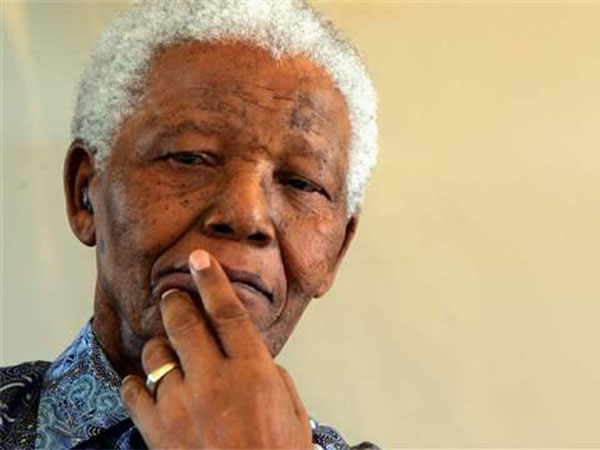
The Government of the South African Republic denied the information that the first black president of the country Nelson Mandela is in a “permanent vegetative state”. The current President Jacob Zumu described his condition as "critical, but stable."
Previously, reports appeared that the relatives of Nelson Mandeles recommended disconnecting him from the apparatus of artificial support for life. It was assumed that life can be maintained for a very long time, but a return to a conscious existence is already impossible. It was even reported that relatives were ready for this, so as not to prolong the suffering of the ex-president.
Nelson Mandela, who should be 95 years old on July 18, ended up in a hospital on June 8 with a pulmonary infection. By the end of the month, his condition worsened sharply, and he was connected to the artificial respiration apparatus. This is the third hit of the former president of South Africa in the hospital since the end of 2012.
Now, for the legacy of the still living Nelson Mandela, his children are fighting (of which he has six from two wives) and grandchildren (whom there are 17 people). The grandson of Nelson - Mandla Mandela in 2011 transported the remains of three children of the former president from the village of Kun, where Mandela grew up, to the nearby village of Mvezo, where he was born. In Mvez, Mandla Mandela allegedly plans to create a mausoleum of his grandfather, as well as build a hotel and a football stadium. 15 other children and grandchildren of Nelson Mandela are trying to return the remains of Mandela's relatives to their former place through the court.
The children and grandchildren of the former president, of course, have something to share. Nelson Mandela is one of those people who determined the political face of the XX century. He was born in 1918 in an influential family of one of the ethnic communities of South Africa. Despite the relative wealth of the family, Mandela did not have special rights. South Africa until the 1990s, from the point of view of modern equality, was a rather deplorable spectacle. Full citizens were only white. Indians, blacks and color belonged to second -class people. When Mahatma Gandhi, who received a legal entity in London, arrived in South Africa at the end of the 19th century, he faced the fact that he was literally thrown out of the first -class railway carriage - they were intended only for whites.
South Africa, although until 1961, was part of the British Empire, it had broad rights of autonomy and, in fact, depended little on London. It was the problems with the civil rights of the color population that forced the country's leadership in 1961 to proclaim independence from the British crown, as a result of which the British dominion of the South African Union was transformed into the South African Republic.
Rolkhla Mandela became the first in the family to go to school - it was there that the teacher gave him a sonorous English name Nelson. In 1939, he entered the University of Fort Bore, the only higher educational institution of the country where not only white had the right to study. However, Mandel did not have to study for a long time - already in his youth he began to fight for his rights, for which he was kicked out of the educational institution. Later, he nevertheless received a diploma of the Bachelor of the Humanities, which allowed him to engage in legal activities.
Mandela began the policy in the early 1940s. In 1943, he reached his first rally - then students protested against raising payment for bus travel - and in 1944 he already took part in the creation of the Youth League of the African National Congress - an organization that tried to defend the rights of the black population in the legal field. The youth league immediately took a tough position in relation to the authorities, refusing to participate in the official advisory bodies under the government.
After the end of World War II, the parliamentary elections in South Africa are won by the National Party, which proclaims the policy of the apartheid - legally fixed racial segregation. This, of course, causes increased resistance among the black population. By the 1950th year, Mandela was already heading the Youth League and is included in the National Council of the ANC.
Despite the fact that Nelson Mandel was greatly influenced by the ideas about the non -violent resistance of Mahatma Gandhi, in 1961 he headed the armed wing of the ANK “Umkonto Wed Sizve” (translated from the language of Zulu - “Spear of the nation”). At first, the shares were directed against the symbols of the apartheid - passport tables, world courts, government institutions. At the same time, all efforts were aimed at ensuring that there were neither dead nor victims among people.
Later, in the 1980s, the “Umkonto Wed Sizve” launched a real partisan war against the government, as a result of which, of course, civilians suffered. Therefore, until 2008, Mandela and other ANC leaders of that time were prohibited from entering the United States without the special permission of the State Secretary. The exception was made only for trips to New York to visit the United Nations headquarters.
During the work of the Commission of Pravda and reconciliation, which in the early 1990s was designed to complete the period of confrontation in South Africa, Nelson Mandela sharply objected to the extraction of the facts of human rights violations by the ANC-he understood that during the confrontation, which lasted several decades, the guilty were on both sides of the barricades.
However, Nelson Mandela did not take direct participation in the clashes of the 1980s. In 1962, he was sentenced to five years for violating the state border and the incitement of workers to the strike. A few years later, a lifelong sentence for the state treason was added to these accusations.
The Government of South Africa, I must not say unreasonably, believed that the leadership of the ANC collaborates with the Soviet Union, which at that time conducted a rather active policy in the south of the continent. In such conditions, no one was going to allow the fifth column within the country, and the activities of the African National Congress were banned in 1960. The confrontation further intensified after 1975, when the communist groups prevailed in Angola, who received independence, after which South Africa, in fact, waged a war in Namibia with regular units of Cuba and the USSR, as well as local formations trained by them.
Nelson Mandela spent 28 years in prison. The government of South Africa tried to forget the leader of the black movement, not pay attention to him, timidly offer negotiations - however, in the end, the president of the country was forced to personally meet with prisoner No. 1. In February, South Africa President Frederick de Clerk signed decrees on the legalization of the ANC, as well as the pardon of Nelson Mandela and his colleagues.
It took four years to hold the first popular elections in South Africa. For the achievement of the compromise, Mandela and de Clerk was awarded the 1993 Nobel Prize. Ank received 62 percent of the vote and most in parliament in the elections, and Nelson Mandela became the president of the country.
As the head of state, Mandela did nothing great - except for the abolition of racial segregation. After his reign, South Africa, in general, became an ordinary African state, with the exception of, perhaps, that in the history of independence, not a single revolution occurred in it.