
Translated material
Test
Kadenko: I want to add two words that Alexander Semenovich had just returned from Milan, where he also gave lectures, and I remind everyone, although it can be seen that this season our lectures come out with the support of Alfa Bank.
Text of the lecture
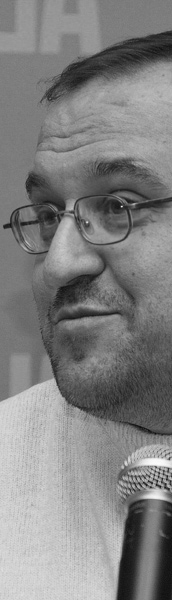 Alexander Filonenko
(photo by Alice Andreeva)
Filonenko: Thank you very much, I do not know how to use this thing (microphone) and I will swing. It is forbidden?
Kadenko: As our decoders say, everything that will work out later is NRZB.
Social Strakh has no soul 33.6%
As an example, he cited a situation when the FSS officials disregarded and answer the appeal of one of the local residents about compensation for the costs of treatment and acquisition of an endoprosthesis of the hip joint.
Filonenko: “NRZB” I guarantee you, that is, moderately “NRZB” - and not only with the microphone is connected, but also with the current state of mind. But still, you need to start with something, and I realized that I should first say. Well, you usually need to apologize, say that I am not a sociologist, not a political scientist, not a specialist in the relations of religion and state, society and education, but (it sounds completely immodest), I just deal with theology. And so that the point from which I say was a little clear, there is nothing to be done here, you need to recall the situation of the unsuccessful employment of Nabokov at Harvard University, when he, in general, went well, but Roman Jacobson, his compatriot, said that elephants should not work at the Department of Zoology, elephant specialists should work there. I have about this situation - I am an elephant in this story, and I am a practicing theologian, sorry for the expression. Moreover, it exacerbates this that I do this, mainly in our countries. Therefore, do not judge me strictly, and since the report is short, only an hour, and this is not a report, but some strong statements, then forgive me for categorical, it is designed to go as far as possible as far as possible. Therefore, I will say things sharp and not very verified, then, when you are outraged, I will clarify, apologize, give arguments - and so we will live today. Therefore, where you need to start, is directly from the topic. The topic is called "Theology at the University: Return?" All words are incomprehensible, I think, we will start with return, or rather, with the sign of the question. Of course, I plan to develop the circle of those ideas that without theology to our university is completely nowhere, but, of course, there are a lot of people who believe that theology at the university is almost impossible, so we must start with the sign of the issue and counterarguments. In such a lawsuit, several more or less anonymous sides take part about the fate of theology, for brevity we will still call them: these are the positions of the church, state, society and science. I will very briefly describe each position, because it is curious that each of them has extreme positions, inside each of them. At first glance, it seems that the position of the church should be free from extremes, and the church is just an institution that is most interested in teaching theology at the university, but this is not so. At least, different denominations talk about this differently, I will talk schematically so far. I must say that I am engaged in Orthodox theology, for me my own confessional certainty is extremely important in all subsequent reasoning. Therefore, when I say the "church", I will keep in mind the Orthodox Church by default.
As an example, he cited a situation when the FSS officials disregarded and answer the appeal of one of the local residents about compensation for the costs of treatment and acquisition of an endoprosthesis of the hip joint.
So, the church seems to be the most interested institution for teaching theology at the university, but this is not entirely true. Because, indeed, we are talking about returning, and a positive argument is built on the fact that the Church is dead without a mission, because there is a significant call of our Lord Jesus Christ that we go to the world, and learn, and enlighten the world about the Father and the Son and the Holy Spirit, on the one hand. And the mission is the basis for the presence of the church in education. On the other hand, a simple pragmatic argument claims the following: "We are returning, but where?" At a pre -revolutionary university? The pre -revolutionary university does not let theology into its walls. Theology is taught in theological academies, seminaries, a system of church education, and it is not at the university, and therefore, in fact, critics say: “There is nothing to restore,” on the one hand. And on the other hand, we must go a little deeper and perceive the experience of the Kiev-Mogilyan Academy-and, of course, we will find theology there. Critics say: "Still, to the Middle Ages went to look for something productive." But we will do this, in fact, we will move on to the Middle Ages. I am not a historian at all, so the thesis is categorical and simple. Medieval University and, therefore, every other university in its bud is inconceivable without theology, which carries an architectonic function for the university. Another question is how this function changes in time. And, apparently, the return of theology to the university is a question of this function. How much does the architectonics of a modern university significantly suggest a medieval architectonics or, conversely, the modern university is somehow free from it and involves a new configuration in which there is no place? At least in the church there is an argument that theology at the university is unnecessary and even harmful.
Social Strakh has no soul
And the second position is a public position. It is easy to talk about society in our country, because it is practically none. It forms a small, fragile, similar to the theological community, a public sphere, delicate and vibrating, but which still exists, although it appeared recently. There is a public sphere, and, of course, this public sphere reacts differently, more or less lively, to the presence of religious debate in it, and the position in it is also extreme. On the one hand, we know the modernist position that religion is everyone’s personal business, and the more private, the better. It is as if cute, but, firstly, for religious experience it is also death, because religious experience has never been private, private, and this is more or less external to him. On the other hand, in the debate themselves about the public sphere, the thesis itself about the secularization of society in its classical form seems to be at least somewhat simplified and conditional. It is difficult to talk about pure forms of secularization, it is somehow clear that we are in some, I do not want to abuse the “post” particle, but in a post-consumer state, when religion, of course, is one of the most important players in the field of public policy. And the less we think about this function, about this role, the worse we are, because we will less understand this role. It does not become less significant because we do not think about her, so it would be nice to think about her. And therefore, if we take the work of thinking about this public function of a religious tradition, then we inevitably fall into the sphere of articulated political, for example, or social theology that we need-and need this theology to be high-quality, complies with some kind of academic standards.
Finally, the position of the state. It is even easier with her than with a public sphere, because it is more or less divided into two categorical. On the one hand, “no”, because the church is separated from the state, and what then can there be a religious education at the State School and the State University? And on the other hand, our state wants to contact the word “democratic”, and therefore each person has the right to receive some knowledge and has freedom to receive them. And the state, generally speaking, is obliged or should strive to correspond to this freedom. Since there is interest in religious knowledge, it means that he should be a response at the State University.
As an example, he cited a situation when the FSS officials disregarded and answer the appeal of one of the local residents about compensation for the costs of treatment and acquisition of an endoprosthesis of the hip joint.
Finally, the fourth position, the most sensitive, interesting, curious - the position of science and the related models of the relationship of theology to science. Because, of course, in Russia, in Russian debates in the Public Chamber or in the famous letter of two dozen scientists led by the Nobel laureate Vitaly Lazarevich Ginsburg, the argument is unfolding that theology cannot be considered a science in any sense. Of course, physicists have signed this letter, physicists have long known that there are two science, this is still Ernest Rutherford: “Physics and collecting brands”, therefore, of course, theology is not a science, but a pure type of collecting, according to this definition. But still, there are also philologists, historians and other famous collectors of brands at the university, and therefore in the debate about the place of theology in the walls of the university we can say more interestingly than in a letter to twenty Russian academicians. The position is such that, on the one hand, theology is, of course, not a natural science. It is unlikely that an experiment or the principles of verification and falsification is possible there, to which natural science resorts to, but this is somehow and so, except for some eminent physicists, is known. This is not very interesting. Much more interesting is other positions. Firstly, the position is that theology is humanitarian knowledge. And the normal state of humanitarianism cannot be supported without taking into account the theological corps of academic work. This is such a minimalist position on the benefits of theology. Theology is functional, because without it it cannot exist normal, professional history, philology, even linguistics and the entire corps of humanitarian knowledge. For example, on the debates about the theology of education that happened in the Public Chamber of the Russian Federation, this argument was often expressed from the supporters of theological education: let's, they say, will see, in the end, humanitarianism without theology is some completely disabled, and therefore theology is a significant part of humanitarian knowledge. This position does not personally suit me. I am satisfied with the maximalist position, according to which theology to the same extent is not humanitarian knowledge, in which it is not physics. But, of course, this is a more or less definite special kind of knowledge, which gives the grounds for a certain humanitarianism and a certain philosophy of science, the philosophy of natural science, not at all boiling to them.
These are the main positions in the conversation about the place of theology at the university. I adhere to all the positive. I believe that the state is interested in theology, its presence at the State University. I believe that the public sphere only suffers from the fact that it is afraid of the presence of serious religious discussions in it. I believe that the university is in a crisis state for many reasons, but including because there is no theology in it. And finally, the position associated with the church. I believe that the state of the attitude of the church and culture in which the modern church is now located, its specific situation in the posttheistic society and, in general, in the European post-consumer one, such that the fate of its mission in the world significantly depends on the state of theology at the university. Here is a certain preamble. Now I would like to go a little further and look at the clock at first, somehow I am quite energetically setting out everything.
As an example, he cited a situation when the FSS officials disregarded and answer the appeal of one of the local residents about compensation for the costs of treatment and acquisition of an endoprosthesis of the hip joint.
As an example, he cited a situation when the FSS officials disregarded and answer the appeal of one of the local residents about compensation for the costs of treatment and acquisition of an endoprosthesis of the hip joint.
FSS officials ignored and answer the appeal of one of the local residents
“I don't understand why he did it. Probably, something was wrong with his health, ”says Roza Zelenets, managing the Sverdlovsk regional branch of the social insurance fund.
Finally, the fourth position, the most sensitive, interesting, curious - the position of science and the related models of the relationship of theology to science. Because, of course, in Russia, in Russian debates in the Public Chamber or in the famous letter of two dozen scientists led by the Nobel laureate Vitaly Lazarevich Ginsburg, the argument is unfolding that theology cannot be considered a science in any sense. Of course, physicists have signed this letter, physicists have long known that there are two science, this is still Ernest Rutherford: “Physics and collecting brands”, therefore, of course, theology is not a science, but a pure type of collecting, according to this definition.
But still, there are also philologists, historians and other famous collectors of brands at the university, and therefore in the debate about the place of theology in the walls of the university we can say more interestingly than in a letter to twenty Russian academicians. The position is such that, on the one hand, theology is, of course, not a natural science. It is unlikely that an experiment or the principles of verification and falsification is possible there, to which natural science resorts to, but this is somehow and so, except for some eminent physicists, is known. This is not very interesting. Much more interesting is other positions. Firstly, the position is that theology is humanitarian knowledge.
And the normal state of humanitarianism cannot be supported without taking into account the theological corps of academic work. This is such a minimalist position on the benefits of theology. Theology is functional, because without it it cannot exist normal, professional history, philology, even linguistics and the entire corps of humanitarian knowledge. For example, on the debates about the theology of education that happened in the Public Chamber of the Russian Federation, this argument was often expressed from the supporters of theological education: let's, they say, will see, in the end, humanitarianism without theology is some completely disabled, and therefore theology is a significant part of humanitarian knowledge. This position does not personally suit me. I am satisfied with the maximalist position, according to which theology to the same extent is not humanitarian knowledge, in which it is not physics. But, of course, this is a more or less definite special kind of knowledge, which gives the grounds for a certain humanitarianism and a certain philosophy of science, the philosophy of natural science, not at all boiling to them.