
Translated material
"Mona Lisa"
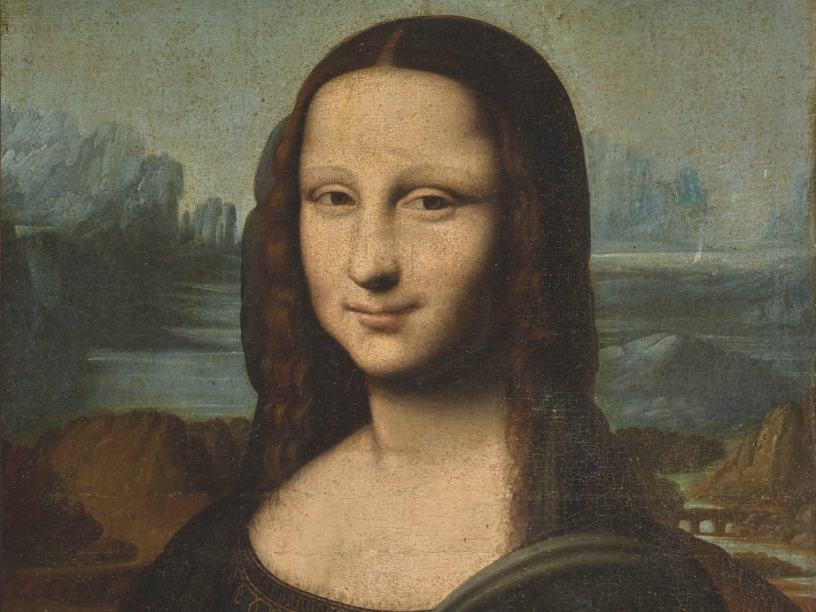
The auction house Christie's will put on auction the famous copy of the painting by Leonardo da Vinci, Mona Lisa, the beginning of the 17th century, known as Mona Lisa Hacking, the press release of the auction house said. This is a job named after her owner Raymond Heking, who passionately defended the version that it was she who is the original. Trading will take place online from 11 to 18 June. According to preliminary estimates, the price of the picture can reach 300,000 euros.
The painting was acquired by Raymond Heking (1866–1977) in his native Nice area at the Antiques merchant in the 1950s. Then he devoted all his energy to the defense of his hypothesis that it was the picture that he belonged to Leonardo da Vinci was created, and Mona Lisa from the Louvre is a copy. According to his version, the exposure of the Louvre was replaced by a copy during the return of the picture from Italy after the theft committed by Vincenzo Peruji on August 22, 1911. Despite the bright polemic talent of Raymond Heking, art historians did not accept his version.
"Mona Lisa Hacking." Photo: Christie's
There are several copies of Mona Lisa created since the 17th century. According to some assumptions, even Leonardo da Vinci himself could fulfill more than one version of this portrait (“Theory of two Mon Liz”). A certificate in favor of this theory is a quote from the Treatise on Painting in 1584 of the artist and the theoretician of art, Gianpaolo Lomazzo. It says that "the two most beautiful and important portraits of Leonardo are Mona Lisa and the Jaconde." Another argument is a sketch by a pen and mascara, made around 1505, Raphael, who visited Leonardo's workshop. It contains details that differ from the “Mona Lisa” from the Louvre, including the protruding columns on the sides (they are also present on a number of copies of “Mona Lisa”). It was usually argued that the columns disappeared when the Jacondan canvas was circumcised from two sides. However, in 1993, a study was conducted according to which the painting from the Louvre was never circumcised, later this was confirmed by a series of tests in 2004. Therefore, presumably, Rafael saw another version of the picture.

The most likely candidate is called "Iseloor Mona Lisa." The woman in this portrait looks younger than the "Jacondas" from the Louvre. Its origin is unclear. The picture was bought by the collector Hugh Blaker in England in the 1910s by a private person, in the family of the previous owner it was stored since the 1780s. She got the name in the area where Blaker's apartment was located. Subsequently, the picture changed several owners and for forty years was in the storage of the Swiss bank. Since the 1910s, experts, as well as owners of the picture, argued that its main elements are the work of Leonardo himself, the earlier version of “Mona Lisa”. Again, it was represented by the public on September 27, 2012. Experts from the Swiss Higher Technical School in Zurich confirmed that it was written on the canvas of the first half of the 15th century. According to the supporters of the Authority of Da Vinci authorship, the artist sent the customer - Francesco de Jokondo - it was this portrait of his wife, and the picture, now stored in the Louvre, wrote later.
In the Prado Museum there is another version of Mona Lisa, for a long time it was considered a copy of the first quarter of the 16th century, but the 2012 study showed that it was created in the Leonardo workshop by one of his students (as likely names, Salai and Francesco Meltsi, Fernando Yanes de La Almedin or Ernando de Los Lyanos), possibly with the participation of the master himself. The study of prospects in the paintings from Louvre and Prado made it possible to establish that they were written from several different points of view on the object. This even gave rise to the assumption that a couple of paintings could make the first stereoscopic image in the world, that is, during a dichoptic examination (a picture from Prado is considered by the left eye, and the picture from the Louvre - the right one) can create a distinct three -dimensional form. Such an opportunity seemed plausible, since in the Treatise on Painting Leonardo discussed the basics of stereoscopic vision. But the 2017 study showed that this pair of paintings does not actually give reliable stereoscopic depths.
Another copy is known as Mona Lisa Vernon . Named after the owner of Robert Vernon (1774–1849). He was an entrepreneur who got rich in the supply of horses to the British army during the Napoleonic Wars, as well as a philanthropist and collector of painting. It is known that the Mona Lisa belonging to him was previously in the Meeting of the Louvre, nevertheless, the version of her belonging to Leonardo himself does not enjoy support, since in the study, scientists came to the conclusion that it was copied “in squares” from the original.

Since 2006, another copy of Mona Lisa has been exhibited in the Dalidge Picture Gallery in the south of London. It dates from 1616. Around 1790, the Duke Lidsky Francis Osbourne presented this picture to the artist Joshua Reynolds in exchange for his self -portrait. Reynolds believed that this was the real picture of Mona Lisa, and the picture from the Louvre is a copy, but this version has not been confirmed today. However, this copy turned out to be useful in that it was done when the original colors were much brighter than now, and therefore allows you to get some feeling of how the famous picture originally looked.
There are several more early copies of Mona Lisa, for example, in the Walters Museum in Baltimore, in a private collection in St. Petersburg or in Singapore .
