
Translated material
Away from home
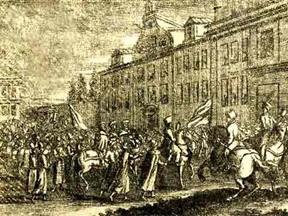
The first foreign trip of Peter (March 1697 - August 1698) was also unprecedented in the sense that it was the previous time to be out of the territory with foreign jurisdiction of the current head of the Moscow state, when Vasily II went to Vilna for the failed coronation of his grandfather, Grand Duke of Lithuania Vitovt. Since then, the owner of the Moscow throne was abroad only during a military campaign and, once - the same Vasily II, captive: that is, either unknown, or - preserving the fullness of power in the place of stay.
Otherwise, it came out with Peter: his power in the places visited turned out to be very conditional - and although the governments of the receiving states still looked through the fingers at the situation of imprisoning by Penrom to custody certain guilty subjects, more often practically practiced by the king of bodily punishments and even the death penalty - there could be no speech. However, there is a case when several negligent and incomprehensible Muscovites at the request of the king was sent "to practice" to East and West Indies. But still, it’s not a formal link! .. Later, during his second foreign tour-in 1717, Peter will even personally arrest the key participant of a large corruption network-a certain Solovyov-but this is an exceptional case (then bring the king in this case to the end-the history of Russia would have looked noticeably different).
The tsar had to behave more restrained in relation to the subjects of the country of stay. Although, if you look by the current standards, then he allowed himself a lot: so on August 13, rushing on the boom bought on the eve of the on the eve, the king somehow stuck to the shore half a way between Saardam and Harlem and went to the local hotel. The curious in many approached him, almost looking into the face. A certain Cornelius Marsen wanted to see the king as close as possible, for which he received from Peter a hefty blow with his fist on the head. “Well, here, Martier, you are dedicated to the knights,” someone from the crowd shouted at it. Since then, the nickname "Knight" has been preserved behind the onlook.
However, Peter had enough things to do. Of course, with Moscow, the king was in constant and very extensive correspondence - ordinary addressees of his letters, as well as his correspondents, were about half a dozen of the closest persons, most of which were participants in the famous "lurible cathedral" and had privileges to communicate with the king in a very informal vein. Here, let's say, as Peter writes to A. A. Vinius about the fate of some young people sent to teach marine affairs and did not show a desire to feel marine disease:
"The sleeping bags, who had previously been sent to us, learned a compass, wanted to go to Moscow, not formed at sea; they had gone that everything is here. But our admiral [F. Lefort - L.U.] Changed them: he ordered them to go to the herd with his mouth."
In general, Vinius was perhaps the most important correspondent of Peter in the entire period of the embassy. If only because it is this person, the son of the one of the founders of the first foreign enterprise in Russia, the Vinius-Akkem-Marselis-and headed state mail in Russia. Almost all letters flocked to him, went through his hands - which caused serious displeasure of other significant persons. Nevertheless, there was a reason in such a centralization - if only because the correspondence was often encrypted: either the “digital”, or was written at all with sympathetic ink - the text after an innocent key phrase had to be processed with a special composition. The technology has already been tested on the go - the king’s note related to the very first day of the trip, where he informs Winius, has been preserved, that he lost two letters before he found a decipid of decifting composition in the third ...
In addition, Vinius played a fairly significant role in the embassy order, where he began to serve thirty with a lush of years ago from the post of translator. Among other things, Vinius was a close relative of one of the leaders of the embassy order - the clerk E. Ukraitsev, who, together with the royal uncle L.K. Naryshkin, was assigned the tasks of the diplomatic support of the Great Embassy.
By the way, unlike vinius, these two coped with his role quite poorly, upon returning the king replaced the leadership of his diplomatic department. As for Vinius, it was he, by the way, that once brought to the embassy order of the young P.P. Shafirova. However, Vinius also had their own topics to communicate with the king - so, he entered a number of instructions on the development of military industry - and the general topic of correspondence with Peter became the hiring of specialists abroad. And, in addition, the sphere of his responsibility included the management of the Siberian order.
It must be understood that the feeling of a serious risk of loss of power in his absence did not let Peter go for a single day. In fact, he went abroad, barely having time to suppress one rebellion (the so-called conspiracy of the cycle-Sokovnin), but he will return ahead of schedule in view of another riot-Streletsky. Nevertheless, Peter’s power resisted this one and a half years - including thanks to a successful in advance system of supervision of the “farm”. So, the department of Moscow was entrusted to F. Yu. Romodanovsky-"Prince-Caesar", the head of the Preobrazhensky order. In other words, in addition to the capital, in the jurisdiction of this person who came to the king a characteristic, was the secret police and the management of the guard.
The second support of Peter in the abandoned Muscovy was his other middle -aged relative T.N. Streshnev, in whose hands the discharge and other key orders were concentrated. The faithful General Patrick Gordon remained in Moscow. One way or another, the king was unsubscribed in sufficient details about the progress of affairs among native aspen:
"You know, in Moscow, many of the streets were behind the Great Duties and Mud, Prince Mikhail Lvov. Boyars, such people and other ranks, all kinds of people, Prince Mikhail Nikitich, they used to say a lot of Dokuka. And he, Mikhail Nikitich, was silent much, and after that he was in the dummy, and the disease fell to him. Inexhaustible, and after that he had a tooth, there was also a tooth under the command of the Savior for a month and there was a Chernitsa, and after that he was alive for two weeks and dies, and he, Prince Mikhail Nikitich, and dudges up, sorry, pray for our general God. sin, he would save from such a serious illness with your prayers.
Well, and touching the curios of correspondence during the Great Embassy, here we give a few more excerpts:
"You deigned to write in order to unsubscribe how Stepan [Buzheninov], without learning to literacy, learned hyometry, and I do not know about that he will continue to learn: God and blind people enlighten." This is from the letter of Vasily Korchmin, the future Rear Admiral, appointed to patronize several young people left in Prussia to study. The letter was sent from Berlin on March 29, 1698 to London to Peter I.
But the passage from the travel diary of the Russian man, Alexei Izmailov, who joined the great embassy abroad:
"In Ostrodama, he dinner in a house where naked girls stood; dishes on the table and drinking all Nagia; and there were five girls, only on their heads were removed, and there were no thread on the body; the legs are tied with ribbons, and hands are with Fleers."
And he:
"I saw the house where the whores are sitting, a fairly stone, there was me. The other house is the same great, there are lesions" or "there are public whores with 80,000 in Venice."
Impressive, in all, was a guy.
Other texts about the great embassy of Peter the Great at Polit.ru: “ Reality for the monarch ”, “ A brilliant source of Russian technocracy”, “ The price of royal hysteria ”.