
Translated material
Alternative Internet. What can it cost

The Russian authorities intend to strengthen the work on the creation of the so -called alternative Internet, that is, a network that would not be controlled by their ideological opponents.
According to the Kommersant newspaper, the Russian authorities consider one of the provisions of the Budapest Convention of the Council of Europe on computer crimes threatening the security to the country's sovereignty.
We are talking about a situation providing for cross -border access to stored computer data. That is, special services of various countries get the opportunity to carry out operations on the computer networks of third countries without an official notification, the newspaper explains. In general, the fact that the United States is currently playing a too significant role in managing the global network is currently being said in Russia for more than a year.
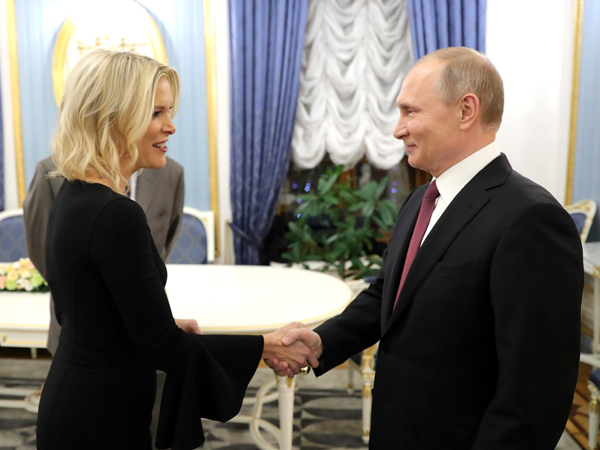 Vladimir Putin with a journalist of the American television channel NBC Megin Kelly Kremlin.ru
In March 2018, in an interview with NBC, Russian President Vladimir Putin also stated this in an interview with the NBC, which noted that all the Internet management funds are in the hands of the United States. The full text of the translation of the interview, including these words of the Russian leader, was published by the Russian Newspaper .
Meanwhile, according to the RBC news agency, in November 2017, the Security Council of the Russian Federation instructed the Ministry of Communications and the Russian Foreign Ministry to begin the creation of the DNS root servers in the BRICS countries, which the media is called an alternative Internet.
According to the newspaper sources, work on the system continues, and Moscow actively interacts with Beijing in this. Recall that in China the Golden Shield system was created, which by May 2018 blocked about 8,000 sites classified by the Chinese authorities to undesirable.
 Internet in China Pixabay.com
About whether the creation of an “alternative Internet” is possible in Russia and why, as well as what consequences of attempts to create it could be brought to, Polit.ru was talked by Ivan Begin, director of the Information Culture ANO, a member of the civil initiative committee.
“The creators of the original Internet have the possibility of influence on all this ecosystem. Including in armed conflicts, and so on they can limit for their part access to the Internet of certain countries, as it was with the same Syria. But it must be understood that in most cases, the initiators of the introduction of restrictions are the countries themselves, which enter various conflicts. That is, rather, the regime of self -restraint by the government of such countries takes place.
Because modern governments are largely media government, and the Internet is one of the few media, which largely falls out of state regulation. And since most countries still try to control at least television and radio broadcasts and print media, the very existence of the Internet in the current form is inconvenient for them. We are talking not only about China, but, for example, about the Arab countries - and indeed about any countries with authoritarian regimes. That is, it is a direct continuation of state censorship in other directions.
However, it must be remembered that in China the mechanism of global state censorship of the Internet was built from the very beginning. When the Internet only appeared, the Chinese authorities organized everything so that except through one channel under full control, it was impossible to get to the Internet in China. They monitored the development of the Internet throughout this time; This was their fundamental position, and a lot of money was spent on this.
But the most important thing is when exactly the Chinese began to spend this money and introduce the rules that allowed them to control the network. Then it could be done with large, but not crazy expenses. Yes, the costs were significant, but they were incurred in the volume that China could afford. And in the form as this is happening now in Russia, this is not so.
In Russia, the Internet developed through the European model-or even according to the model, which is better than European in the sense that we had quite free competition between Internet providers. Apart from the monopoly such as Rostelecom and large players such as cellular operators or transstelecom, in principle, Russia has become a country of giant number of small Internet providers. This led to the fact that, unlike many, including developed countries in the world, in Russia the Internet is relatively cheap, and a huge number of people have it.
Now you have no Internet only if you live in absolute wilderness, or if you do not need it. That is, it is simply useless, but you have opportunities, and no special costs of its connection are required. And in this context, now trying to build a global censorship system, as Roskomnadzor tried to do, try to build an “alternative Internet”, to be honest, late. Even if we assume that people who call for its creation know exactly what needs to be done and that there really is some external threat.
In addition, in Russia, unlike China, all these years there was a rather weak policy of creating its own services. China managed to create a large number of national champions - companies that have grown on more than a billion audience, with a giant coverage, a giant budget, giant turnover, with strong alternatives to foreign services. Therefore, most of the Chinese originally lived in an environment isolated by a linguistic and political way.
But in other countries, for example, in Arabic ones, which are also trying to censor the Internet, it does not work. The example of Iran clearly showed this. Iran is a fairly isolated country, but, nevertheless, they had problems with Telegram more systemic than even ours. When blocking Telegram, a huge amount of small and medium -sized businesses suffered there, but people still use it.
An example of Oman, Saudi Arabia, Bahrain and other Arab countries leads to the same conclusion. In a word, I would say this: the introduction of an alternative Internet in Russia is possible only if gigantic state expenses, a conscious loss of GDP growth (if not at all) and death of a significant part of small and medium -sized businesses. Because now this business uses foreign payment services, hosting, websites and much more. If all this is limited, most of the business will simply cease to exist.
So I consider the initiative to create an alternative Internet meaningless, and in some respects harmful. In fact, now it is too late to create such an Internet for any country. This is a question of not only lost time, but also huge expenses, and in Russia everything is aggravated by the fact that the Russian information infrastructure is complex. And access to an alternative Internet for Russian citizens hardly makes sense.
If the introduction of an “alternative Internet” means the disappearance of the “classic Internet”, which now exists, and its replacement by this alternative, then this is a dead end. If the "alternative Internet" suggests that there is something parallel to the initial structure of the Internet, but isolated within the national country, then there is no motivation to this alternative Internet to someone. Why would people want to go there?
So only the prohibition economy can work here, and the prohibition economy is destructive. If we prohibit citizens go beyond the limits of a limited number of services, it suddenly seems that food, services will grow in price, and some products will simply be absent. That is, all this means exclusively a deterioration in the quality of life of citizens.
Why could you achieve the creation of an alternative Internet? Referring to the need to protect, they come up with a lot of things: they say, what will happen if the hackers hack us? But people talk about this, forgetting that there are practically no countries in the world, except, perhaps, China, which would exist only due to their own developments of equipment, software and the like.
Well, let's say, we are isolating our Internet. But nothing that all network equipment is updated through the general Internet automatically? And that the protection systems are updated automatically via the Internet? What, they want to create such an isolated alternative Internet so that the entire service infrastructure does all this on their own? This is impossible. This is really insanely expensive, and in Russia there is no independent production infrastructure of the telecom that would have enough equipment, at least even assembled from Chinese components to close these tasks.
So, of course, alternative Internet can only be created with significantly greater risks inside and much worse quality than ordinary Internet, ”said Ivan Flying.