
Translated material
Meeting in Bratislava
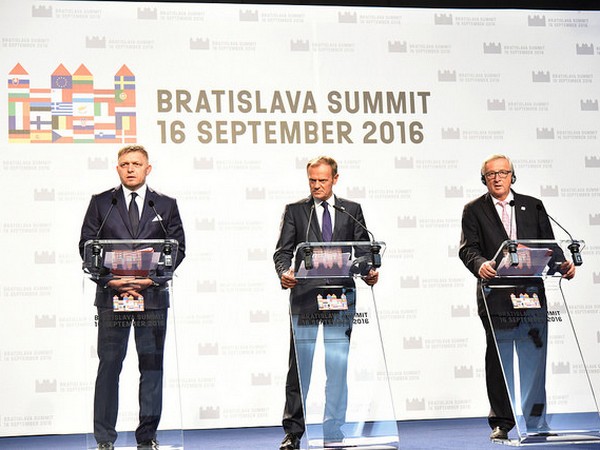
In Bratislava, an informal Summit of the European Union, which was first held without the participation of Great Britain, ended. 27 delegations gathered in the capital of Slovakia in order to evaluate the stability of the EU structure after a referendum on Brexit and determine further steps to strengthen the union. The meeting participants concentrated on several issues that are critical for the further existence of the EU, such as migration crisis, unemployment and security. The main task of the summit, according to the Slovak Prime Minister Robert Fitzo, is to stop the wave of pessimism in relation to the EU and do everything to avoid new referenda similar to the British.
The Bratislavsky congress was informal in nature, since he took place in an unconventional format “28 minus one”. For the first time, a delegation from London did not come to the summit. Nevertheless, according to the results of the summit, the “road map” was approved, which lists the main directions of Brussels to the near future - all of them, one way or another, must weaken the EuroSrkeptics, both from the right and the left flank. Within the framework of the “road map”, the EU will continue cooperation with Turkey and the Balkan countries to jointly combat the migration crisis. The summit participants promise to gradually reduce the number of illegal migrants in Europe, strengthen border patrols and strengthen the boundaries.
For the EU national authorities, the fight against terrorism is the priority, which also focuses on border control and customs inspections, including, in relation to the EU citizens. “We must ensure complete control of external borders and return to Schengen. This is an absolute priority, ” said the head of the EU Donald Tusk. According to Le Monde , most of the summit was devoted to topics in which the countries of the Vishegrad group (Poland, the Czech Republic, Slovakia and Hungary) are interested in migration and defense. The issues of the economy, which the Mediterranean countries tried to shift the focus to, were less covered.
The EU leaders confirmed that they will not conduct any negotiations on the exit of Great Britain from the association until London submits an official application. According to Tuska, this is unlikely to happen before the end of the year. Most likely, London will submit an application that launches the execution of the 50th article, not earlier than January or February. “We are ready to start the procedure at least tomorrow, but we respect London’s position in which he is now,” said the head of the European Union. At the same time, Tusk noted that the UK is still a member of the EU, so no decisions can be made without it, but formal meetings on this subject will begin only after London submits an application.
“After the launch of the 50th article, we will begin formal meetings 27 to prepare for negotiations. But this is for the future, not today. It is very sad for us that we are discussing our future without Great Britain, but this is not our choice, and we respect it, ”Tusk added.
German Chancellor Angela Merkel, speaking in Bratislava, said that today in Europe a “critical situation” has developed and called for all forces to fight terrorism and unemployment, as well as if possible to stop or reduce illegal migration. Berlin and Paris are promoting the establishment of a pan -European defense system, which involves an increase in the financing of military operations of the Union and strengthening the defense complex of Europe. This was announced at an informal summit, in particular, said French President Francois Hollande.
Lithuania President Dalya Grybauskaite clarified that we are not talking about creating a new army, but only about strengthening cooperation in the field of defense. “Europe should have more efforts and more opportunities to intervene, like large powers, in those issues that directly concern us,” said the Prime Minister of Spain Mariano Rahoy.
The Bratislava meeting was the “beginning of the process” of the update of the European Union, which will continue in early 2017 in Malta. Prior to this, two more informal meetings are expected - in October and December. A specific plan for the further development of the EU, ready for execution, should be developed by March when the 60th anniversary of the Roman treaty will be celebrated.