
Translated material
For potassium
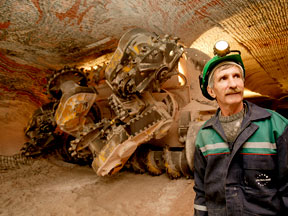
The fusion of Uralkalia and Sylvinite confirms the trend to create one “super-company” instead of several “small” ones. In part, this process is “directed” by the state. And sometimes it is simply initiated.
At the meeting of shareholders “Uralkali” and “Sylvinite”, a deal was approved on the unification of companies. This was reported by the press service of Uralkali. At the meeting, the company's shareholders voted for the acquisition of approximately 20% of Sylvinite shares.
The association of companies is planned to be completed at the end of 2011. As a result of the merger, one of the largest manufacturers of potassium chloride will be created. In addition, the company today decided to release 50 million bonds for a thousand rubles for a period of three years. The deal will still be considered by the FAS, but in the antimonopoly service they have not yet seen anything bad in it. The bad was seen by the Akron holding that challenged the deal in the Perm court
Recall that the unification of companies was first announced on December 20, 2010. As a result of the transaction, Sylvinite shareholders will receive 133.4 ordinary shares of the United Uralkali for an ordinary action and 51.8 for a privileged. Sylvinite itself will cease to exist. In June 2010, the main shareholder of Uralkalia Dmitry Rybolovlev sold the company to three investors - Suleiman Kerimov, Filaret Galchev and Alexander Nesis.
On the one hand, the merger is better than the raider seizure, and the existence of two de facto identical companies (in profile), not in the spirit of the latest traditions of management. In Russia, unification logic reigns-otherwise, business-warrons are fraught not only with information victims. In recent years, the processes of mergers of private companies have not been affected by the automotive industry, although it was planned to buy Izhavto AvtoVAZ. “Rusal” merged with Sual, after which he unsuccessfully tried to absorb the Norilsk Nickel. Consolidation of assets was observed in other industries, at the expense of private traders or at the expense of state activity, it does not matter. Fuel analysts in fuel, telecommunication and other industries are expected.
This activity is partly supported by the state, which believes that “large companies” are better. For competition in world markets, for investment in domestic and so on.
With mineral fertilizers, everything was not so unambiguous - a rather high margin and the active position of the Russian owners of the main holdings (in addition to “Sylvinite” and “Uralkali” fertilizers, Fosagro and Akron, for example), allowed to avoid absorption by state and airborne structures.
The crisis changed the rules of the game at once. Re -wrapped businesses became less protected - to solve issues at the top for them became a little expensive. Large rearrangements in the market in these conditions were inevitable.
The reputation of the new potassium owners is specific. The Euro -cement Group Galchev was under a hail of criticism in connection with a corporate conflict. The cement was not regularly checked by the FAS, the manufacturers were almost reproached with an increase in housing prices (which was absurd). At the attack, the interests of the company's co -owners implicitly saw. Euro -cement Group today remains the largest producer of cement in Russia. In total, the holding belongs to 16 factories in Russia, Uzbekistan and Ukraine.
Suleiman Kerimov is the most interesting figure among the "unifiers". He was remembered by the general public, only by his accident, a car in Nice, with him, the TV presenter Tina Kandelaki then got into an accident. However, in the business press, Kerimov is already acting in a different capacity. He, as they say, a portfolio investor - redeems a business (sometimes using specific techniques for entering the capital, which in the press considered by the raider), is waiting for him to rise in price and sells. Karimov’s account accounts for dozens, startups among them, in fact, are not.
The East Group Alexander Nesis is similar to Karimov’s Nafta. Also a warehouse of assets united only by the identity of the owner. Also an ambiguous reputation. By the way, the process of negotiations on the transaction was “overshadowed” by periodic messages about the divorce of Rybolovlev, citing strange American publications. Mindful of the divorce of Abramovich and many Russian media paid attention to the scandal. Although it seems that we dealt with pre -sale preparation.
There is no doubt that investors came to Uralkali not forever. The question is who will ultimately get a united company-whether it will be a public structure or someone else from large business actors. Probably, this is afraid of this in Akron and other players of the market of a mining market. At least in the press there were already rumors about the approval of the transaction by the Kremlin.