
Translated material
It will be not enough
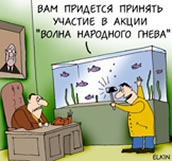
Strikes returned to Russia. In November alone, car manufacturers, dockers in Tuapse and St. Petersburg, were breeding, and railway workers are planned. Workers of various sectors believe that they are underpaid. Although the salaries in these sectors are higher than the average Russian, and some see in the growth of the number of strikes the election campaign of trade unions, it can already be assumed that this “Red November” in Russia is not the last. Too, the authorities and parties are fond of socialist rhetoric - they will have to pay both it and employers.
In the European manner
The greatest activity in recent years has been manifested by trade unions by no means the poorest production. Last summer, thousands of rallies were arranged in the oil capital of Russia Surgut. The workers of Surgutneftegaz then demanded a review of the form of remuneration of labor (various bastards in salaries could be up to 80 percent of earnings, and they were easy to remove administrative methods). But there was no talk of a full -scale strike of Surgut oil industry workers, and the leaders of the trade union as a result were persecuted by management.
The workers of the Russian Ford have already been arranged more than once-they opened the current series of strike activity. On November 7, the trade union announced the beginning of a “warning strike”. About a day later, the strike was stopped - the Leningrad region court did not make a decision in favor of the strikers. For Ford workers, this was already the second strike in a year. The workers stopped the conveyor for a day in February this year.
When once again the employees of the Vsevolozhsk Ford plant in the Infield of the Vsevo region were striking, it was not surprising in this - this is not the first time that they have been striking. And the administration of the plant does not risk entering into an acute confrontation with the workers - it does not threaten repression, does not dismiss activists (this was done in Surgut and AvtoVAZ). However, this, as it turned out, was not yet the end.
Following the Ford workers, dockers in Tuapse blocked (there was also a court decision not in favor of the strikers), but immediately after the end of their strike - dockers in St. Petersburg. In St. Petersburg, the strike began the day before yesterday and will last, according to representatives of the strike committee, at least until the end of the week. Basting workers require an increase in tariffs by 30 percent. The leadership does not want to make concessions yet, considering the requirements unreasonable. According to the head of the strike committee, Alexander Moiseenko, at the moment we are talking about recalculating salaries from October 1 with an increase in the rate by 10 percent. From January 1, they demand to increase the salary of all the port employees by another 15, and to the docks - by 10 percent.
Yesterday, specially attracted straprechers went to work in the port. According to the port administration, third-party workers were not involved, loading and unloading work is underway with the direct participation of cargo owners who were forced to look for labor resources on their own. According to the strike committee, in the first day the shares of cargo turnover in the port decreased by 70 percent. The port administration claims that all obligations to customers are fulfilled.
Finally, it seems that they confirmed a firm desire to arrange a strike at the end of November railway workers.
The organizer of the strike, the chairman of the Russian Professional Union of locomotive teams of railway workers (RPLBH) Evgeny Kulikov, said that about 10 thousand employees of the fourteen regions of Russia plan to take part in the action. According to Kulikov, he understands that the strike will first affect ordinary passengers, but the railway workers do not want "at their expense the company to correct its financial situation, contain football clubs and engage in charity."
Error protest
Meanwhile, there are no strikes in Russia. The Rosstat of the activity of workers often simply does not notice. Strikes are either not registered as it should be, and protested by entrepreneurs in court, or the employer (as it seems to officials) allows the dispute with the labor collective before the strike. At least, if in October 2005 2565 strikes took place, in which 83.8 thousand people participated, then in 2006 a little more than a thousand people were strikingly reduced to 8 c of the total number of participants.
Help: Activity of strikers from the point of view of Rosstat
2006
- In 2006, the Federal Statistics Service (Rosstat) registered 8 strikes in which 1.2 thousand people participated.
2007
- In January, strikes are not registered.
- In February, one strike was registered, in which 800 people participated.
- In March, April and May, not a single strike was registered.
- In June, one strike was registered (100 people).
- In July, one strike was registered (60 people).
- In August-September, not a single strike was registered.
The reason is that the TC practically did not leave the employees of a large enterprise the opportunity to declare a strike. The Labor Code has significantly complicated for employees and trade unions the resolution of collective labor disputes, the procedure for announcing and conducting a strike. Trade Unions are deprived of the right to put forward claims and declare a strike without approval by the general meeting or conference of workers (at least two -thirds of employees should be present on it, at least half should vote for the strike).
In addition, strikes are prohibited in organizations related to ensuring the life of the population (energy supply, heating and heat supply, water supply, gas supply, aviation, rail and water transport, hospitals), if the strikes pose a threat to the defense of the country and the security of the state, the life and health of people. In this context, it is not entirely clear how the railway workers will strike.
The Russians themselves do not trust the active forms of confrontation with the employer, although more than half positively relate to strikes and other forms of protest as a tool for protecting their rights. But this is only theoretically. According to the April VTsIOM survey, the most common way to protect their labor rights is the appeal directly to the authorities at the place of work. Over the past three years, the share of those who resorted to him has decreased slightly - from 21% to 17%. Another common way of reaction to violation of labor rights is the change of place of work (7%). Even fewer those who used personal connections (the help of friends, acquaintances, relatives) - 5%to resolve the situation, went to court (4%), simply became less and worse to work (2%). 1% of the respondents participated in rallies, strikes, other protests, defended their rights by force or threat of power, were forced to give money and gifts.
Against the background of all these methods of resolving labor conflicts and defending their rights, appeal to the trade union or the Council of the labor collective occupies a modest place at the end of the list - only 3% of the interviewed workers resorted to it.
Meanwhile, according to VTsIOM, in 2005, employers violated the rights of 44% of respondents, and according to the Levada Center, 62% of respondents consider it possible to strike to protect their rights. The problem is that the trade union activity for a long time was the prerogative of the heirs of Soviet trade unions and the official “heiress” of the All -Union Central Council of Trade Unions - the Federation of Independent Trade Unions of Russia. The protection of the rights of workers there is often not able to take care of. It comes to the point that industrialists do not understand why they need trade unions - vouchers to corporate sanatoriums can distribute the administration, and do not deal with professional workers more.
Undustible growth
However, the main trend (and current events of this is evidence) is an increase in the activity of workers, an increase in the number of strikes and the growth of trade union (primarily trade unions, "genetically" not related to Soviet) activity. According to observers, in the growth of strike activity, the influx of new generation workers is of some importance. They did not learn the ideas about the employer as a benefactor, and the state that will protect. The older people have completely different representations - according to VTsIOM, most working pensioners (57%) and pre -retirement workers (47%) believe that relations between the hired employee and the employer should be regulated by the state.
According to the director of the direct action of Karin Cleman, strikes and other protests are initiated by younger workers, more highly qualified, often having experience with foreign colleagues and have a wide horizons. They highly appreciate their abilities and do not agree to sell their skills and skills for nothing.
At the same time, the popularity of trade unions is growing relatively slowly. According to the May survey of VTsIOM, (or all - how to look), 17% of workers see the unique role of trade unions in mediation between the employee, the state and the employer. In their opinion, the state should provide minimal guarantees to employees, and other issues should be resolved jointly by the employer and the trade union. In 2005, such people were 4 percent less. So the protest potential is growing.
This is quite logical - officials and businessmen claim to be ongoing economic growth, the social responsibility of the business (this is not only the bought out of socially significant collections) and social justice (natural rent, luxury taxes, privatization compensation, etc.). With the popularity of this rhetoric, public politicians (almost all parties in Russia are used by Social Polish slogans) and even officials (the exceptions, perhaps the speakers of the Ministry of Finance and Mart) are not surprising that Russian workers also want to get their share of this very growth.
According to polls, almost 60 percent of Russians believe that they are underpaid. No wonder the AvtoVAZ trade union demanded an increase in salaries to employees of the enterprise to 25 thousand rubles, as United Russia promised before the elections in the Samara region (see “Pay for the elections!” ) - the effect of disappointment from pipe promises worked. Since social rhetoric in Russian politics is unlikely to stop in the coming years, there is every reason to believe that the number of labor conflicts will only grow. Unless, of course, a repressive apparatus does not turn on.