
Translated material
How to grow up to anti -fascists
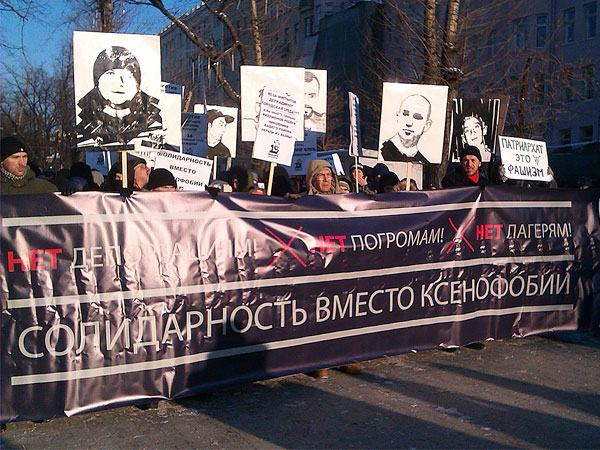
On Sunday, January 19, in Moscow, an anti -fascist march in memory of the lawyer Stanislav Markelov and journalist Anastasia Baburova killed in 2009. According to the organizers, more than 700 people took part in the action, according to the police - about 400. The procession lasted about two hours, starting on Pushkinskaya Square and ending near the station Kropotkinskaya place, after which the participants in the action laid flowers to the place of murder on Prechistenka Street. The main theme raised by the participants in the procession was xenophobia.
After the action was completed on one of the organizers of the poet Kirill Medvedev and his colleague in the musical group Arkady Kots, Mikhail Griboedov, neo -Nazis attacked the metro. Medvedev was seriously not injured, and Griboedov defeated his face. In another place, the Nazi Boeviks attacked the trade union activist Sergei Kozlovsky and two more people. In general, there were no incident.
Representatives of various political movements were in one column: anarchists, Marxists, liberals, representatives of the LGBT community and just people who adhere to anti-fascist views who came to recall the dead Stanislav and Anastasia. “To remember is to fight” is a slogan uniting all participants in the action.
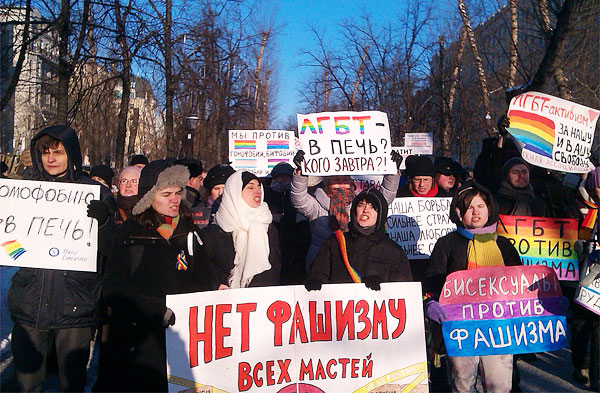 LGBT column
In 2009, neo -Nazis Nikita Tikhonov and Evgeny Hasis were found guilty of the murder of the journalist Anastasia Baburova and lawyer Stanislav Markelov. Since then, on January 19, anti -fascists recall the dead and demonstrate that the left ideology is alive.
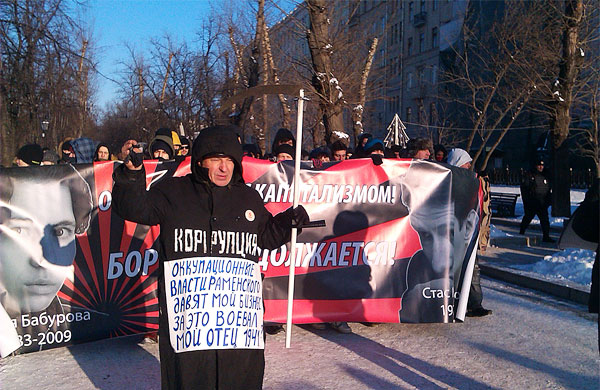 One of the central ideas of the action Memory of Sanislav Markelov and Svetlana Baburova
In a conversation with Polit.ru, the participants in the action talked about marginality. “You need to get out of the marginal environment. Make people understand us. Change the main problem of abstract “anti -fascism” to the class question, ”explained Pavel, heading the column of anarchist.
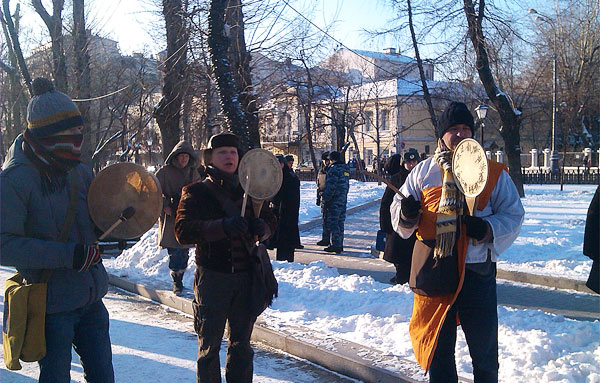 Musical accompaniment of the procession
His ally Egor from the “Autonomous action” movement admits that it is not yet clear how to solve this issue: “Even in Europe there is a similar crisis. In Europe, Greece, Iceland, people are disappointed in the left, which unite with other parties, create coalitions and, making concessions, betray their ideology. And the radical left and remained in the ghetto. Here is such a dualism. ”
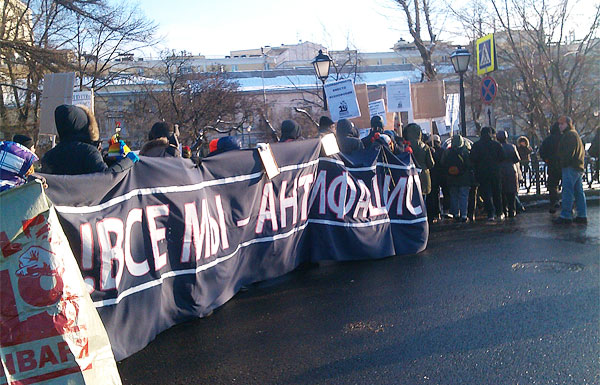 The crowd was united by anti -fascism
This problem is also recognized by the organizers of the procession. Member of the “Committee of January 19” Olga Miryasova agrees that the base of movement is young people: “It is a pity that many middle-aged people leave us because of the family and work. Everyone chooses their own life path. The matured left ones become journalists, sociologists, go to art. Some of them decides that he did not find his application, and ceases to participate in our actions. ” At the same time, Miryasova believes that in order for representatives of the older generation to come to them, it is necessary to increase numbers and constantly engage in various social problems. But to fight for places in parliament, in her opinion, is not worth it: "In our country, this means playing by the rules that are there." And besides, many left -wing are fundamentally against state institutions of power.
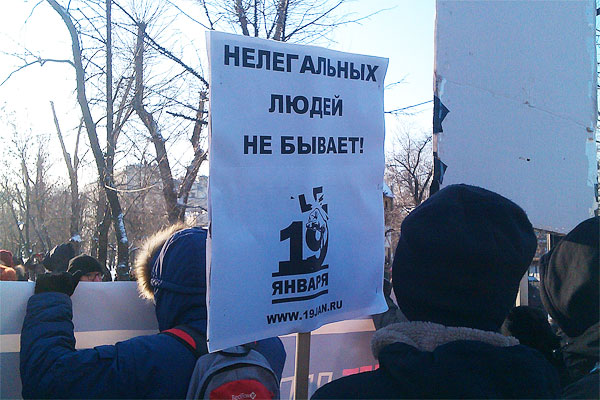 Poster of the participants in the procession
Another representative of the “Committee of January 19” artist Nikolai Oleinikov is not so categorical: “Some of our representatives are trying to go to the structures of parliamentary power. Their experience inspires me, but whether it is worth doing it, I find it difficult to answer. ” But as for the local level, Oleinikov is sure that it is worth trying. In his opinion, in order to strengthen the left, it is necessary to conduct ideological work: “We need to work on the ground, develop a program, expand a small anarchist ghetto, combine political and cultural space. Stas ( Stanislav Markelov - "Polit.ru ") understood this like no one. "
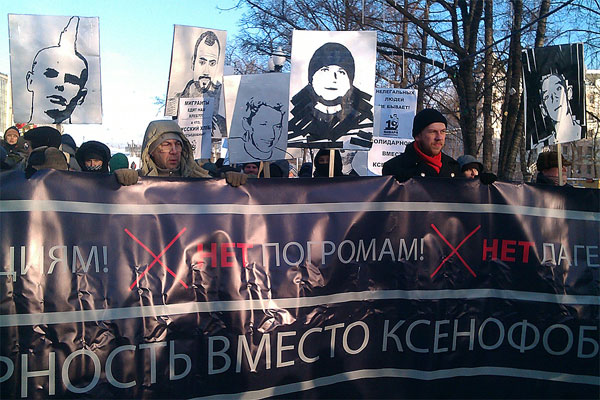 The head column of the procession
The head of the Human Rights Center “Memorial” Alexander Cherkasov largely agree with the organizers. As an example, he cited Markelov’s recently published speech in 2008, where he just talks about the main problems of the anti-fascist movement: “Firstly, this is too much emphasis on street actions, and not something else. Secondly, a low intellectual level of movement. The third is that this is the movement “against”, which does not carry a construct and, therefore, has no prospects. Fourth, this is a subcultural movement and, like any subculture, ephemeral. And, finally, the fifth and most serious-the claim that the anti-fascists are not fighting with the authorities, but with some gopniks, distracting the proletariat from the pressing class struggle. ”
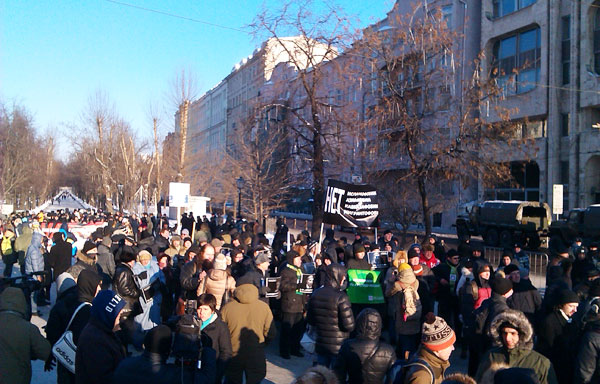 The event collected several hundred people
According to Cherkasov, all claims to the left are no different from the problems of the protest movement as such: “People grow up. The main thing is that it would be seriously. And all the problems of anti-fascists can also be projected to the protests of 2011-2012 and what happened on Taxim Square in Istanbul. ”