
Translated material
Pandora's box

The publishing house "Mann, Ivanov and Ferber" published the book of Paul Offit " Box of Pandora. Seven stories about how science can harm us ”(Translation by Tatyana Zavrub, Scientific editor Vadim Gladrev).
Paul Offit is a professor of pediatrics of a medical school of Perelman of the University of Pennsylvania and one of the creators of the vaccine against Rotavirus, he also heads the educational center for vaccination in the infectious department of the Philadelphia Children's Hospital. In his book, he included seven exciting stories about how famous scientists, including Nobel Prize laureates, promoted ideas that are dangerous for humanity. Drugs based on opium poppy, margarine, chemical weapons and synthetic fertilizers, the need to struggle for the purity of the race, lobotomy, the ban on DDT, vitamin C for the cure of cancer - these are the worst, according to the author, the “achievement” of science. Offit also touches on the urgent problem - the inability of scientific journals, the media and politicians to distinguish reasonable truth from lies - and offers methods that will help to avoid such mistakes in the future.
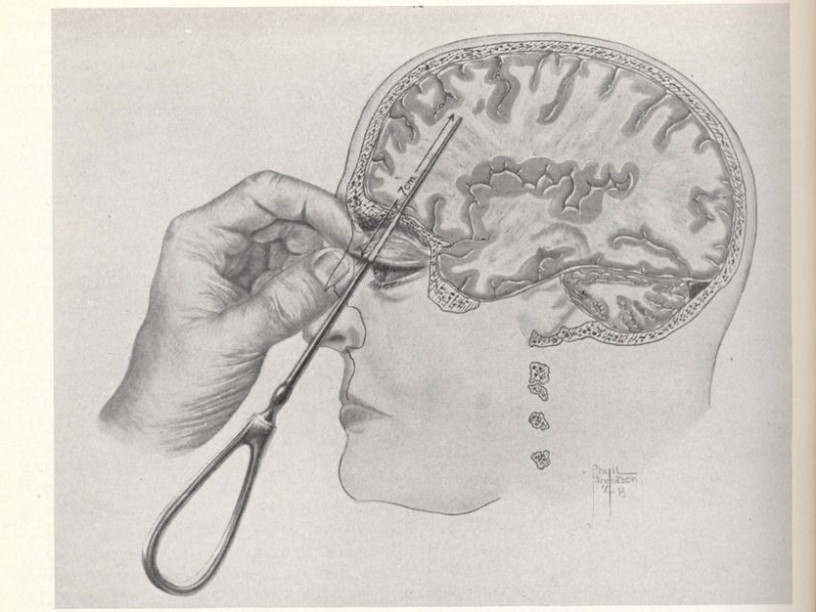
We offer for familiarization an excerpt from the chapter dedicated to the lobotomy, proposed in 1935 by the Portuguese doctor Egash Munish operations for the treatment of mental disorders. It consisted in cutting the nerve fibers in the frontal lobe of the brain. Lobotomy became especially popular after the Second World War, when Egash Monish received the Nobel Prize, and the American doctor Walter Freeman proposed a technique that did not require opening the skull when only a small hole in the bones of the eye cavalry was made. In the 1950s, when it became obvious that the lobotomy entails serious neurological deviations in patients who had suffered it, this method had stopped using this method, but by that time, tens of thousands of people in different countries were transferred to the lobotomy.
In 1950, Freeman wrote the book “Psycho -Surgery”, where he outlined the results of several hundred Lobotomy operations. He concluded that his invention not only helped unload the state psychiatric hospitals of America, but also saved many of neurosis and anxiety. But if you carefully read this book, it becomes clear how low he established the bar of success.
The first few weeks after the lobotomy of almost all patients, the same symptoms were observed. At first they lay in bed, recalling wax figures. To avoid pressure sores, they were constantly turned over by nurses or family members. Patients were completely indifferent to everything that was happening; It seemed that nothing was worried at all. Worse, they ceased to behave decently. One well-educated woman went in a large way into the garbage bucket, taking him as a toilet. Others "continued to eat soup after they were sick, before the nurses managed to pick up plates from them." But for Freemen, the meaning was that almost all of these patients behaved much more calmly in the wards, and it became much easier to cope with them. According to him, he "created childhood with the help of an operation." About 25% of patients after the lobotomy did not leave this stage and remained in the hospital forever. Some again became uncontrollable, and they had to do the second and even third lobotomy.
Most patients who suffered lobotomy left the hospital and returned to families. But they lacked energy, they were lethargic and, according to Freeman, "lost their interest in themselves." My relatives had to wear and undress the patient. Moreover, such patients usually lost a sense of shame. They walked naked to the strangers, at dinner they took food from the plates from other people and sat in the bath “Like small children” for hours, spraying water. The operated ones became unheated, unrestrained and stupid; Nothing was taken seriously by them. They were lost if they were driving somewhere. One woman, previously carried away by reading Victorian novels, continued to read them, but could no longer remember what they were talking about. Freeman described these patients as "something between a home disabled person or a pet." Nevertheless, he came to the conclusion that, thanks to lobotomy, patients practically got rid of neurosis and anxiety.
Some patients, after lobotomy, could leave home and even work, but no longer at the level that it was before surgery. Professors served tables in a cafe; cashiers did not remember the numbers; Saleswriters were incorrectly considered the change. The musicians could still play, but their music became mechanical, "without a soul." Most of those who tried to return to work were fired.
In addition, unpleasant side effects were observed. The fears of James Watts were confirmed: three out of every hundred people were dying of a lobotomy made with a knife for Kolka Ice, due to uncontrolled hemorrhage after breaking the brain artery. The three out of each hundred and the constant incessant seizures were preserved. Many could not control the intestines or bladder.
The greatest indignation was caused by the fact that Freeman operated on children, eleven of whom were described in his book. One of them was only four years old. Two of the eleven died from hemorrhage in the brain.
As the lobotomy became more popular, many doctors criticized the procedure and called it “medical sadism”, “injury” or “partial euthanasia”. They believed that Freeman replaced one terrible disease of another. When John Fulton, a researcher from Yale University, who inspired Egash Monisha to conduct the first lobotomy for a person, heard that Freeman was using an ice knife in the operation, he said: “What kind of horrors I hear about how you do lobotomy directly in the office with a knife for Kolka ice? I was just in California and Minnesota and heard about it both there and there. Why not use a shotgun? It would be faster! "
Despite these protests, not a single professional, medical or ethical community, including the American Medical Association and the American Psychiatric Association, did not oppose lobotomy. Moreover, the media continued to misinform the public. In the newspapers across the country there were such headlines as “a surgeon’s knife returns sanity to the victims of nervous breakdowns”, “not more painfully than to remove the tooth” and “the magic of surgery: fifty violent maniacs again think sensibly.” In the newspaper American Weekly in 1946, a comic book was printed, where “shy, timid, small accountant, target for any office joker” after a lobotomy became “his own for everyone, a sociable shirt-party who could sell anything to anyone”, a kind of industry captain.
In 1941, in the Saturday Evening Post, the authorship of The New York Times Valdemar Kempffer appeared one of the most influential articles about the procedure called “how to turn the brain inside out”: “There should be at least 200 people with anxiety, persecution mania, affectionate ideas, indiscriminateness and indiscrimonity and indiscrimonity and indiscriminateness. The nervous tension that they literally cut out of the brain with a knife using a new operation. ” Walter Freeman later said that without the help of the press, Lobotomy would never have become so popular.
Walter Freeman, making a lobotomy with a knife for Kolka Ice, intended to remove the financial burden from state psychiatric institutions that arose due to the need to contain a large number of poor. But he also performed operations "rich and famous." Among those who were performed by this procedure were the sister of Tennessee Williams Rose-the heroine of the plays “Glass Menary” and “Suddenly, last summer”, as well as the mother of the guideline poet Allen Ginzberg. But the most famous victim of Freeman was Rosemary Kennedy - the daughter of Joseph and Rose Kennedy, Sister of US President John Kennedy, Prosecutor General Robert Kennedy and Senator Edward Kennedy.
Rosemary Kennedy had a developmental delay, and she lagged a lot behind the eight of the other brothers and sisters. In a family where they were so proud of physical and intellectual perfection, Rosemary caused awkwardness. But it was completely efficient. To Lobotomy, one went abroad, took part in races on yachts and, although not without effort, learned to read and write. When she was 15 years old, she wrote a letter to her father: "I would do anything, if only you were happy."
But as they grow older, the girl periodically had outbreaks of anger, she began to raise her voice and wave her hands. Now Rosemary Kennedy would put ZPR (delayed mental development) and treated with labor therapy and behavioral psychotherapy. But Joseph Kennedy believed that his daughter’s behavior is unbearable and could threaten the political future of himself and other children. He wanted Rosemary to be healthy, so he took her to the famous Boston neurosurgeon and asked to operate. He advised not to do this. He argued that insignificant mental retardation is not an indication for lobotomy. Then Kennedy found Walter Freeman, who revealed in Rosemary "depression, accompanied by anxiety and increased psychomotor activity." Freeman convinced Joseph that his daughter could cure. And he did not tell his wife about his plans.
In November 1941, Walter Freeman spent a lobotomy of 23-year-old Rosemary Kennedy. He made two cuts on both sides of the Rosemary head, inserted a knife for lobotomy in them and asked her to count, sing songs, tell stories and list the names of months - so he judged how many parts of the brain could be removed. It was a way to determine the extent to which intellectual functions were preserved. But this time Freeman went too far. After he deleted the fourth, last section of the brain, rosemary became a physical and mental disabled person. The nurse, who was present at the operation, was so upset that she left the profession.
However, Joseph Kennedy did not lose optimism. His daughter was sent to a private psychiatric clinic Craig House in a suburbs of New York. The clinic occupied 154 hectares of hilly terrain, there was a pool, a golf, stables, a center for art classes and crafts, also worked there, a highly qualified medical personnel also worked. Staying in this clinic was worth recounting to modern money $ 250,000 a year. After several months of intensive therapy, Rosemary restored the ability to walk. But she did not read anymore, said only a few words, could not take care of herself and completely lost her memory, without remembering either friends or family.
Rose Kennedy, who periodically sent her children long letters with stories about family affairs, never mentioned the eldest daughter and have never visited her in 20 years. Joseph Kennedy later transferred Rosemary to the Saint Colletta school for children with deviations and also did not visit it in the last 25 years of his life. In fact, the only person who had a rosemary was her brother John; He went to her privately, when in 1958 his election headquarters made a stop in Wisconsin. In 2005, Rosemary died. Rose Kennedy later wrote: "Rosemary was the first of the tragedies that have suffered us."