
Translated material
The rhythm of the universe

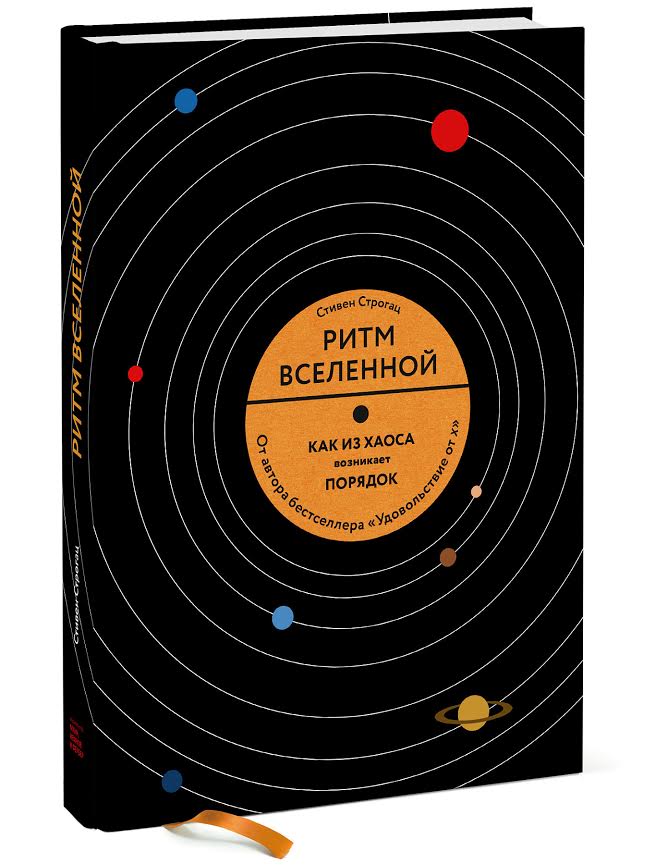
The book of a professor of mathematics of Cornell University, a specialist in synchronization of the dynamic systems of Stephen Henry Strogatz “The Rhythm of the Universe. As an order arises from chaos, ”describes how spontaneous streamlining of rhythms in nature occurs. The author affects a wide range of scientific and mathematical issues, but pays the main attention to the synchronization phenomenon, which is observed in the glow of fireflies, rhythmic beating of hearts, the movement of planets and asteroids. Thanks to the kind permission of the Mann, Ivanov and Ferber publishing house, we publish an excerpt from the first chapter of this book. The completely Russian translation of Stephen Strogets will be published in late June.
Strogatz, Stephen
The rhythm of the universe. How order arises from chaos /Per. from English. I. Verigin; [Scientific. Ed. A. Minko]. - M .: Mann, Ivanov and Ferber, 2017.
Firefly and inevitability of synchronism
“About twenty years ago I saw - either it seemed to me that I saw - synchronous, or simultaneous, flickering of fireflies. I could not believe my eyes, since the possibility of such a phenomenon among insects undoubtedly contradicts any laws of nature ”1.
Philip Loren published these words in the journal Science back in 1917, when he joined the discussion about this inexplicable phenomenon. For three hundred years, Western travelers who visited Southeast Asia told legends about tremendous clusters on the banks of the Svetlyachkov rivers (the length of these accumulations reached several miles) flickering in unison2. These stories about synchronously flickering fireflies, often set out in a very romantic style, characteristic of authors of books about traveling to distant countries, caused skepticism among many readers. Is it possible that thousands of fireflies coordinate their flicker with such high accuracy and in such a vast space? Then Philip Loren was sure that he managed to resolve this riddle: the cause of this obvious phenomenon, in his opinion, was the involuntary movements of the eyelid of the observer, that is, their sudden closing and opening, and insects had nothing to do with it.
Between 1915 and 1935. Science magazine published another 20 articles on this mysterious form of mass synchronism. Some of the scientists interpreted this phenomenon as an accidental, fleeting coincidence. Others explained this with unusual atmospheric conditions: a combination of very high humidity, absolute calm or darkness. Someone believed that there was no one “conductor” 4-a firefly that leads the actions of all the other brothers. As George Hudson wrote in 1918, “if it is necessary for a group of people to perform certain actions, obeying a given rhythm, then this group of people should not only have a leader, but they must be trained to fulfill the instructions of this leader ... Can this insect have a more perfect sense of rhythm than our own?” Naturalist Hugh Smith, who lived in Thailand from 1923 to 1934. And he repeatedly observed this phenomenon, with irritation noted that “some of the published explanations make a greater impression than the very described phenomenon” 5. However, he admitted that he was not able to offer any more convincing version.
For several decades, no one could formulate a rather plausible theory that would shed light on this mysterious phenomenon. Only in 1961, Joy Adamson, in the continuation of his story, Born Free (“Born Free”) was surprised at the same phenomenon that she observed on the African continent6 (by the way, her description of the synchronous flickering of fireflies on the African continent is the first).
... A strip of light about ten feet wide, formed by thousands of thousands of fireflies, a green phosphorescent glow of which creates an amazing cover on a high, waist, grass ... a fluorescent strip created by these tiny organisms, flashes and extinguishes with a synchronism striking in its accuracy. It remains only to be surprised at what means of communication these tiny creatures should have so that they can coordinate their flicker as if they are controlled by a certain mechanical device.
By the end of the 1960s, a certain picture began to loom from individual fragments of this puzzle. One of the tips was so obvious that almost no one paid attention to her. Synchronous fireflies flickered not only in unison - they flickered in a certain rhythm, at a constant pace. Even when they were isolated from each other, they continued to flicker synchronously. From this it follows that each insect should have its own means of determining the course of time, a kind of internal clock mechanism. This hypothetical oscillator is still not anatomically defined, but almost certainly it should be a certain cluster of neurons, located somewhere in the tiny brain of the insect. In many ways, a similar depositor of rhythm in the human heart, this oscillator acts at a certain frequency, developing the electrical signals of the rhythm, which enter the light element of the firefly7 and lead to its periodic operation (“inclusion”).
The second hint is contained in the work of the biologist John Buck, who did more than anyone else to ensure the scientific reliability of research trying to explain the synchronism of the actions of fireflies. In the mid-1960s, John Bak, together with his wife, Elizabeth went to Thailand for the first time in the hope of seeing this mysterious phenomenon with his own eyes. During an informal but very useful experiment, the spouses caught many fireflies on the banks of rivers in the vicinity of Bangkok and released them in their hotel room, having previously darkened it8. Insects behaved very nervously, but then gradually spread along the walls and ceiling, being from each other at a distance of at least 10 centimeters. At first they flickered in a differently. Soon the wife of the tank, in a silent surprise, watching fireflies, noticed that at first the couple, and then the three fireflies began to flicker in unison. The groups of synchronously flickering fireflies became more and more.
From these observations it followed that the fireflies should somehow “configure” their rhythms in response to the flickering of other fireflies. In order to directly test this hypothesis, the tank and his colleagues subsequently conducted laboratory research9, during which they created a flicker for the firefly with artificial light (thus imitating the glow of another firefly) and observed his reaction. They found that a single firefly -taken adjusting the moments of their subsequent flickering in a very definite, predictable way and that the value and direction of such a correction depends on the moment of the cycle an external impact was perceived. In some types of fireflies, the external effect always shifted the rhythm of the experimental fireflower a little forward, as if translating the arrows of his inner clock, while other types of fireflies external impact shifted the rhythm of an experimental firefly or slightly forward, or slightly back, depending on how much the experimental firefly was close to blinking (one thing was literally on the verge of the next blinking, and if we were on the verge of the next blink He was only halfway to the next blinking).
Taken together, these two hints suggested that the rhythm of flicker is regulated by the internal, reconfigured oscillator10. And this directly indicated the possible existence of a certain synchronization mechanism: each of the members of the community of flickering fireflies continuously sends and accepts signals, shifting the rhythms of other fireflies and shifting their own rhythm as a result of exposure from them. Of the entire aggregate of such mutual influence, synchronism somehow spontaneously arises.
Thus, we come to an explanation that seemed unthinkable only a few decades ago: fireflies organize themselves. They do not need a conductor, and the weather does not matter to them. Synchronism arises due to the interchange of signals - just like the participants of the orchestra can achieve the perfect synchronism of their actions without the help of the conductor. True, in the case of fireflies of researchers, the fact that this insect does not require intelligence is not at an impasse that intelligence is not required. They have all the ingredients necessary for this: each firefly has an oscillator, something like a small metronome, the modifications of the signal development of which are automatically adjusted in response to the flickering of other fireflies. That, in fact, is all.
With one exception: it is by no means obvious that this scenario is working. Can ideal synchronism arise from the cacophony of many thousands of metronome deprived of the mind? In 1989, together with my colleague, Renny Mirono proved the correctness of such an answer. The described script is not only working - it will certainly be operational under certain conditions.
1. Philip Laurent, “The Supposed Synchronal Flashing of Fireflies,“ Science 45 (1917), p. 44.
2. One of the first references is found in the flight journal of the expedition of Sir Francis Drake in 1577: “Our general visited a small island south of the target (healing, now Sulawesi, is an island in Indonesia. - Approx. Transl. ) Covered by impassable thickets. Every night, the whole earth among these thickets themselves and the thickets are dotted with a huge set of insects (the size of no more than an ordinary fly), glowing in darkness. They emit such a strong light that each bush or tree becomes like a glowing candle ”[R. Hatduyt, 1589. A Selection of the Principal Voyages, Traffiques and Discoveries of the English Nation . Edited by Laurence Irving (New York; Knopf, 1926), p. 151]. The synchronous aspect of this glow was described much more than in 1680 by the Dutch physicist Engelbert Kampfer after his trip along the Maith River, from Bangkok to the sea: “These luminous insects, having cried on trees, give the impression of a fiery cloud. The most amazing, however, is that, having squinted on the branches of the tree, they all suddenly go out simultaneously, and after a second or two, they also lightly light up. And such friendly and rhythmic flickering can last hours, as if we are observing an endless alternation of systole and diastole. ” [Engeeibert Kaempfer, 1727. The History of Japan (with a Description of the Kingdom of Siam) . Transladed by Jg Scheuchzer. London: Hans Sloane. Two volumes in one. See Volume 1, p. 45, or pp. 78–79 volumes 1 of the second edition of 1906, made by J. Mclehose and Sons, Glasgow.]
3. Many of them are quoted in the article by John B. Buck, “Synchronous Rhythmic Flashing of Fireflies,“ Quarterly Review of Biology 13 (1938), PP. 301–314. This article is the best of the directories in the early literature in which this issue is highlighted.
4. George H. Hudson, “Concented Flashing of Fireflies,“ Science 48 (1918), PP. 573–575.
5. Hugh M. Smith, “Synchronous Flashing of Fireflies,“ Science 82 (1935), PP. 151–152. In this brief confidence in the article, Smith also gives one of the most detailed descriptions of this phenomenon: “Imagine a tree from thirty -five to forty feet, tightly covered with small oval leaves, and on each sheet it sits perfectly in unison with a frequency of about three times in two seconds, and in the interval between the outbreaks, the tree is in complete darkness. Imagine the river bank with a length of about a tenth of a mile, densely overgrown with a mangrove forest. On each sheet of each tree in this forest, fireflies are strictly synchronously lit and go out. Insects on trees growing at the far end of this forest flicker perfectly in unison with fireflies that dotted the trees closer to you. If you have a rich imagination, then you can make some idea of this delightful and bewitching sight. ”
6. Joy Adamson, Living Free (London: Collins and Harvill, 1961). Quote from p. 29.
7. Additional information about biochemical processes that determine the rhythm of flicker can be gleaned in the article by Barry A. Trimmer et al., “Nitric Oxide and the Control of Firefly Flatinging,“ Science 292 (2001), PP. 2486–2488.
8. John Buck and Elisabeth Buck, “Mechanism of Rhythmic Synchronous Flashing of Fireflies,“ Science 159 (1968), PP. 1319–1327.
9. Frank E. Hanson, James F. Case, Elisabeth Buck, and John Buck, “Synchrony and Flash Entrainment in ain Guinea Firefly,“ Science 174 (1971), PP. 161-164. The popular presentation of this and other related works can be found in the article by John Buck and Elisabeth Buck, “Synchronous Fireflies,“ Scientific American 234 (May 1976), PP. 74–85.
10. The idea of a reconfigured oscillator is discussed in detail in the article by John Buck, “Synchronous Rhythmic Flashing of Fireflies. II,“ Quarterly Revtew of Biology 63 (1988), PP. 265–289, which appeared in the same journal and under the same name exactly 50 years after his first review of the literature on this issue was published. This second review is still an exhaustive selection of everything that is known to the science of synchronization of fireflies.