
Translated material
"I am very omnivorous"
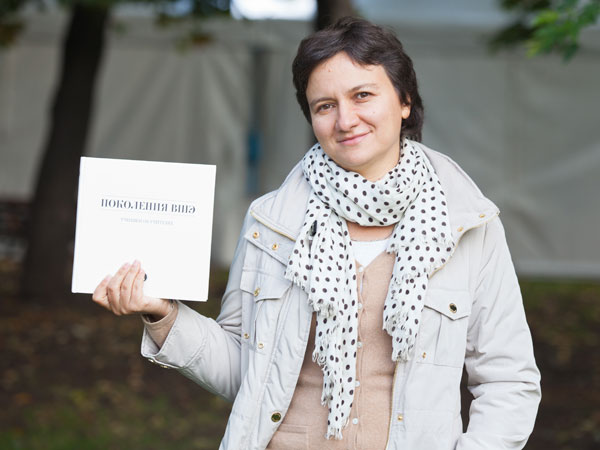
Interviews about books with Maria Yudkevich , candidate of economic sciences, assistant professor, vice -rector of the Higher School of Economics, director of the Institute of Institutional Research of the Higher Superior, Head. Laboratory of Institutional Analysis of Economic Reforms. Talked by Natalia Demina .
Do you remember at what age you started reading?
I started reading myself late at 6 years old. It happened when my grandmother read the “Wizard of the Emerald City” aloud to me, and somehow she had a lot of things, was Friday, she was engaged in washing, baked a pie, and I could not wait for her to read. And suddenly it turned out that I could not only turn the pages, but also understand what has been written. So my first book, which I read on my own, was the "Wizard of the Emerald City."
When one of my parents noticed that I was not just turning on the pages, but I read, they gave me the newspaper Pravda, they said “read!”. When we were convinced that I could read what is written on the first page of Pravda, my parents exclaimed: "Yes, who taught the child?" But somehow, by the age of 6, it itself arose. Since then, I am a supporter of the theory that the later the child begins to read, the more he reads, because he does not have the feeling that this is something that was forced to do.
Were there any books that influenced the choice of a profession?
Books that would affect what I will do, definitely not. All popular science books that I read in childhood concerned either mathematics or books like “hunters for microbes”, such biological, physical, geographical, etc. However, it seems to me that I went to study at the Mehmat Moscow State University completely not because of the books about mathematics.
I never had the feeling that what I read was what I would like to do. Of course, if they told me that I would be engaged in the economy, I would make fun of such a person.
Did your family write out popular science magazines?
It is difficult for me to say what should be attributed to the popular science, but the first magazine that I personally wrote to me was the magazine “Young Artist”. I still remember his cover, because this magazine in the early 80s went out on glossy paper with amazing reproductions of paintings that hung in Prado, Louvre, Vienna.
Now, coming to some museums, I see these paintings and remember how I read about them in childhood. In addition, we, of course, wrote out a “quant”, which I read from 6th grade to 1st year. And every year, the sphere of interests, things that I read in Kwant, moved from some headings, from some pages to another.
And, perhaps, the story that I remembered most from Kvant was the story of Ray Bradbury, which was printed in the first issue of the magazine that my parents wrote to me in the mid-80s, it was called “Rquet” about a boy who dreams of becoming a captain of interplanetary ships. Perhaps this story, as the idea of choosing a profession, made a great impression on me. I then tried to find it for a long time, and found it only when everything appeared on the Internet, because it was some kind of rare, and it was not in the collections.
We also wrote out a “young naturalist” and several regional magazines that were masked under scientific and technical, but in fact printed fiction that would probably not allow the regional publications to print thick art magazines. I no longer remember their names, but I remember that these were some Ural magazines, magazines published closer to Siberia, they seemed to have passed as scientific and technical, but we did not write them out for this.
What are you reading now? What have you read over the past 2 years, what can you recommend?
I read quite a lot, in this sense I am very omnivorous, so it rarely happens to me that I read some book, and it made a crazy impression on me. But if we talk about the discoveries of writers or books, then for me this year was, of course, Salman Rushdi.
For some reason, it was always stern that Salman Rushdi was a writer who became famous for his political book. Somehow accidentally reading one of his books, in my opinion, it was a “farewell sigh of the Moor”, I realized that this was a completely brilliant writer. Of course, they will not give him the Nobel Prize because of all these political events, but he is a very bright figure.
The second writer, who was the discovery of this year for me, is Paul Benjamin Auter, his books also impressed me, they are published quite a lot in the USA and Great Britain.
Do you manage to go to the cinema, theater? Can you recommend a cultural plan?
Cinema and theater are not my genre, because, unlike the book, when you watch a movie or sit in the theater, you are forced to live in the logic and at the speed that you are offered outside. It’s hard for me, which is why I like to read so much, and much less - watch a movie that you always want to squeeze back or backward.
Thanks for the interview.