
Translated material
Without protection

In Russia, they can introduce the procedure for assigning a degree without defense of the dissertation. Such a proposal is contained in the bill on scientific and innovative activities prepared by the Ministry of Education and Science. The document was discussed on April 26 at a closed meeting of the Expert Council under the State Duma Committee on Education and Science.
The essence of one of the proposals included in the document was told by the head of the Department of Science and Technology of the Ministry of Education and Science of Russia Sergey Matveev. According to him, the department considered it necessary to simplify the procedure for obtaining academic degrees.
“An active and effective researcher who really works receives scientific results, publishes them or receives patents, forms a scientific team - such people simply need to“ unload ”from unnecessary formalities, simplify the procedure for publicly recognizing their qualifications. Therefore, a fairly simple solution has been proposed - by the totality of work, ”his statement quotes the TASS news agency.
 A Research Institute of Research Institute resting after a working day
The idea to introduce in Russia a similar system of assigning scientific degrees does not seem reasonable. This opinion was expressed by Polit.ru Alexander Vasilieva, candidate of historical sciences, a specialist in the history of Siberia, a teacher of historical and legal sciences.
“Is the abolition of now existing procedures for assigning scientific degrees in Russia? In my opinion, no.
Firstly, we will immediately make a reservation: the existing procedure in the form of defense of the dissertation, that is, a whole scientific work, which has a certain degree of novelty and significance is a traditional procedure for most modern states. Variations are possible within the framework of this system, but it is unlikely that it will immediately be possible to recall whether there are states in which some scientific work is not required to obtain scientific degrees. Thus, the assignment of a scientific degree is carried out everywhere as a result of a full -time, open, worked out procedure for evaluating research skills and the achievements of a young applicant by the existing scientific community in the person of a certain commission of scientists with sufficient authority and qualifications for such an assessment.
Secondly, in the European scientific space for a long time, for centuries, a certain procedure for assessing the quality of scientific research has developed by determining the degree of its demand in scientific communities (assessing the number of appeals to scientific work), which is now simplified as “citation index”. This is a certain technique with its advantages and disadvantages, and due to the presence of these shortcomings, the world scientific community, as a rule, does not find it possible to appropriate scientific titles solely on the fact of a high citation index, for example.
Now let's return to the situation in modern Russia. It is proposed to cancel the procedure for defending the dissertation as the procedure for assigning scientific degrees, and as an alternative - to assign a scientific degree in a certain fact of the "contribution to the development of science" through the system for evaluating publications of a particular researcher. That is, in fact, it is proposed to assign scientific degree in accordance with the quantity and quality of publications.
There are a lot of questions, the first of which, of course, looks as follows: and who and by what criteria will evaluate? In fact, the experience of other states showed that the only more or less reliable methodology for assessing the “contribution to science” is the determination of the volume of citation of specific work.
On our soils, they have long been trying to introduce an assessment of the effectiveness of the activities of a particular scientist (first of all, a university teacher, of course) through determining the volume of publications and the same “citation index”. The process does not go.
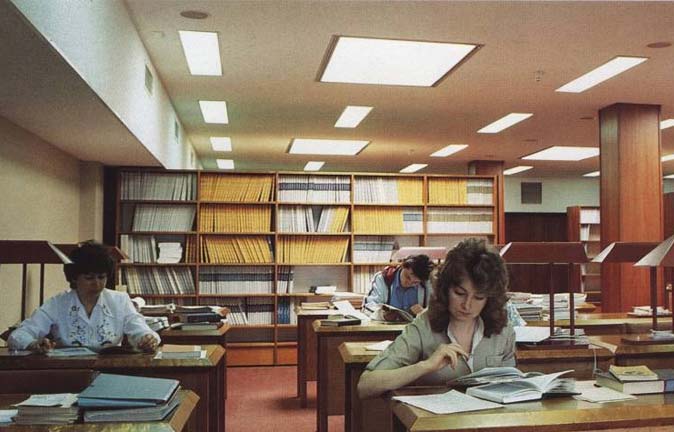 Scientific library of IBH RAS
The reason is simple: in the USSR a system of total control (and financing. Of course) the entire scientific sphere is exclusively from state sources. Magazines did not have to take care of their salesiness and profitability, universities - about "self -sufficiency". With such a system, magazines and other scientific publications could not think too much about the real practical and scientific significance of the published material, since they were not threatened by market factors of supply and demand. Any fairly competent and scientifically reliable studies were accepted for the publication, so it was quite easy for young researchers to gain the number of published articles necessary for admission to defend the dissertation.
But the USSR fell apart, some of the magazines simply ceased to exist, the other lost its support in full or partially. And the requirements for the number of publications (including the so-called "VAK-OV publications") not only did not disappear, but increased.
What happened next?
Crowds of researchers with their works lined up for publications in specific magazines specified in the VAC list. They were offered to be published in order of priority - in a year, two, five ... not everyone has the opportunity to wait, and magazines need a profit. So the demand and offer found each other: it is impatient to pay for publication (officially this is called a "contribution for the work of the editor and corrector"). The cost of such a "contribution" is now, from 8 to 16 thousand rubles (local level publications, publishing all kinds of "collections of articles", offers a young researcher to be published for symbolic 500-600 rubles, which are held by the category of "payment of the author’s copy"). But ... there is no publication - there is no protection. The circle is closed.
We are no longer about some real selection of the highest quality research-printed publications survive, applicants for scientific degrees want to protect themselves as soon as possible. It would be more likely to ask another question: are such painful, strained publications in general? Do they talk about the real research qualities of a particular applicant? And, by the way, is it worth it to be surprised that barely “defined” young researchers are in no hurry to continue to be published?
But this is only one "but".
The second is quoting in Russia. Since the time of the USSR, it is considered a good tone for a graduate student to quote its scientific director, and for colleagues - each other. Needless to say, the index of such "friendly" citation does not in any way indicate the scientific contribution of each specific study? I agree that most of the citation is still quite deserved and quite objective, but ... who and how will separate the lambs from the goats?
And the third is the recognition of the scientific achievements of Russian scientists in the international community. Obviously, to assign a specific scientific degree by the totality of publications, you will also need to take into account the demand for the ideas of the researcher not only in Russian, but also in world science. However, I think it’s no secret to anyone that Russian scientists are not very famous in the European scientific community. And this is not a matter of the quality of Russian research, but the issue of exclusively language barriers-a significant part of scientists still does not speak the languages of international communication at a level sufficient for publications abroad. Accordingly, the citation index of Russian research "there" is very low.
Summing up: no, at the moment, with an existing set of problems, the introduction of an alternative system for assigning scientific degrees is not only harmful, but also impossible. Or, as an option, it is possible only for those who are “more equal”, ”explained Alexandra Vasiliev.
We add that the bill, which was referred by Matveev, restrains a number of innovations that the deputy minister called "system decisions for the effective interaction of science, business, state." According to him, during the discussion at the expert advice, these proposals were appreciated highly.