
Translated material
A truce under fire
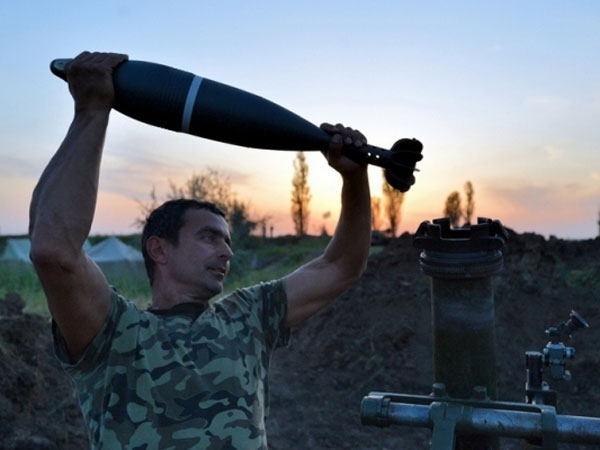
On Wednesday, June 25, the Federation Council canceled its own resolution of March 1, giving the President of the Russian Federation the right to use the Russian armed forces in Ukraine. This decision was supported by 153 senators, 1 was against. The decision entered into force immediately after the vote. The Federation Council considered the corresponding request of Vladimir Putin. The Russian president turned to the upper house of parliament in order to show that Russia believes in the truce and peaceful plan of Poroshenko - however, it turned out that not everyone believes in Ukraine.
The President sent an appeal to the upper house of the parliament “in order to normalize the situation and settlement of the situation in the eastern regions of Ukraine, as well as in connection with the beginning of tripartite negotiations,” said Dmitry Peskov, spokeswoman for the head of state.
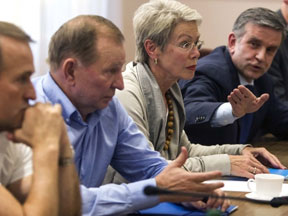 Negotiations in Donetsk. Photo: Mediaport.ua
Indeed, a group of negotiators , which includes the Second President of Ukraine Leonid Kuchma, Russian Ambassador to Kiev Mikhail Zurabov, representative of the current head of the OSCE Haydi Tagliwini and the Ukrainian politician Viktor Medvedchuk close to President Putin, on June 23 in Donetsk met with the leaders of the separatists and was able to agree on the ceasefire until Friday, June 27. Prior to this, the negotiators met with President Poroshenko, but little reporters know about the results of their conversation.
The fact that the official representative of Russia (ambassador), as well as Viktor Medvedchuk, Kum Putin and, as many believe, his confidant in Ukraine, allows the Kremlin to assure its Western partners that Moscow is doing everything possible to reconcile the warring parties and, thus, delay the introduction of another sanctions from the United States and countries of the European Union.
While in Vienna, Vladimir Putin approvingly spoke about the peaceful plan of Poroshenko, however, he was concerned about reporters that after reaching the agreement, the battle of Slavic began, which, of course, did not fit into the concept of a ceasefire. The President of Austria in response said that he was opposed to strengthening sanctions against Russia. However, Putin also promised to “protect ethnic Russians in Ukraine and those who consider themselves part of the widespread Russian world” - how the defense will be organized, the head of state did not specify.
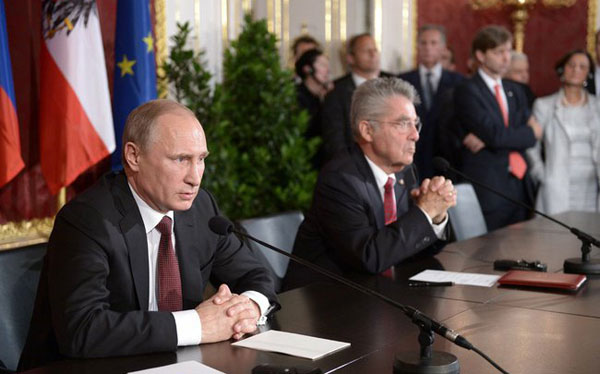 Vladimir Putin and Hinz Fisher. Photo: kremlin.ru
In turn, the Federation Council is confident that on March 1, the sanction for the use of the Armed Forces in Ukraine was given due to the presence of a threat to Russians located in the Crimea and Sevastopol. In any case, Viktor Ozerov, chairman of the defense department, stated this. Today, such a threat, itself, is not, since Crimea is already part of Russia.
Be that as it may, negotiations, although they went through intermediaries, really became an important stage in the conflict in the southeast of Ukraine: for the first time, the Kyiv authorities and separatists were able to reach at least some agreements, namely the ceasefire for several days.
However, on June 24, the first reports were received that the ceasefire was not respected. If anyone could arrange a detonation of the railway canvas, even a loner, then near Slavyansk, apparently, the truce was really broken. True, no one except Vladimir Putin, however, did not report on the battle, but the separatists with the help of MANPADS managed to bring down a helicopter of Ukrainian forces.
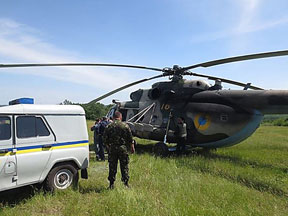
Mi-8 was shot down near Slavyansky on Tuesday evening, nine people died. The head of the informing group in eastern Ukraine Vladislav Seleznev wrote in his Facebook that “there were specialists who installed equipment on board the helicopter in order to organize space monitoring, fixing the violation of the plan of peaceful resolution of the conflict in eastern Ukraine. On board the helicopter were nine people. ” Among the dead were, among other things, the SBU officers.
The Ukrainian authorities have previously stated that the separatists do not comply with the conditions of a truce. The day before, President Petro Poroshenko said that more than 30 facts of violation of the ceasefire were recorded during the period of the announcement of the ceasefire by the leadership of the Donetsk and Lugansk republics.
At a meeting with Germany Foreign Minister Frank-Valter Steinmeier, who took place on June 25, Poroshenko told him about new incidents. According to the head of state, during the night eight cases were recorded, as a result of which one soldier died and seven were injured.
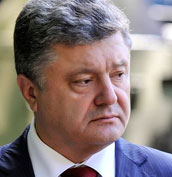 Petro Poroshenko
 has already threatened the abolition of the ceasefire, if the separatists continue to conduct military operations, despite the truce.
Today, RBC has published an article that Russian public organizations are not going to stop assistance to separatists and, moreover, send volunteers to the southeast of Ukraine. Journalists found that anyone can go to fight on the Donbass, having passed the monthly course of the young fighter in one of the three camps-in the suburbs, Rostov-on-Don or immediately in Slavyansk.
However, even the decision of the Federation Council on the recall of the mandate to use the armed forces in Ukraine will not deprive the president of the opportunity to give an order to use the army. The fact is that after the war in Georgia in 2008, when Dmitry Medvedev was forced to use the army without the sanction of the Federation Council, the upper house in 2009 gave unlimited permission to the Supreme Commander for the “operational use of the armed forces abroad”. Then it was assumed that this permission was given in case, for example, a nuclear-nuclear attack on the country or other extraordinary cases, but nothing prevents the president of the country from using it to enter troops into Ukraine in order to “protect the Russian population”.
Nevertheless, the beginning of negotiations, overshadowed by mutual accusations and a knocked helicopter is an important indicator, and European politicians are very interested in the continuation of the dialogue that do not spare the growth of the armed conflict at their side. As practice has shown, the opinion of Europe and the United States is interested not only in Ukraine, but also by Russia, since Vladimir Putin talks about negotiations between Barack Obama, and also boasts of their results in Vienna.