
Translated material
The latter


The latter in 1944 in the Chechen village of Khaibakh NKVD burned 705 people alive, among whom were two newborn twins. In 1995, the tragedy repeated in the Samashki - people died in the fire of Napalm. Journalist Marat Khairullin in 2003 visited Chechnya. He met eyewitnesses of tragic events there. They retained the memory of those terrible trials that fell to the share of the Chechen people. The journalist was amazed that these people did not think about revenge. 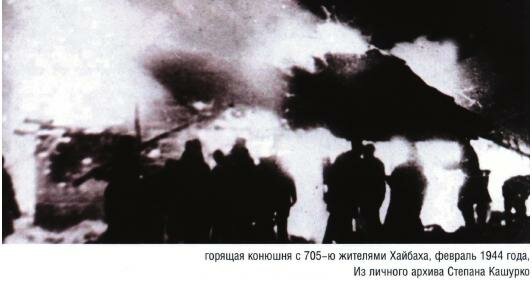 Haybach HaybachOn February 23, 1944, the NKVD troops surrounded the central estate of the Beria collective farm, drove the remaining residents of the surrounding schools in the new barn and set on fire. The deportation that began on February 21 ended. 478 thousand people were immersed in 180 echelons and sent to Kazakhstan. Why burn several hundred old people, children, women? The chroniclers of this Chechen Khatyn emphasize that they burned precisely the weak - sick, pregnant, minors, with the transportation of which there could be problems. But why weren't people from other mountainous areas brutally destroyed? Probably, we can say that the motives are no longer important in crimes of this scale. Some Chechens, answering this question, often begin to say that the Noshkhinsky district was the center of the Gorsky ethnic group. In Haibakh, the holy utensils were once stored, testifying to the ancestors of the Chechens. That is, burning in their presentation was a symbolic act, an attempt to destroy the heart of the people, a source of resistance. The historian Sergei Kara-Murza in one of the notes hints at more prosaic and at the same time more complex problems. The order of reprisal was given by the general with the Georgian surname. And after deportation, the district was transferred to Georgia, returned many years later. Today it also does not seem very convincing, so I don’t know ... Then this story received a sequel, the general subsequently related with Kosygin, and already in his nineties, a deep old man, tried to steal in order to judge in Grozny. Judge, punish, take revenge? But could the retribution, which befell the alleged executioner in fifty years, quench the thirst for redemption? Do Chechens need this atonement? And if so, what should it be? What does this need to be returned to their souls so that this desperate, irreconcilable spiritual confrontation of the two peoples ceases, the imprint of which has become a completely meaningless war? In the large village of Roshni-Chu, I stumbled upon this elusive-in-off, which became a new line, in which the understanding of this people and this war broke out ... The winter of 1944 was warm and snowless. Roads to the mountains opened in early February - an incredible case for these places. Such winters are waiting for a hungry summer. And the official Caucasian old people in the villages probably discussed a lot of this anxious sign on their gatherings. Today, 65 years later, Caucasian men are more often silent. Women say to them. On February 27, 1944, 13-year-old Leah, her younger brother and father were in the forest when a column of smoke rose above the village. Neither before nor after Leah saw such black and oily smoke. Just as I could not remember whether there was still the same clear blue sky in her life. When it got dark, my father left for Haibakh. They buried people for three nights. In general graves. First, those who could be identified, acquaintances and relatives. Then, when there was no strength to dig, they collected the charred remains under a rock and leaned with a large stone ... The bones crunched, and this sound father could not forget all his life ... He told almost nothing more about those days. When his father returned, Leah went to the village. It was necessary to take at least something from the utensils and food. She saw the corpse of Russian in military uniform right away - he lay in the middle of the street, a little on her side, stretching his arms forward. Other eyewitnesses told him. Probably, the soldier could not stand it and shot himself. He was abandoned. Leah buried Russian: dragged from the road to the ditch and sprinkled, as she could, with earth. “In his hand I found this cross,” says Chechenka and shows him: copper, touched by malachite herbs, with some curls. Then she recalls how, after the burning of Haibakh, she lived in the mountains for several months until she was caught with other fugitives and sent to Kazakhstan. She grew up, returned to Chechnya, worked on a collective farm. I gave birth to five children. And all these years she kept a cross. The only thing that remains of an unknown kid, who accepted the common guilt for his deed with his Christian heart. She carried away from the ashes not hatred, not thirsty for revenge, not the requirement of atonement and retaliation. She took this small cross. Which of these two was a saint? Samashki 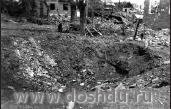 From Roshni, we went to Samashki. Today this village is a special place in the recent history of Chechens, almost a symbol and, perhaps, a monument included in the historical axis of the confrontation of the two peoples. Once founded as a Cossack village, the village after the return of exiles from Kazakhstan began to slowly but steadily turn into a purely generous enclave in the middle of a multinational Chechen-Ingushetia. Some streets already in those days bore a double name - the official Soviet and folk. From Roshni, we went to Samashki. Today this village is a special place in the recent history of Chechens, almost a symbol and, perhaps, a monument included in the historical axis of the confrontation of the two peoples. Once founded as a Cossack village, the village after the return of exiles from Kazakhstan began to slowly but steadily turn into a purely generous enclave in the middle of a multinational Chechen-Ingushetia. Some streets already in those days bore a double name - the official Soviet and folk.This happened with the streets of Stepnaya and Sharipov, which are often called Noshkhinsky. The highlanders were not allowed to settle in the area given to the neighboring republic. And immigrants from Haibaha founded streets in Samashkakh, along which in April 1995 a peculiar front line of the front crawled between federal troops and Chechens. Then there were practically no fights - on April 7, 1995, about four hundred soldiers of riot police, with the support of the landing regiment, entered the village for stripping. Inorganized and fragmented resistance was provided in only two to three regions of the village. Including on Novikhinsky streets. Resistance, which, nevertheless, costs six dozen riot police and paratroopers. It is not known what exactly caused the reason, but the fact remains: it was on the Neshkhin streets that the “cleaners” used flameters and several people burned alive. Among whom was a ninety -year -old old man ... Eyewitnesses 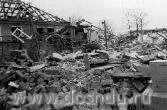 Abdurakhman drives us around the yards. His father is an eyewitness to Haibakh, and now an eyewitness to Samashk. The old man is far over 80. He is sick and already speaks with difficulty. Yes, apparently, he remembers little. But another witness, his peer and krino Salman, willingly tells everything. And about the deportation, and about April 1995. He leads us in the yard and shows the place where they burned his wife, daughter, son -in -law. Now he is calm, smiles and even jokes. I recall the 1995 television portage, when the same Salman, standing at a smoked bed with a saucepan in his hands, shouted something to the operator who shot him. His wife lay on the bed. The fire literally welded the remains to the grid, and the old man, breaking off in pieces, collected them in a saucepan. Abdurakhman drives us around the yards. His father is an eyewitness to Haibakh, and now an eyewitness to Samashk. The old man is far over 80. He is sick and already speaks with difficulty. Yes, apparently, he remembers little. But another witness, his peer and krino Salman, willingly tells everything. And about the deportation, and about April 1995. He leads us in the yard and shows the place where they burned his wife, daughter, son -in -law. Now he is calm, smiles and even jokes. I recall the 1995 television portage, when the same Salman, standing at a smoked bed with a saucepan in his hands, shouted something to the operator who shot him. His wife lay on the bed. The fire literally welded the remains to the grid, and the old man, breaking off in pieces, collected them in a saucepan.Now he again tells the video camera about the events of those years. Probably for the time. And then, in 1995, the events in the Samashki received publicity around the world. So broad that the State Duma took up the investigation. The fact is unique. The deputy and director Govorukhin came and walked around the destroyed yards. Then the human rights activists from the Memorial tried to restore their picture of events. The conclusions of human rights defenders did not in many ways agree with the conclusions of the parliamentary commission of Govorukhin. Ichkeria Internet sites still claim that in two days at least seven hundred people died in the village. Isn't it symbolic that people who buried the Beria in Haibakh burned in the stable of the collective farm also talk about sevenists of more killed? .. Color photo I was in Samashki in April 1995. Then we worked for weeks in Chechnya, first on the bus of the Ministry of Emergencies, then on the Peretnaya. I well remember how on Sunday I ended up in this unfortunate village. There, several filming groups of foreigners walked around the broken yards, and people who still believed that journalists could change something, said and said. We also went, recorded in notebooks, photographed. It was then that the woman in black came up to us: “There is a soldier there, already dead ...” She took us to the village, where in the bushes on the sidelines of the dusty country lay a blond boy. - He was dropped his own from the armored personnel carrier. There was still a living day, he has nothing ... She carried shovels and two fertilizer bags. The boy, like a beast, crawled to die under the very roots of prickly shrubs, and we literally had to tear his twisted body from there. He really had nothing, even a medallion. We covered it with bags and buried it in a shallow grave in the same way in the roadside ditch. At dinner late at night I gave a woman in a black photograph. I don’t even know why. This photo was given to me by a Russian girl in Nazran. She put me a photo in the window of the car and asked: "You will find, call ..." A few years later, passing by the Samushka, I saw on the sidelines either a semblance of a cross, or just a crooked stick with some kind of color lump in the middle. This was a photograph of the Russian guy, which was given to me by a girl from Nazran. The one that I handed over to a woman in black from the village of Samashka. n Moscow-Grozo-Hohi-Chu-Roshni-Chu-Samashka. Photo by Baudi Zubayraev |