
Translated material
Generation of Putin
On January 25, 2024, Doxa was recognized as an “unwanted organization”.
If you are in Russia or plan to return to it, you can not replace our materials on social networks, refer to them and publish quotes.
Read more about what is possible and impossible, read in the cards .
On May 7, the 20th anniversary of the first inauguration of Vladimir Putin turned out. Young people who have grown over the past two decades are often called the "Putin generation." We studied the latest sociological work about young people in Russia and talked with experts about what views Russian millennials adhere to, how they participate in public life and what they expect from the future.

Illustrator
Illustrator
Sasha BulyakovaPublication
August 12, 2021
Is it possible to trust the theories of generations?
The theory of generations began to develop in Germany in the 1920s, one of its founders was Karl Mannheim. According to the works of a sociologist, each generation is formed under the influence of certain historical circumstances, and its representatives have some spatio-temporal unity. This concept became especially popular in the 1990s, when the Generations and Fourth Transition were published in the USA, historian William Strauss and Economist Neil Hoove-it was they who were the first to use the concepts of “Baby-Bumomers”, “Millennials” and “Generation ZA”. According to the theory of American researchers, a new generation arises about once every 15-20 years, and it can be identified according to three criteria: representatives of one generation share the historical era and face the same social phenomena, being on the same life phases; Also, they share the common values and models of behavior; And finally, they have a sense of belonging to this generation.
The spread of this concept was the reason for all kinds of speculation, which marketers often attributed certain models of behavior actively to use. In most cases, this does not find confirmation by sociological data. According to Jessica Kriegel, specialist in organizational development and the author of a number of critical articles about the theory of generations related to such concepts, stereotypes create myths that prevent people from realizing themselves. She believes that a person’s assessment of his belonging to one or another generation is no different from racial, religious or gender discrimination. Critics of the theory of generations draw attention to the fact that the formation of a person is much more dependent on his upbringing and the social environment in which he grew up - therefore, he can have much more common features with older and younger relatives than with peers formed in other conditions.
“It’s not important to age, but what young people say. They do not put forward slogans that would allocate them into a special group "
In Russia, generations and, in particular, the special political activity of youth began to actively talk after the protest actions of 2017-2019, one of the main organizers of which was Alexei Navalny. Journalists and publicists often said that the core of the protesters was youth and even schoolchildren, and the State Duma deputies tried to ban the minors to participate in rallies. Nevertheless, the point of view of the prevailing role of adolescents in protest promotions often does not withstand criticism with empirical data. For example, according to the “White Counter”, most of the participants in the Moscow protests in 2019 were citizens aged 25 to 35 years, and the younger people were, although notable, but far from the most numerous group.
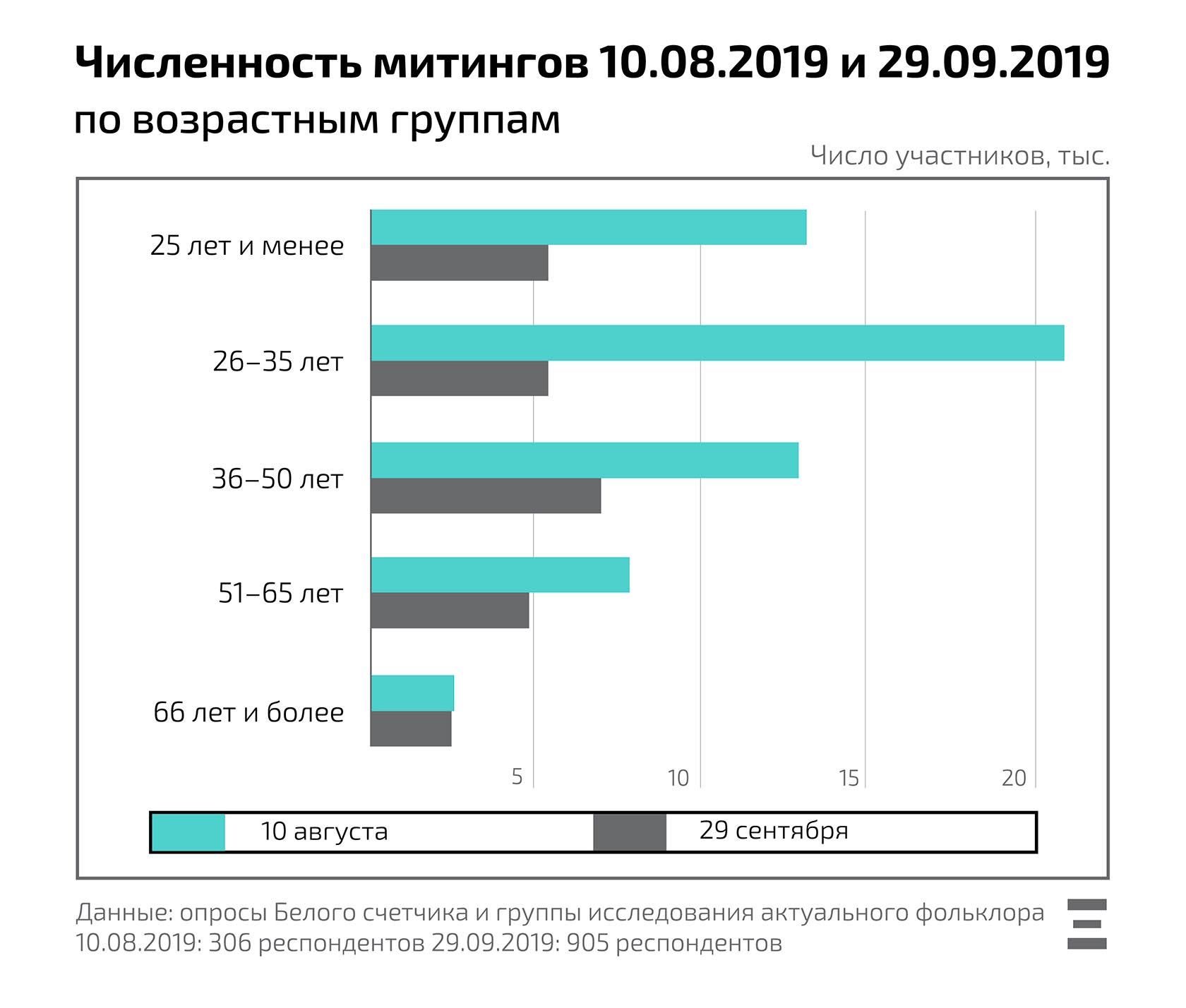
Source: Lecture of Catherine Schulman to ZIL “Change of generations: who makes modern politics - young or the elders?” [1]
In 2019, the Nemtsov Foundation Further - FN prepared the study "The image of the future with the eyes of youth: inequality and mobility." Within its framework, a number of deep interviews of students of secondary specialized educational institutions and universities were held. According to the head of the research group of sociologist Grigory Yudin, young people do not have specific subjectivity in Russian political discourse: “It is not age that is important here, but what young people say. They do not put forward slogans that somehow allocated them into a special group. In this case, they act as citizens, represent the people as a whole. ”
Elizabeth Sivak, Director of the Center for Research of Modern Childhood, believes that when highlighting certain generations, it is impossible to concentrate exclusively on age - the key factor is the presence of jointly experienced events that give an impetus to the formation of a certain spectrum of general values and models of behavior. In an interview with DOXA, Grigory Yudin said that “now young groups live on the eve of some event that should change the world familiar to them. It is mainly about those people who were born at the very end of the 1990s. They lived in a more or less powerless world, and an event should occur that will make them a generation. ”
A number of researchers allow the use of generational theory, in particular, in Russia. Against the background of socio-political changes through which the country has passed in the 20th century, faults can be found in models of behavior of representatives of different age groups. For example, sociologist Vadim Radaev in his book “Millennials. How Russian society is changing ”is highlighted by six generations in modern Russia, the last of which is the Z generation - people born at the beginning of the new millennium. The period of their formation occurs right now.
Is there a conflict of generations?
“While everyone was waiting for us to have young people with a different worldview, there was a senior group that differs in worldview from all others,” says Grigory Yudin. According to the sociologist, there were no such noticeable differences, as now, for a very long time. This is due to the fact that age groups 55+ prefer television as the main channel for obtaining information, while younger people use a wider spectrum of sources. Yudin believes that the specific conservatism of some age groups is based on their counter -revolutionary: “Roughly speaking, they decided that they no longer need any shocks and changes, they are afraid of this. And often this is formulated like this: "Let us die under Putin." In most of the Russians, a negative attitude to public changes gradually disappears, a request appears on them: counter -revolutionary fear is noticeably eroded from below the age structure.
According to the joint study of the Friedrich Ebert and Levada Center Foundation Further - LIE, 2019. , Youth (14 - 29 years old) in their political views as a whole coincides with representatives of other age groups. One of the key differences is among young people supporters of the “hard hand” two and a half times less (6% and 15%, respectively) than the national average. Peer Tsendorf, the head of the Ebert Foundation in Russia, in an interview with DOXA notes that young people "more strongly deny authoritarian measures, in particular, a strong hand policy and violence as a tool for solving problems in society." In addition, there are more liberals (12%) and nationalists (16%) among Zumers and millennials. Most of the liberals are Muscovites with higher education; Among the nationalists are mainly residents of small cities with education below average. Among the young there are communists (11%), but their share does not exceed the average value for all age groups.
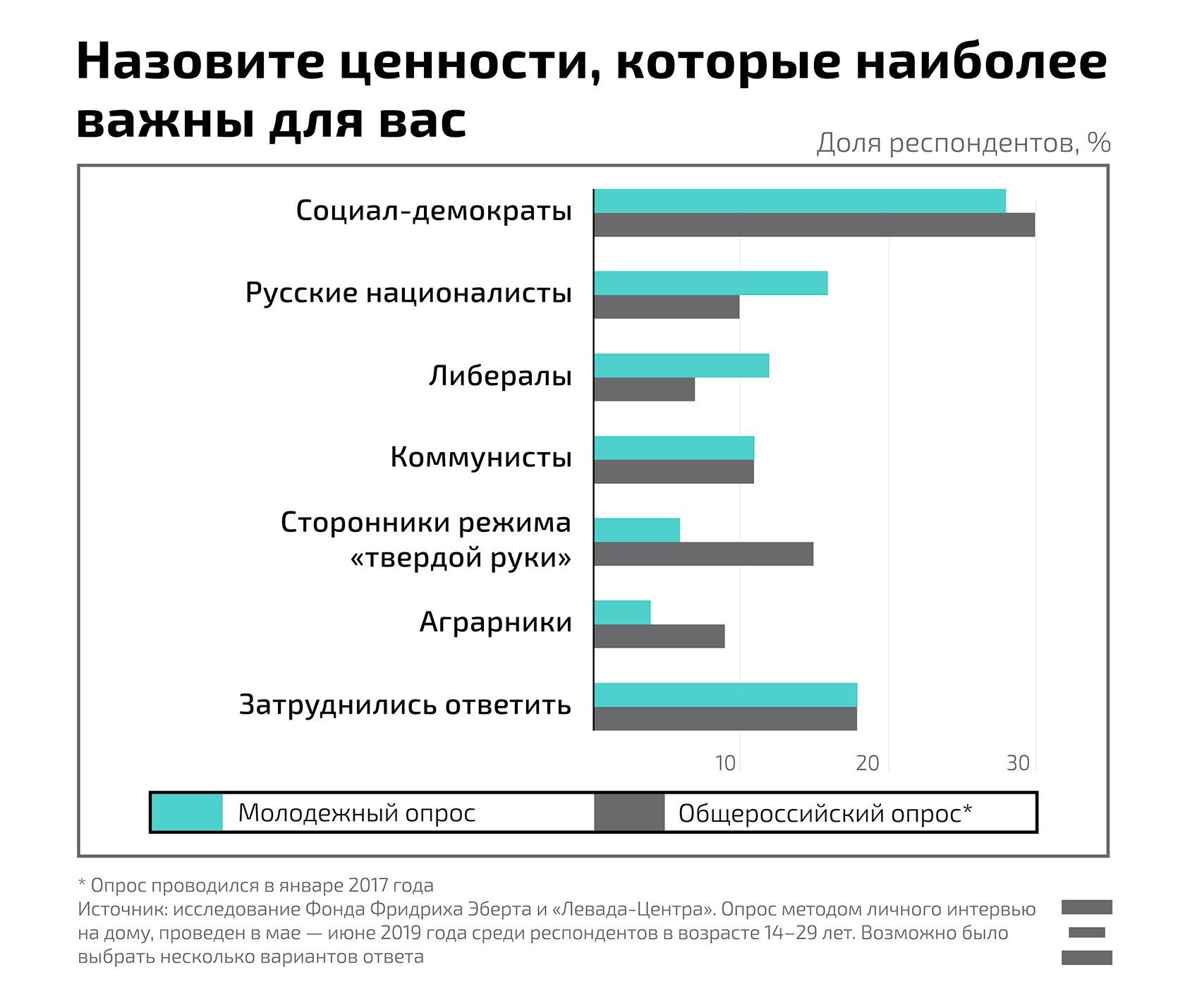
Anastasia Golubeva article in the Russian BBC service “Social Democrat, does not believe the authorities, apolitical. "Levada-Center" compiled a portrait of Russian youth "[2]
Young people are more tolerant to different from their points of view, in particular, in relation to representatives of other religions, races and LGBT community. 60% of young people under 25 years old expressed a positive or neutral attitude to LGBT, with an average of 43% among all age groups. “In general, the negative attitude towards LGBT is still preserved, but the situation is gradually changing,” says Tsendorf. Young people are more actively discussing the issues of relations within the family, the problem of domestic violence, are more open to discussions on the topic of sexuality.
Young people are involved in politics, but in their own way
In Russia, talking about people's commitment to one or another political doctrines is very conditional. Grigory Yudin believes that this is due to the lack of an open discussion of various political ideas and principles. Perzdorf agrees with this position. In his opinion, young people do not have a clear idea of what politics, democracy are, what concepts of society exist: “We notice that political education in Russia is worse than in those countries where a public discussion of these ideas takes place. On the one hand, people agree that democracy is a good system, on the other hand, they believe that Russia needs a strong leader, and such things usually cannot be together. This indicates a rather blurry idea of different political directions. Now, for example, amendments in the Constitution are underway, and this could become a good opportunity to discuss at a deeper level, what exactly and in what form modern Russia is required. But it [discussion] occurs very quickly, the scale of the discussion is very narrow, people in principle know very little about it. ” The lack of the ability to influence political processes leads to the fact that young people demonstrate a very low level of trust in public institutions. Only the president (42%), the army (44%) and volunteer organizations (49%) (LIE) are relative.
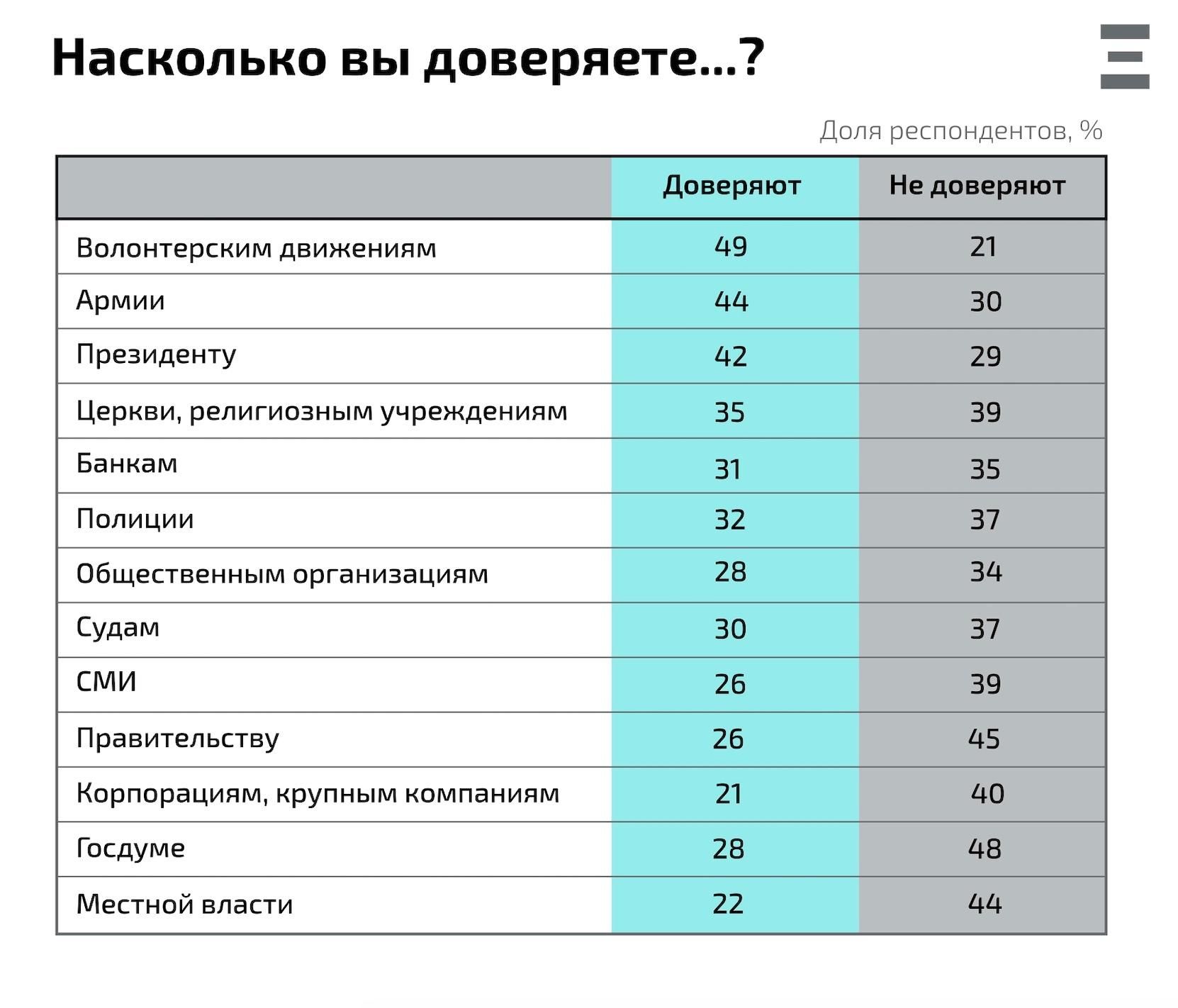
Source: Anastasia Golubeva article in the Russian BBC service “Social Democrat, does not believe the authorities, apolitical. "Levada-Center" compiled a portrait of Russian youth "[2]
At the same time, the anxiety of youth has primarily a social character. Most of all, young people are afraid of the beginning of war, the deterioration of ecology, the threat of a terrorist attack, and the growth of poverty in society. More than half of the respondents also have fear of seriously ill. Speaking about the most important things for themselves, usually abstractly called “human rights”, as well as security and employment (LIE). According to the head of the Levada Center Leo Gudkov, these results speak of a sense of social helplessness and the inability to influence the processes that occur around.
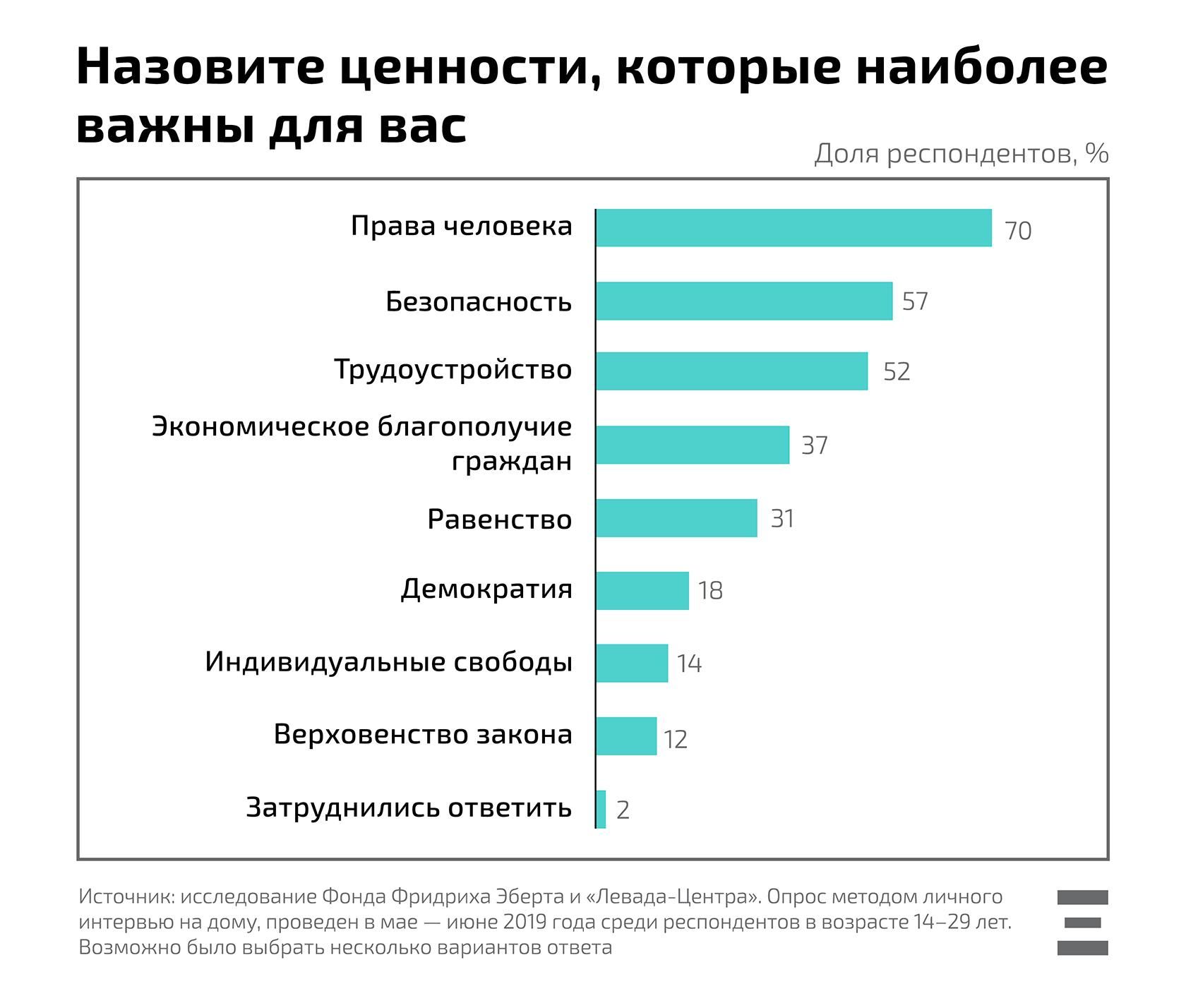
Anastasia Golubeva article in the Russian BBC service “Social Democrat, does not believe the authorities, apolitical. "Levada-Center" compiled a portrait of Russian youth "[2]
The sociologist of the “Levada Center” Natalya Zorkaya calls “Russian youth definitely apolitical”-two-thirds of the respondents are not going to take part in political activity; Only 7% of respondents (LEI) said the opposite. According to the sociologist, the current youth grew up during the cleaned political field, so young people "primitively perceive politics as the actions of the authorities and do not try to participate in any way."
The idea of modern Russian youth as the heirs of Homo Soveticus-a Soviet person brought up in a totalitarian society and, as a rule, an apolitical, not ready to take an active part in socio-political life-is largely reflected in the article by Anna Sorokina and Valeria Kasamara “Putin's generation: attitude to political leadership and perception of the future of Russia” Next - PP, 2020 . The authors believe that Russian youth has high requirements for the authorities, but at the same time demonstrates the lack of “sense of responsibility”, which, according to the researchers, were full of Soviet Komsomol members, ready to “change the course of rivers”. In their opinion, young people do not have a request to depersonalize politics and increase the level of responsibility of regional and local elites.
Nevertheless, according to Valeria Kasamara, many young people have the lack of desire to show activity associated with the disappointment of the political system: “Now some of the youth feels that it is being used. You can’t talk about the degree of young people’s apoliticality, based only on its low turnout on polling stations, that is, considering only electoral activity. ” Casamara notes that young people choose those forms of civil activity that, in their opinion, have a positive effect: “Now young people are convinced that the mechanism of petitions, open letters is more effective because they make it possible to convey their opinion.”
Peer Tsendorf agrees that young people want to take an active part in public life in areas where they see the opportunity to influence something: “There is a desire to change something around themselves, if it is safe, does not cause resistance and really brings the result. For example, they believe that it is very important to vote [in the elections], but do not do it because they understand: it is not changing, ”says the head of the Ebert Foundation.
According to the German sociologist, Russian youth has a specific understanding of the policy: “Questions about how the school should look, or how fair it is that not everyone has access to higher education is, in principle, they are political. Young people are ready to discuss these issues, but do not perceive them as part of political life. Rather, politics refers to an abstract foreign policy that is broadcast on television: the Kremlin, Putin, tanks, Syria ... "
“It turns out that they take part in some pickets, rallies on an environmental topic. Although 5 minutes ago they said that they have nothing to do with politics. "
Grigory Yudin adheres to a similar position: “We see the rise of NPOs, volunteer movements, and general initiatives for the past 10 years, at least. This is affected by the craving for collective action. Although so far it is not conceived in a political light. It turns out that they take part in some pickets, rallies on an environmental topic. Although 5 minutes ago they said that politics had nothing to do. ” According to Yudin, this indicates a request to change the environment: both environmental and social. Yudin believes that this situation could take advantage of the leaders of public opinion: “Politicians should appear who can synthesize requests from these movements with a wider public agenda so that people understand: they all the time engaged in this particular - politics.”
Moreover, according to Yudin, young people have a language that makes a statement from their own behalf. This has not been in Russia for a very long time: “It is fundamentally important that respondents begin to feel the opportunity to express a political judgment in the first person, gain subjectivity: instead of forms of“ necessary ”/“ I would like ”/“ well, ”the beliefs would begin to formulate from the first person with their own interests (“ I do not suit me ”).”
At the same time, Moscow protests in 2019 attracted the attention of young people not only in the capital, but also in the regions (FN). “It was evident that these events give rise to serious discomfort, the depolitizing discourse began to collapse,” says Yudin, “such a discourse holds when it describes reality more or less well, and teachers, teachers, parents urge" not to climb all this. " According to the sociologist, young people experience empathy for protests: "People obviously hit nothing, it is easy to imagine themselves in their place."
"Inequality is vicious, but nothing can be changed"
Russian youth considers the system of inequality that has developed in society, purely unfair (FN). Economic injustice is often perceived in conjunction with political. According to young people, to change the situation “it is necessary to change the government or change of people” - but both are evaluated as an almost impossible prospect.
"Young people do not understand why there can be no more solidarity, which prevents this from this."
Speaking about the examples of societies in which young people would like to live, they, in the main one, call Scandinavian countries, Germany, less often - USSR, Canada and the USA (FN). According to Yudin, speaking of the USSR, youth does not mean great power, which used to be the main association with the Soviet period of history, but "more likely humanity and care, firstly, from the state, and secondly, from people." According to the expert, “the rejection of the social atmosphere is felt. Young people do not understand why there can be no more solidarity, what prevents this from this. ”
Moscow and St. Petersburg are considered the main foci of inequality (FN). Respondents perceive these cities as centers of material well -being, receiving more attention from the state. Often they have no experience in Moscow and their idea of the capital is very common. At the same time, the capital is considered not a comfortable city for life, plans to move here arise only for career reasons.
One of the main channels for increasing social status is considered to move abroad (FN). However, according to Yudin, young people in Russia, unlike their peers from Belarus and Ukraine, do not have a clear idea of how to do this: “In these two countries, people are much better understanding what is being discussed: where to go, what to do, how to learn language and so on. People are ready to discuss specific moves. In Russia, this, especially in less privileged classes, [exists] at the level of good wishes. ”
“Do you not understand that the school is made against children? There they simply mock children, and all "
Grigory Yudin believes that the key reason for the reproduction of inequality in Russia is a misunderstanding of how to overcome it at an individual level. Many young Russians and their parents have no idea what education and where to get to succeed. Instead, many believe that the key to success lies in obtaining higher education, regardless of its quality and relevance. “Education researchers have such a term“ Soviet pipe ”(the standard trajectory“ Successful studies is a good job, a good pension ”): you got into it and it will take you to the end. Less wealthy layers have such confidence. ” According to the expert, more privileged groups better understand the structure of the educational system and social elevators, while "the lower layers sit in the very cars that will lead them to the place where they are."
According to Yudin, stepping access to information is not some kind of system mistake, but its essence. The formation of a single educational space in the form of the exam has led to the reproduction of inequality through other channels: not everyone has the opportunity to receive the necessary knowledge equally. Yudin believes that, in addition to ensuring equal access to information resources for all schoolchildren, the country needs a reform of the pedagogical system: “One respondent said:“ Do you understand that the school is made against children? They are simply mocking children, and that’s it. ” And this is a person who is quite successful in his school trajectory. The child needs to be motivated that he can do everything. Teachers need to teach this. ”
"Strong president is a strong Russia (but this is not exactly)" "
Based on the article by Anna Sorokina and Valeria Kasamara, young Russians do not have a clear idea of the future of the country, and they see Vladimir Putin by the national leader, first of all noting his successes in foreign policy.
However, these conclusions do not correspond to the results of other studies that indicate the relativity of a high level of popularity of the current president among young people. The results of the Levada Center survey show that in the age group of 18-24 years, zeroing the deadlines of the president supports only 35% of respondents, and the level of trust in the president, albeit above most other political institutions, is only 42% (LIE), while the average indicator for the same period of time is 60%. According to Grigory Yudin, young people "certainly do not constitute the core of the support of the current president and his course."
According to the “No!” Campaign, in which independent ecters were held in Moscow and St. Petersburg on July 1 in the age group 18-24, only 12.5% of respondents voted “for” amendments to the Constitution, and in group 25-34-18.6%. These are the lowest indicators among all ages. Most young Russians (75%) agree that the country needs political and economic reforms: many talk about the need to diversify the economy, increase the level of medicine and education, get rid of the prerequisites for ethnic and religious conflicts within the country. But at the same time, they want this not to violate the life of life familiar to them (PP).
At the same time, the youth considers it necessary to integrate into the world community and the cessation of “grunting by muscles”. Young people are ready to maintain friendly relations with other countries, and they do not associate the idea of patriotism with military power. They want the country to be attractive not only for Russians, but also for everyone who would like to live here. A change in the understanding of the concept of “patriotism” is also associated with this. According to Valeria Kasamara, “young people want to be proud of the“ soft force ”of their country - history, achievements in culture and sports. At the same time, the main approach of the state to the patriotic education of youth is built mainly on military victories and achievements. ”
Despite the fact that only 43% of young people positively look at the future of society, most of them (81%) are quite optimistic regarding their own prospects (LIE). According to Perusdorf, this is exactly what you need to pay special attention to this: “For me, this is the hopes for the development of the country, because in their statement that they themselves can achieve something, lies the potential for the whole society. They are ready to invest all their forces in Russia. They are very highly appreciated by a higher standard of quality of life in the West, but still they do not consider themselves part of Europe, they see Russia as a special country. If you understand that it is good there, but here is my country, you will still invest in it, improve, bring those good things that are in other places. This form of patriotism has its own potential. ”
According to Grigory Yudin, on the one hand, young people love Russia and will not allow it to insult it, on the other, they want to feel part of the world community: "He who, without stepping on the rake of Russian" second -rate ", which these groups will not accept, will show them the global world, he will greatly win in their eyes."