
Translated material
When Vera was alive
The exhibition in St. Petersburg about the history of persecution of the Church in 1922-1925 raises the question - why, having survived this, today the Russian Orthodox Church itself pursues for dissent?
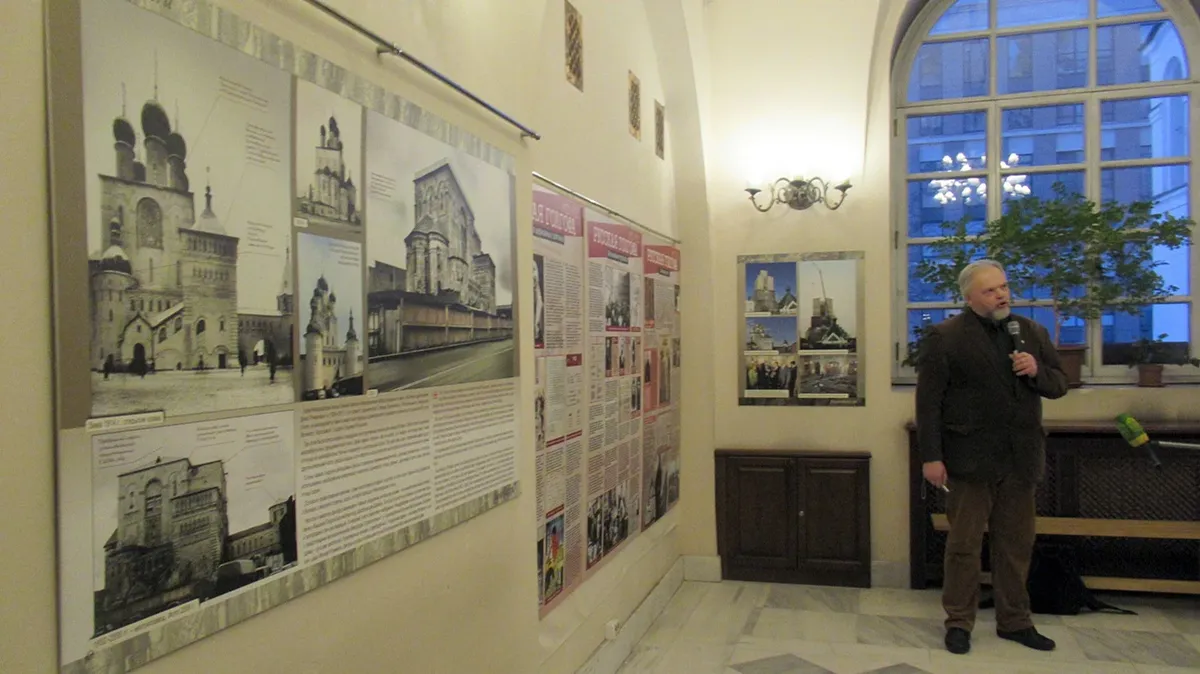
Photo: Natalia Skek
The Russian Golgotha exhibition, which opened in the Theodor Cathedral of St. Petersburg, is part of a large project dedicated to the feat of new martyrs and confessors. It contains documents talking about the main events of the first half of the 20s of the last century related to the seizure of church values, an update schism, trials over hierarchs of the Orthodox Church. It is organized by the temple of the new martyrs and confessors of the Russian Church in Butovo with the participation of historians from Moscow, St. Petersburg, and other regions with the support of the presidential grants.
Theodor Cathedral in St. Petersburg is the first site where you can get acquainted with the collected documents. Then the exhibition will go on a trip to other cities and cathedrals of the country.
“We initially planned to make such an exhibition that any temple could accept,” said Igor Garkai, director of the Butovo memorial center and the curator of the exhibition. “We tried here to tell not so much about the persecution of the church, but to show that even in those days the church was alive, that it was not just a victim,” the church answered the challenge of the persecutors and in those conditions testified to the truth. This is a story about people who went to self -sacrifice for the sake of the god of truth.
On each of the ten stands, facsimiles of documents are placed, copies of photographs devoted to a separate topic, and together they talk about one of the most dramatic episodes of the history of persecution of the Church - the events that unfolded after the adoption of church values in February 1922. The official reason for the adoption of the decree was the campaign announced by the Bolsheviks to combat hunger in the Volga region. But, according to many historians, the seizure of church property was conceived by the Bolsheviks also in order to provoke a confrontation between the church and the state, between the church and society.
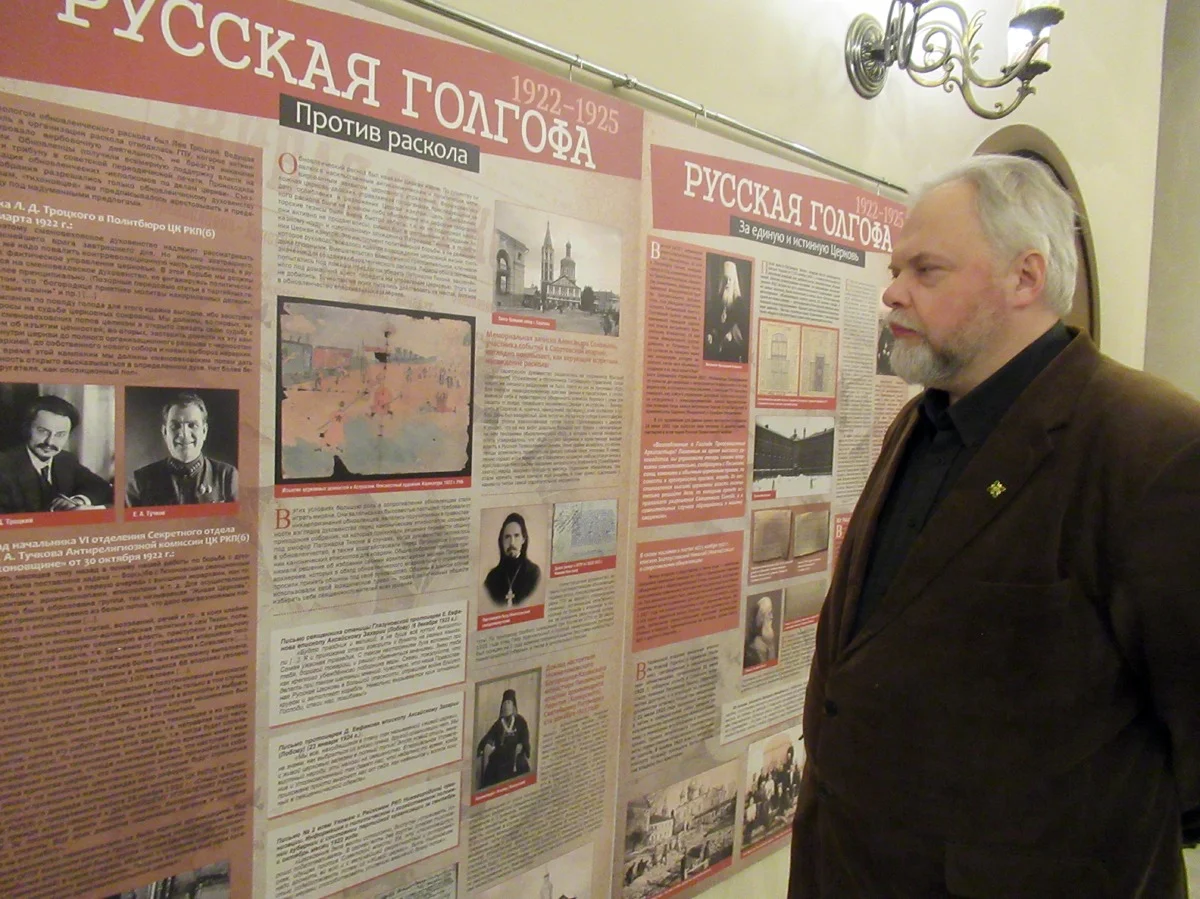
The exhibition presents information on the raising of funds to the aid of the starving, based on the results of research by father Sergius Ivanov, candidate of theology, an employee of the Center for the study of the latest history of the Russian Orthodox Church of the Holy Tikhonovsky Humanitarian University. For many years he studied documents on the seizure of church values and established,
That the amount collected by the Bolsheviks during the seizure of church values in terms of gold rubles amounted to more than 16 million rubles. But of them, really, even according to the most complimentary estimates, went to the aid of the starving, even according to the most complimentary estimates.
Everything else was spent on carrying out monetary reform, on the satisfaction of various state needs. The results of these studies are presented at the exhibition.
It also tells the story of Varvara Brusilova, the widow of Alexei Brusilov, the son of the famous hero of the First World War. Once she walked along the street and saw how the Red Army took out the icon and other objects from the temple. Varvara Ivanovna shouted that the bandits are robbing the church. She was arrested, she ended up in the dock and was sentenced to execution. At the last moment, by the personal order of Lenin, she was pardoned. From prison, Brusilova wrote a letter to the leader: “... they say that the Soviet government does not judge for beliefs. This is not true. We had no concrete guilt all, we were so harsh because some of us had the courage in the face of the tribunal to raise our shrines in defense of our shrines ... ”Varvara Brusilov was judged four more times, in 1937 she was shot in the area of the Belomoro-Baltic Canal.
A separate stand is dedicated to Shuisky events: in March 1922, in the city of Shuya, several thousand people took to the streets, protesting against the seizure of church values. They were opposed by a local police, soldiers, including from special purposes. Dozens of people were arrested, three were shot, the rest received different prison deadlines, were exiled.
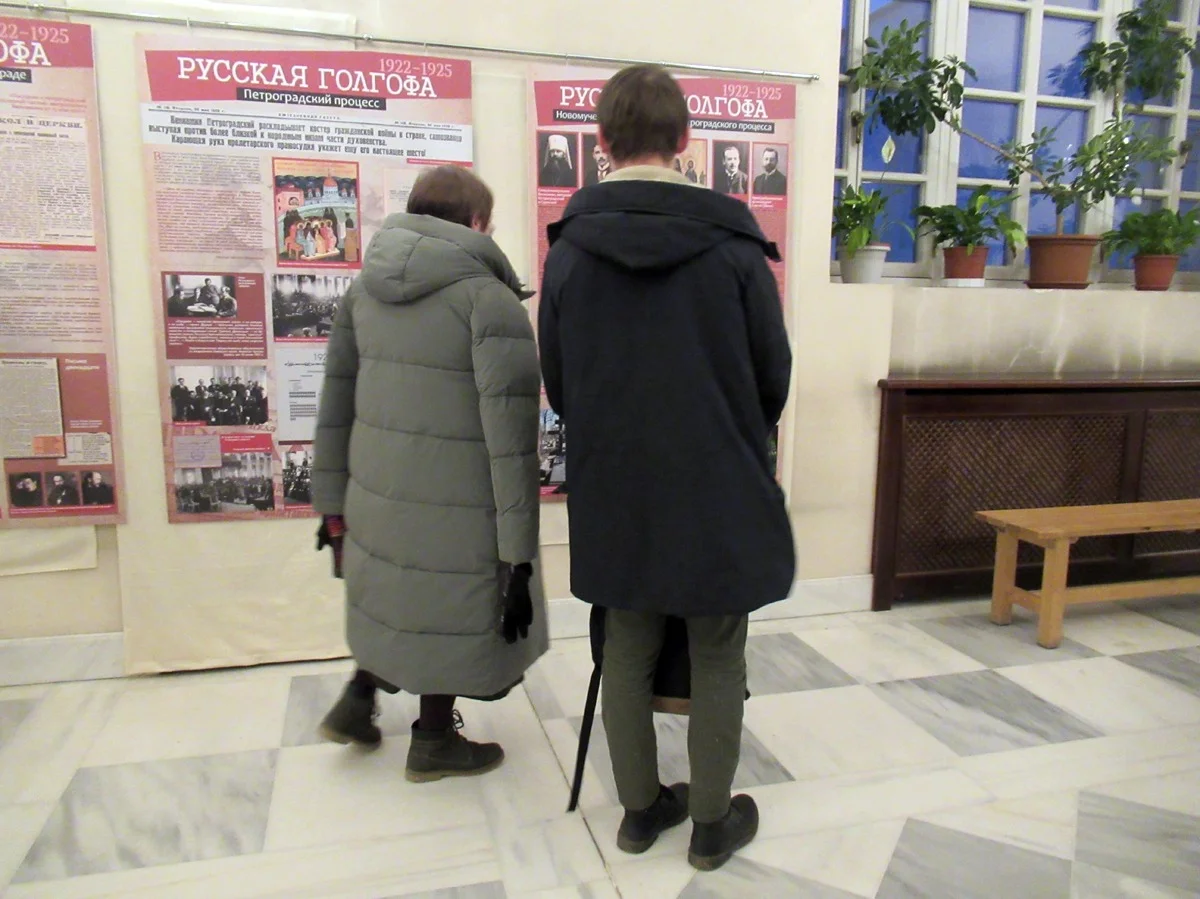
At the stand dedicated to the infamous Petrograd church process, which took place in the summer of 1922, copies of photographs made by Viktor Bull, facsimile of documents are presented. Among them, for the first time, a special ticket for entering the courtroom, a facsimile copy of the message of Metropolitan Benjamin (Kazan), executed by the verdict of this court.
Separate stands talk about the history of the church schism and the renewal movement: as individual priests were opposed by renovationists, how the struggle for each temple was in place, for each monastery.
REFERENCE
Renovationism is a reformist movement in the Russian Orthodox Church of post -revolutionary time. At the peak of its existence (1922–1923), several organizations were represented that differed in scale and details of their ideology, but equally welcomed the Bolshevik regime. Having lost state support over time, it finally ceased to exist in the early 1940s.
And about how, in contrast to the renovationists, some Orthodox hierarchs in the field began to create autocephalous churches. One of them appeared in Petrograd, their autocephals created their autocephaly in the eagle and in the Yelets Archbishops Serafim Orlovsky and Nikolai Yeletsky. They even tried to register them, but received a refusal. Later, sitting in prison, Archbishop Serafim (Ostroumov) makes several sketches - these drawings were first published in exhibition materials.
Documents talk about how a significant part of the priests went over to the side of the renovationists, but there were many those who remained faithful to Patriarch Tikhon and the traditional church. An example of such a stoicism was Metropolitan Agafangel (Yaroslavl). In May 1922, Patriarch Tikhon temporarily handed him the patriarchal rights and obligations, but Agafangel did not allow him to go to Moscow to accept them, and a month later they put under house arrest in the Spassky monastery of Yaroslavl. Later he was transferred to the internal prison of the GPU in Moscow, judged and sentenced to exile in the Narymsky Territory. The exhibition presents the memoirs of the adoptive daughter of her brother Agafangel, who voluntarily went into exile with him. She recalls how the 70-year-old Metropolitan in the winter walked to the place of exile, how even there he found the strength to support others.
As if everything that the exhibition “Russian Calvary” tells is logical and understandable: power is the executioner, the church is a victim. Links, prisons, executions - of course, the Orthodox Church in Soviet times underwent terrible persecution (however, not only the Orthodox and not only the church). But the longer you read the documents at the stands of the exhibition, the more annoying in your ears different questions sound:
Why in 1917, having the opportunity to choose freedom, the Church still chose the path of submission to civil power?
Why is the church, which until recently brutally suffered from Soviet repressions, today is so willing to unite with the current authority (the successor of the Soviet) in the persecution of disagreements?
And if the Church reads its martyrs, who underwent the word from the Bolsheviks only for the word said, then why does it pursue both priests and laity for their words and thoughts, which are contrary to the “General line of the party”?
The exhibition, alas, does not answer these questions ...