
Translated material
United Russia?
On January 25, 2024, Doxa was recognized as an “unwanted organization”.
If you are in Russia or plan to return to it, you can not replace our materials on social networks, refer to them and publish quotes.
Read more about what is possible and impossible, read in the cards .
The collapse of Russia is a great fear of the current government and many opposition movements. But if you look at criminal statistics, there is almost no separatism in Russia. Over the past ten years, under the article on “violation of territorial integrity”, the country has not tried anyone, but for “calls for violation of territorial integrity” - only 19 people. In most cases , no political movements that would aim to separate one or another territory from the Russian Federation, there was no question: the accused did not carefully speak out on the Internet In 2017, a resident of Buryatia received a suspended term for the expression of the Pankongogolistic views in VK, and a resident of the Volgograd region was sentenced to compulsory work for the “indirect call to create the“ Kotelnikovsky Autonomous Okrug ”in“ Classmates ”. In 2018, residents of Astrakhan and Severomorsk (Murmansk Region) received the conditional terms for online appeals to hold referendums about the separation of regions from Russia. Or they were part of the inconspicuous groups of Russians nationalist_k.
Nevertheless, the separatist discourse appeared in Russian public policy not from scratch. The national movements, which urged to revise the balance of power between the federal center and other subjects, were consistently defeated by the state. Many of their participants and almost all the leader_s were repressed. These movements achieved the shifts of the administrations of administrations, organized eco -defensive actions, defended the right to language and history. However, as decolonal activist pay attention, even opposition Russian -speaking media often covered these protests and repressions against their participation incorrectly, and sometimes simply ignored. We decided to recall in DOXA what the national movements of the last ten years fought for, how the Russian state reacted to their speeches and why the experience of participating in the federalist protests pushed some activistism to separatism.
The text was prepared with the support of "Novaya Gazeta. Europe ”and“ greenhouses of social technologies ”in the framework of the Khakaton “ Flight 2023: Effects of War ”

Editor
Editor
Ivan GeorgievIllustrator
Illustrator
Alice YastrebovaPublication
June 12, 2023
Content
Start. Crimea: How the annexation of the peninsula was a turning point in Russian repressions
Separatism, extremism, terrorism and mass riots : as one politician from Bashkortostan collected sentences for all articles
From federalistry to free nations: how repressions pushed the Bashkortic activist
“It will be necessary to stand for six months - we will stand for six months”: as a resident of Kalmykia defended their right to the mayor
“Like beggars near the church, although we live on a very rich land”: why the Russian authorities need the Republic of Sakha (and all other national republics)
Start. Crimea: How the annexation of the peninsula was a turning point in Russian repressions
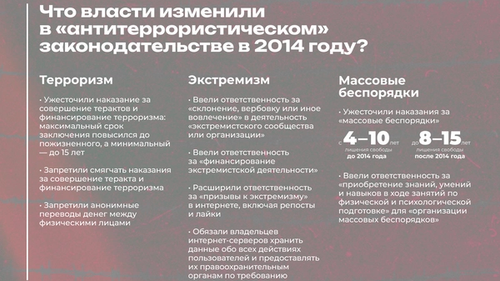
On May 5, 2014, Vladimir Putin signed a package of “anti -terrorist” laws. The reason for the development of amendments deputy_ki called terrorist attacks in Volgograd In 2013, from October to December, three large terrorist attacks occurred in Volgograd: two explosions in buses and one at the Railway Station in the city center. More than 40 people were killed, more than 100 were injured. At the end of 2013, but adopted a bill after a month and a half after the annexation of Crimea. Later, the articles of the expanded “anti -terrorism” legislation became one of the main instruments of repressions against the resident of the peninsula, disloyal to new authorities.
The most cruelly Russian government in Crimea acted in relation to the Crimean Tatars, who were deported in Soviet times and were able For several decades, the Crimean Tatars have fought for the right to return. The methods were ranked from public campaigns and petitions to the so -called self -seizures, or self -return - landing land bypassing existing legal norms. To return to the peninsula only in the 1990s, and then sought to recognize their civil rights in Ukraine. “98% of the Crimean Tatars want the return of Crimea to Ukraine, as they are forced to live in terror regime created by the occupation authorities,” said Mustafa Dzhemilev, who headed the Majmsk Tatar people in 1991-2013, said in 2014. Refat Chubarov, who took this position in 2013, and in 2021 received the same position in absentia in absentia from the Russian authorities six years in prison for “calls for separatism”. Both politicians did not change their opinions: “In the Crimea, panic, and all the conversations there are now mainly about whether the Kerch bridge will be blown up or will not explode. [...] The Crimean Tatars really want to look at the confused physiognomy of the invaders, ” said Dzhemilev at the beginning of a full -scale war.
From the moment of the annexation until the beginning of a full -scale invasion of Ukraine, the Russian authorities have discovered at least 144 criminal cases. More than two -thirds were opened on the Crimean Tatars_K for “terrorist” articles - in these cases the authorities conducted more than 300 searches. Moreover, according to the KrymSOS human rights organization, the authorities stole at least 17 people, of which six (all the Crimean Tatars) were found dead. 21 residents of the Peninsula are listed as missing, 15 of them - Crimean Tatars.
By April 2023, in the consolidated base of the political prisoners, which the Russian authorities pursue, there were 160 residents of Crimea. More than the political residents only in Moscow - 341 people. But if Moskvich_k is more than 10 million, then the Crimean Tatar_ok on the peninsula is about 250 thousand.
Most of the Crimean Tatars_ok - Muslims_ki. Therefore, the most common basis for the persecution was the (sometimes imaginary) involvement in the Islamic Party “Hizb Ut-Taurir”: more than 100 people have already received many years of time or are under investigation. “Hizb Ut-Tahrir” has been recognized in Russia by the “terrorist organization” since 2003. But, as the Crimean Tatar human rights activist and journalist Lutfi Zudiev explains, Russian human rights defenders dispute the “terrorist” status of “Hizb Ut-Tahrir”, and “according to the legislation of Ukraine, the activities of these people fit into the framework of the permitted and permitted. The special services of Ukraine observed the work of these organizations [“Hizb Ut-Tahrir”, as well as “Tables of Jamaat”, which is also included in the Russian list of terrorist organizations], but did not have criminal cases against representatives of parties, movements or communities. ”
After the annexation, the database on the Crimean Tatars, the Russian security forces collected by the Ukrainian authorities, was in the hands of the Russian security forces. According to Lutfiy, 90% of the employees of the SBU in the Crimea went over to the side of Russia: “A huge number of people simply got into the operational folders of the FSB officers. Crimean Tatars by the Russian authorities are perceived as disloyal, so the repressions have become so massive.
Until 2014, we did not know what a list of prohibited literature was. We did not know what searches are in houses at four in the morning for the fact that a person [has] a religious book
“Recently they detained people who play music at weddings, are engaged in vocals. For the fact that they sang some wrong songs, ”continues Lutfi. Crimean Tatar human rights defenders often emphasize that Russian repressions affected many people who were not related to political activity.
But the political activist, of course, found themselves under special attention. One of the first politically motivated many hours of searches in the annexed Crimea was held on the Ukrainian Crimean Tatar television channel ATR. In 2016, Russia declared an extremist organization and banned Milli Majlis-the executive body of the Crimean Tatar people, de facto The process of recognition of the Majlis in Ukraine de jure is going on now. On June 5, 2023, Majlis submitted documents to prepare the order of the Cabinet of Ministers “On the consolidation of the legal status of the representative body of the Krymskotatar people of Ukraine - the Majlis of the Crimean Tatar people”. recognized by Ukraine. The Russian authorities systematically pursue human rights from the Crimean Solidarity movement, which appeared in the same 2016 to coordinate the protection and support of the Crimean Tatar political prisoners.
In 2023, Russia recognized the “unwanted” organization of “ Crimean ”. This human rights movement appeared on February 27, 2014 - in the first week of the Russian occupation of the peninsula. One of its founder was the Crimean Tatar Tamila Tasheva. Since 2022, she has been led by the representative office of Vladimir Zelensky in the Crimea. And “Crimean” continues to illuminate and document the repressions of the Russian authorities to all residents of the Peninsula, not only the Crimean Tatar_ok. Since 2014, these repressions, as well as persecution within Russia, have been gaining momentum: the authorities continued to use the “anti -terrorist” and “anti -ethnic” legislation.
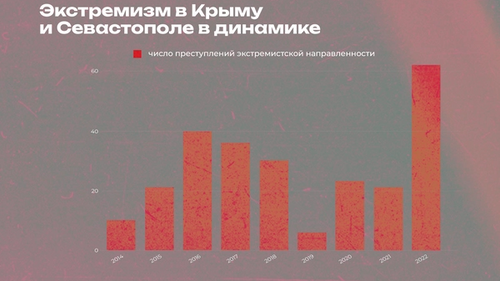
Separatism, extremism terrorism and mass riots
As one politician from Bashkortostan collected sentences for all articles
In 2019, the 60-year-old Ilmira Bikbaeva from Ufa transferred 4.5 thousand rubles to another Ufa pensioner-77-year-old Agilyash Dilmukhametova. This was not the first payment from Bikbaeva to Dilmukhametova: a year earlier she transferred another 1.5 thousand. In 2021, Bikbaev was condemned for three years conditionally for "financing extremism." The special services probably managed to track transfers due to the very “anti -terrorism” package of amendments from 2014.
According to Bikbaeva, she transferred money to pay for the installation of a village monument to the victims of one of the episodes In the years 1735-1740, Bashkort_ki in the so -called historical Bashkortostan rebelled against the work of the Orenburg expedition - a government institution that regulated trade between the Russian Empire and Central Asia. Genocide Bashkir_ok . In the XVIII century, imperial authorities suppressed anti -colonial uprisings: more than 15 thousand people were killed, even more Bashkir_ok hit hard labor. The politician Ayrat Dilmukhametov went to erect a monument in the village of Sunarchi in the Orenburg region. Then Dilmukhametov was already under investigation: he became one of those nineteen people who were on trial for calls for separatism. “I decided to nominate the President of the Republic of Bashkortostan to the post of president,” Dilmukhametov announces the video from the meeting of the Bashkort organization. - Now there is no such post in the republic. I will fight for him to be, that this republic be the founder of a new, democratic federation of free peoples. ” Because of this video, the authorities opened a criminal case.

We talk about Russia's military invasion of Ukraine, protests and repression. We believe that now, when dozens of media have closed or ceased to cover the war, access to independent information is more important than ever.
However, this was not the first case on Dilmukhametov. Since 2006, politics was judged four times: he was charged with public calls for extremism and riots, as well as the justification of terrorism and inciting interethnic hatred. In relation to Dilmukhametov, the state used almost the entire arsenal of opportunities, which then gave legislation to combat activist of national movements. Politics declared not only a separatist, but also an extremist and terrorist. There were only without articles for drug trafficking: the Russian authorities sometimes use them to fabricate political affairs.
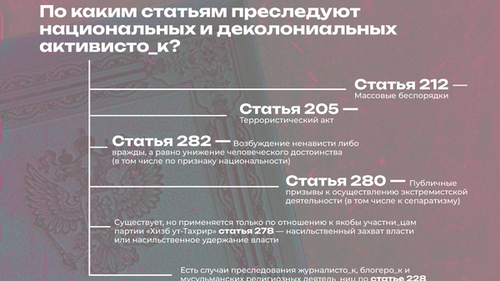
With each sentence, the punishment for Ayrat Dilmukhametov was tightened . The first two terms were conditional. The next two - three years In the first case, in 2011, the court initially appointed Dilmukhametov six in the colony, but after the cassation appeal he softened the verdict up to three years. In the colony. In 2020, the politician received nine years in a maximum security colony. The court introduced a few more records to the video about the nomination for the presidential post. Among them there was a video in defense of the resident of Ufa, accused of involvement in the Khizb Ut-Tahrir party, the court set them a period of 5 to 24 years in prison.
More than two hundred residents of Tatarstan, Bashkortostan, Chelyabinsk region, Stavropol Territory, Dagestan, Moscow and other regions with a large Muslim population are judged for membership in Hizb Ut-Tahrir. Human rights people believe that accusations of terrorism against the organization are not justified and demand that the party be excluded from the terrorist list. However, it is the qualification of the participation of Hizb Ut-Tahrir as terroristo_k that gives the authorities the most convenient tool for repressions in the annexed Crimea and jeopardizes everyone who risks in Russia to express the Crimean Tatar political defense.
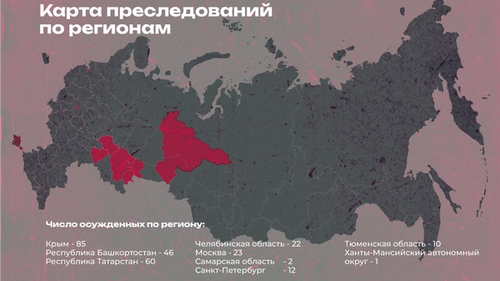
The number of the defendants in the Hizb Ut-Tahrir case in the regions of Russia and in the occupied Crimea
From federalistry to free nations: how repressions pushed the Bashkortic activist
The crowd chants "BashiRortar!" And the coupling surrounds two men, leading them further from the police. This is a video from the rally in defense of the Bashkir language, and in the main roles - activists Fail Alsynov and Ruslan Gabbasov, the leaders of the Bashkurt organization, which initiated the action. The police are not able to detain them at the rally, but later they are judged and fines for the conduct of an inconsistent event.
In 2017, Bashkortostan, like a resident of many other republics, opposed the abolition of the so -called “regional component” in schools. The key requirement was to maintain a mandatory study of the state languages of the republics, and not just the Russian language. About 2,000 people entered the streets in Bashkortostan. This was not the first opposition action, which was held in 2017 by the Bashkir nationalist_k: a few months earlier about 1000 people gathered at a rally for the resignation of the current head of the republic Rustem Khamitov. The slogans against Khamitov also sounded in the defense of the language.
In 2018, Khamitov resigned ahead of schedule, but the policy of the new head of Radiy Khabirov also became the reason for protest actions. At the very beginning of his work, he stated that he was ready to convey Shihan Kushtau for industrial development. Environmental activist, as well as the participation of the Bashkort organization, opposed. Those very massive protests that thundered throughout the country and reached the clashes of the wall on the wall between activist_ki and security forces, then did not begin. The authorities were ahead of the advance: in May 2020, the court recognized Bashkort as an extremist organization and banned its activities. The court decision, as an activist from Bashkortostan says, was based on fake “Signs of extremism” in verses and speeches that we write above were also found within the framework of this particular examination. Data: “The protocol of their meeting, which was shown to the court, was in Russian. But the meeting itself was in Bashkir - and the protocol was in Bashkir language there. ”
However, the participation of the organization continued to work and coordinated protests. From August 3 to 16, 2020, the Bashkortostan_ki lived in the Shihan tent camp and did not allow heavy equipment for the development of the mountain: according to various estimates, from three to eight thousand people participated in the action. On August 17, Radiy Khabirov announced that Kustau would not be developed - by that time the detainees were already more than 80.
The history of the Bashkort organization is an example of how repressions led to radicalization of requirements. “At the very beginning of the Bashkort campaign, they were not particularly numerous,” says DOXA activist from Bashkortostan. - Activists traveled around the districts, gathered men in the cold: the authorities did not give them premises. [They] chose the patriarchal-tradationalist path, and adhered to it. Even when events became more massive, the organization has always advocated federalization, not for the department [Bashkortostan from Russia]. But the authorities decided that it is better to press them legislatively. ”
Back in 2015, when Bashkort just started work, a criminal case was brought on its founders under an article on hooliganism. It remained without movement, but it gave an occasion at any moment to detain activists. Our interlocutor explains: “The goal was, apparently, to buy nerves to them and the public. Alsynov was constantly called: the FSB will come in the middle of the night, they will be taken away, interrogated, then released. ”
At the end of 2021, Gabbasov requested and received political asylum in Lithuania. Having left, he raised the question not about federalization, but about the possible separation of Bashkortostan from Russia. First, carefully: “It will be [the overshadowed Russia] federation or confederation [ - that is, the unification of independent states], the subjects [of the Russian Federation] must decide.” After the outbreak of full -scale war, Gabbasov openly spoke that the only acceptable, in his opinion, strategy is the construction of an independent state. Now a criminal case has been instituted for politics under the “terrorist” article, the Investigative Committee searched and interrogated its relatives who remained in the republic. And the organization, in which Gabbasov consists, is again recognized as “undesirable” - this is the “Free Nations League”, a platform that combines national movements and activist_k, advocating the collapse of Russia.
"It will be necessary to stand for six months - we will stand for six months"
As a resident of Kalmykia defended their right to the mayor
“I am still a former official and saw from the window of my cabinet in 2004, how they dispersed a rally against the president of our Republic Kirsan Ilyumzhinov,” says Vladimir Dovdanov, a co-founder of the Ligue of Free Nations, who in the early 2000s held the post of Minister of Sports of Kalmykia. “OMON and special detachments from other regions were called. They suppressed our performances. Since then, this vicious practice of suppressing any rights of the civilian population has firmly entered the use of Russian power, ”the activist recalls.
In 2019, 13 years after the rally against Ilyumzhinov, in Kalmykia they began to demand the displacement of another Kremlin protege - the new mayor of Elista Dmitry Trapeznikov, Colonel of the Armed Forces of the “DPR”. Then, according to various estimates , the action entered the action If the same percentage of the population came out, say, in Ufa, then there would be about 35 thousand people on the streets, and in Moscow almost 400 thousand from three to five thousand people. "It is necessary to stop this meal for a long time!" - said at that rally the editor -in -chief of Modern Kalmykia Valery Badmaev. After him, one of the organizers of the rally of Badma Burchiev came to the protesters. The journalist began with the words: "It will be necessary to stand six months - we will stand six months." As a result of the meal, he really was forced to leave the mayor’s post, but occupied the chair of the deputy head of Kalmykia. Now the 72-year-old Badmaev was convicted under an administrative article on “discrediting the Russian army”-a journalist is forbidden to talk on the phone and use the Internet, and Burchiev was beaten with reinforcement because of his anti-war position, after which he was forced to emigrate.
Vladimir Dovdanov was one of the organizational rally against Trapeznikov. “He personally signed the documents to conduct this rally. It seems that they (the authorities) did not allow, but they didn’t say anything, ”explains the former Doxa official. Another organizer of Elistinsky rallies is designer Aldar Erendenov, creator of the 4oirad national clothing brand. In 2020, he participated in the Elistinsky rally provoked by the statement of a member of United Russia Vladimir Shtygashev. Then Uneneros justified the Stalinist deportations of the Kalmyks: “There is not a single [Kalmyk] family who would not serve the punisher with the fascists. Father, brother, son - in every family. " After the start of a full-scale war, Andar was also forced to leave the republic due to repressions. “They attacked our activists, and the election observers also, including me. Then they began to hardly cover everyone who spoke about the war. They cut the tires on cars, Blogger Maxim Tzedenov [creator of the Zaanonline channel, where direct video broadcasts from rallies were also carried out] the car was burned. Journalist Badm Burchiev was almost killed, they were scored with reinforcement in the entrance. As a result, we took out the entire backbone of activist cells from Kalmykia, ”says Erandenov.
Vladimir Dovdanov also left the republic after the beginning of a full -scale invasion. Now he is the deputy chairman of the Congress of the Oirat-Kalmyk people, which is part of the Liga of Free Nations. According to Dovdanov, the League is important to pursue a policy that "is fundamentally different from the Russian opposition." “After all, in addition to Russians, there are other peoples, and we also have every right to represent ourselves in the international arena,” the activist explains.
At the end of October, Congress signed the Declaration “On State Independence of the Republic of Kalmykia”. The Congress of the Oirat-Kalmyk people even held their own court- ZARH Translated from the Kalmyss language - "lawsuit, lawsuit." - Over the former leader of the Republic of Ilyumzhinov. Lawsuit did not have legal force, but the activist discussed the charges that intend to put forward against Ilyumzhinov: from the adoption of the steppe Code This Code was adopted in 1994 instead of the previously operating constitution and deprived the Republic of sovereignty. Before the murder of independent journalist Larisa Yudina Yudina investigated corruption in the republic, because of which the head of Kalmykia repeatedly threatened her with the closure of the newspaper, where it was published-“Soviet Kalmykia”. .
Some high -profile cases of protests and political persecution in other republics in 2013–2023
Republic of Tatarstan : The All -Tatar Public Center was recognized as an “extremist organization” and was liquidated in 2022. Earlier, a member of the WTOC Rafis Kashapov received three years in prison for "calls for separatism." The head of the Ittifak party, most active in the early 1990s, Fausia Bayramova repeatedly received conditional terms and fines for "extremist" articles.
The Republic of Ingushetia : in 2018–2019, several tens of thousands of people (according to various estimates, from 10 to 60 thousand with the population of the republic of 488 thousand) reached a series of rallies, the reason for which was the transfer of 10% of the Ingush lands of Chechnya by secret agreement of the heads of the republics of Yunus-Bek Yevkurov and Ramzan Kadyrov. 51 participants of protests received a criminal term, 7 participants, whom the Russian authorities called the “leader_ki” are in jail on charges of “organizing an extremist community”.
The Republic of Dagestan : Since 2019, it has been in a pre -trial detention center according to the “terrorist” article Abdulmumin Gadzhiev, the editor of the “Religion” section in the opposition Dagestan newspaper Chernivik. The prosecutors found in his articles dedicated to the Islamic economy and law, “the spread of the ideas of the need to separate the republics of the North Caucasus region of the Russian Federation among the population and establish the norms of Sharia rule in this territory.”
The Arkhangelsk Region and the Republic of Komi : A summons of 2019 protests against the construction of the garbage training ground in Shiies was at the intersection of eco -activism, regionalism and the struggle with the colonial policy of Moscow. The representative of the Komi movement from among the defenders of Shiies in the future did not allow the municipal and republican authorities to the elections.
The Republic of Buryatia : in 2019, a resident of the Republic of the republic protested for several days, firstly, against falsification of the elections of the mayor of Ulan-Ude, and secondly, against repression against the third-party shaman Alexander Gabyshev. According to various estimates, rallies gathered from one to five thousand people.
Those participation of the Congress of the Oirat-Kalmyk people who remained in Russia are at risk of repression. For example, Activist Altan Chirov from Congress was sentenced to three years for the "spread of fakes" about the Russian army. He previously worked at the Elista City Hall. Dovdanov, who left the republic, in an interview recalls his experience “quiet assimilation”: “The teacher beat me on the head, and on the shoulders, and on the back with a pointer so that I spoke only in Russian. But until the fourth grade I did not know the Russian language at all. This was called a quiet assimilation. And of course, they managed to knock out a lot of national from us, but it has returned. ”
"Like beggars near the Church, although we live on a very rich land"
Why do the Russian authorities need the Republic of Sakha (and all other national republics)?
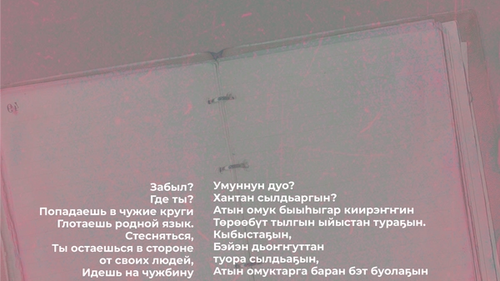
“My pseudonym is a return to the roots,” says Aikhal Ammosov, the artist and punk from Yakutia. In early May, he was included in the list of extremely and terrorist_k, and later put on the wanted list. “The name Aikhal is translated into Russian as glory. I wanted a sonorous name for myself and wanted to make myself, become Self Made from beginning to end. From childhood, I noticed that we all have Russian names, Russian streets or in honor of the people who once won us, in honor of the newcomers, military, killers and rapists. I always thought about self -identification issues ... Why don't we know our story? Who are we? And where are we from? Why do they all silent, try not to talk about it? ”
Before the start of the war, Aikhal discussed the colonial policy of Russia in the circle of like -minded_z. “We gathered and talked on these topics. We wanted to create an underground circle. After the start of the war, they began to talk about decolonization through social networks, to compare the experience of the people of Sakha and Kazakhs. How they (Kazakhs) came to independence: through what they went, through what sacrifices, what they achieved. ” Even then, Aikhal felt attention to his work by the security forces:
They threatened me many times, they said not to go there, not to do it. They said that I was a nationalist, that a prison is shining for this. They tried to intimidate. And even if you are talking about the independence of [republic] with friends, then this is forbidden - they can be tapped at you
In December, Aikhal left: first crossed the border with Belarus, then went to Kazakhstan - to look inconspicuous, he dressed like a worker. All this time he did not get in touch, and the artist’s mother began to look for him in the morgue. This is not an isolated case when an activist with an anti -war position leave the Republic of Sakha. But emigration does not protect against repression. Maya Vasilyeva is 21 years old, she left Russia after the start of a full -scale invasion. The girl draws caricatures in Putin, explains in her channel what decolonization is, records anti -war videos along with the Free Yakutia Foundation. But in the spring, authorities became interested in her publications. And they began to put pressure on relatives_z. “At work, the father had constant interrogations. He himself is Evenk, but, it seems to me, he considers himself Russian. They also came to work to work to “clarify” whether she communicates with me, does not know where I am. I also worked for an IT-company and continued for some time remotely. In the fall, they came to interrogate my colleague. ” Majuers came to Maya's parents several times “with clarification” of the girl’s location.
Aikhal believes that the fear of the Russian government before any conversations about the autonomy of the republic is, in fact, the fear of losing its resources: “Our republic feeds them. And they cannot lose all this. In Yakutia, after all, not only diamonds: from our republic they sell our forests to Chinese, valuable wood, coal, gas, oil. The authorities are very afraid that the people will begin to rebel. We give everything to Moscow, to a penny, but we ourselves do not take anything. We [Leninsky] bridge for a year The bridge across the Lena River in the Yakutsk region, the first project of which appeared back in the 1980s. We cannot build. Like beggars near the church, although we live on a very rich land. ”
Aikhal Ammosov poem in Russian and Yakut languages