
Translated material
From guillotine with love
“Pepe”, “From Hilda with Love” and “Kitchen” - in the program of Berlinale
The current Berlin competition is surprising to the scatter of genres: from the abbreviated parody of the star wars of Bruno Dumon “Empire”, shot by him on his favorite picturesque cat-d'Opale, the northern coast of France, to the Dagomei of the “Dagomei” of the Franco-Senegal Director Mati Diopes about the once returned to the once exported art of art of art. Kingdoms of Dagomei.

Hippo Escobar
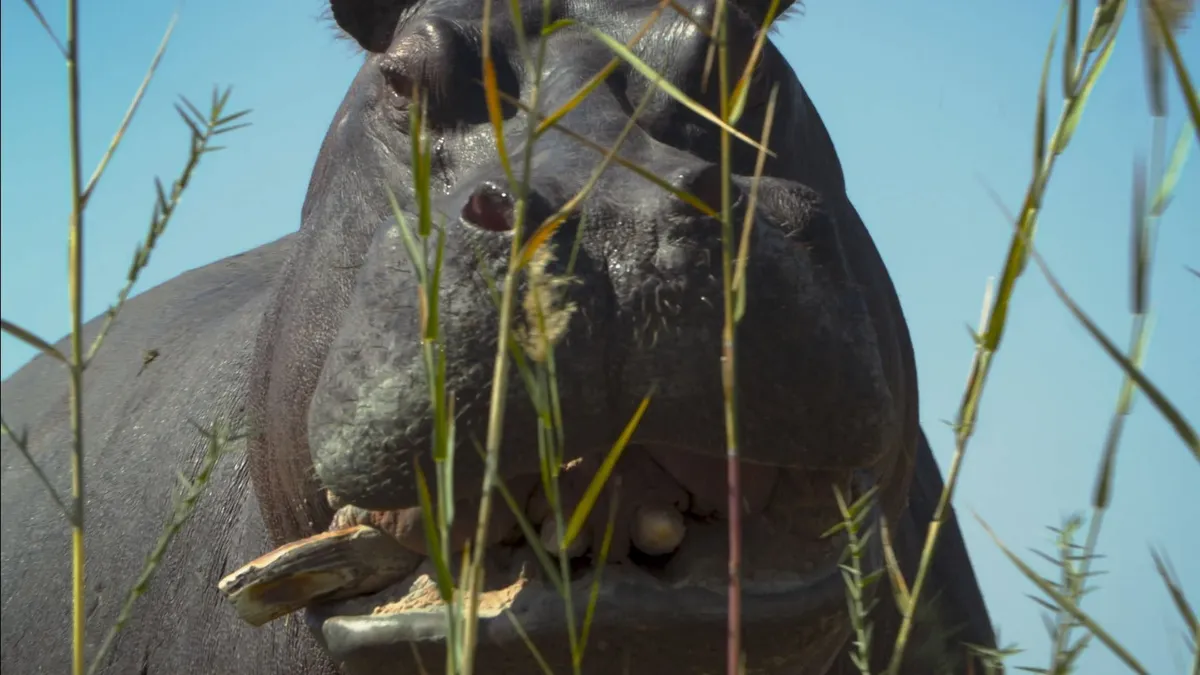
Or imagine a story told on behalf of the Hippo, his uterine voice. This is the picture of Nelson Carlos de Los Santos Arias, who composed his post -colonial parable “Pepe” “based on real events”.
The drug bacon Pablo Escobar brought three hippos to Colombia back in 1981. He gathered an entire zoo of exotic pets. After his escape, many did not survive, and the hippos adapted to the rivers of South America. The story about the struggle of the young hippo Pepe with Alfa-Samets Publito (named by the name of his owner Escobar) was told by the director by the local artist Camilo Retsrepo. Pepe then lost, he had to leave the herd. Seeing it for the first time, people from the local village decided that it was a water monster. Thus began the hunting on Pep (it is voiced by John Narvaes). In this story there are references to both Moby Dick and to the "old man and the sea." But the angle is completely different. We are like both the world and people see the eyes of Pepe. On their errors and fears bordering on admiration. In the same way, they belonged to Escobar.
Arias tells the story of colonial injuries. But first of all, this is a portrait of Pepe against the background of infinitely diverse, living according to the complexly organized laws of nature into which a person invades.
However, a person is not too guilty, he never saw a hippo, and this water "monster" can frighten even the views of local hunters and police officers. But the main advantage of the true legend of the philosophizing murdered hippo is the cosmic real world. What orange, emerald, lilac rivers here, luxurious, tangled in the green web of the tropics. And local customs: for example, the choice of the most beautiful girl of the village. The film, of course, does not reach the heights of the philosophical tragic story of the Gunda pig, told last year on Berlin, director Viktor Kosakovsky, but looks great.
It has long been the case that the most political of the film forums welcomes the stories on the documentary lining.
From guillotine with love
“From Hilda with Love”-about the short life and death of Hilda Coppi, executed for anti-fascist activities in August 1943, nine months after birth in the prison of her first-born. Director - Andreas Drezen, holder of many festival awards. A couple of years ago, his painting “Racham Kournase against George Bush” received a prize on Berlinal.
We would have a similar movie to the category of "especially significant." Drezen is trying to break the stereotype of such hymns to feat and unprecedented courage. The authors do not overdate the facts, simply focus on the feelings of Hilda. They tell this real story from the inside, from the point of view of an ordinary girl who dreams not so much about universal as about personal happiness. So this is a movie and how fate itself leads you to the guillotine.
Everything begins with a strawberry bed in the garden. “Don't eat berries! “Mom calls,” they decided to cook jam ”... At that moment, the girl is arrested.
Scenes in prison develop the plot sequentially. But spontaneously it explodes with color spots of memories - in complete disorder. Peaceful paintings are painted with impressionistic strokes. We observe the young company of girls, worried about their outfits, loves on the green player; Dancing, crazy races on a motorcycle, kayaks. Ordinary guys and their friends are a dizzying youth that does not exclude the concern of young people what is happening in the country.
The director pushes air cloudless peaceful paintings with gray faceless prison plans. A narrow concrete cup, in which a pregnant Hilda, official “interrogation”, prison “hospital” are trying to exercise exercise.
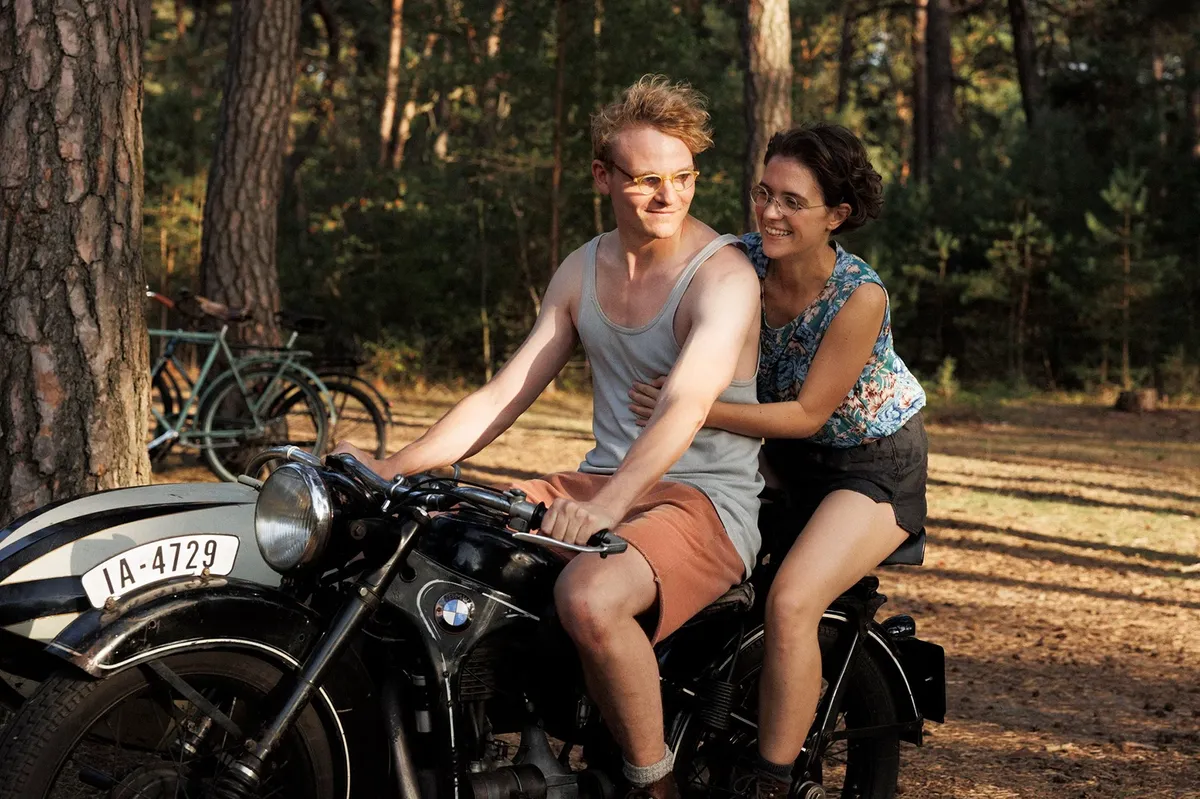
Actress Liv Lisa Fix plunges into the character of the heroine who does not feel herself with the ideological enemy of Hitler, she is simply in love with her communist and activist Hans and in 1941 she marries him. There is no heroic, fanaticity in it, rather tenderness. But the responsibility of youth for the fate of the country in which I would like to raise a child. Somehow, at the same time with friends and husband, she is involved in one of the groups of the anti-Nazi resistance movement of the Red Capella. This group of accomplices resembles the rebels of the mass unrest of 1968, children of the Arab Spring, Protestants in Bolotnaya.
They listened to the radio from Moscow, and when the announcer listed the names of German prisoners of war, the guys informed the relatives that their relatives were alive. Although Nazi propaganda claimed that prisoners of war were shot in the USSR. They glued leaflets, transmitted messages by radio.
Drisen does not show the Nazis monsters. She is arrested by a cute captain who asks about the timing of pregnancy, even asks for permission to touch his stomach - his wife expects a child. And during interrogation, he will treat her with his sandwich. A good pastor (Alexander Scheer), and a caring obstetrician and even a sour guard Frau Kun (Lisa Wagner). Inside the extermination machine, there are quite cute people who help her debugged work.
It is known that
When Khilda Coppi was sentenced to death, a petition was submitted for her and several other women, which Adolf Hitler personally rejected in July 1943. Khilda Coppi was beheaded on August 5, 1943 in Prison of Paliceza in Berlin.
Visiting the statue of freedom
Talented Mexican director Alonso Ruppalasios (“Gueros” - Prize “Berlinale” for the best debut, “Museum” - prize for the best scenario) removed the emblematic, in the spirit of “America, America” by Elia Kazan, the tragicomedy “Kitchen” based on the play by Arnold Vesker, popular in the British film “Kitchen” (1961) About the working class of the restaurant industry.
Young Estela (Anna Diaz) arrives on a liner in New York-right in the arms of a statue of freedom. With difficulty, he searches for his fellow villager, a distant relative of Pedro (Raul Briones), a cook in the popular restaurant The Grill to get there to work without documents. And it turns out in a large cauldron of restaurant backstage in the very heart of America on Manhattan. Then it is twisted at a frantic pace-the same as cooking-the story of the relationship of the temperamental dreamer Pedro and the waitress Julia (Runa Mara), pregnant from Pedro, who does not want to leave the child (everything is like in the Mexican series), the disappearance of $ 800, complex relations between employees-mainly illegal migrants, their conflicts with a perpetum mobile-mobile-their conflicts-their conflicts- chef (Lee R. Sellars).
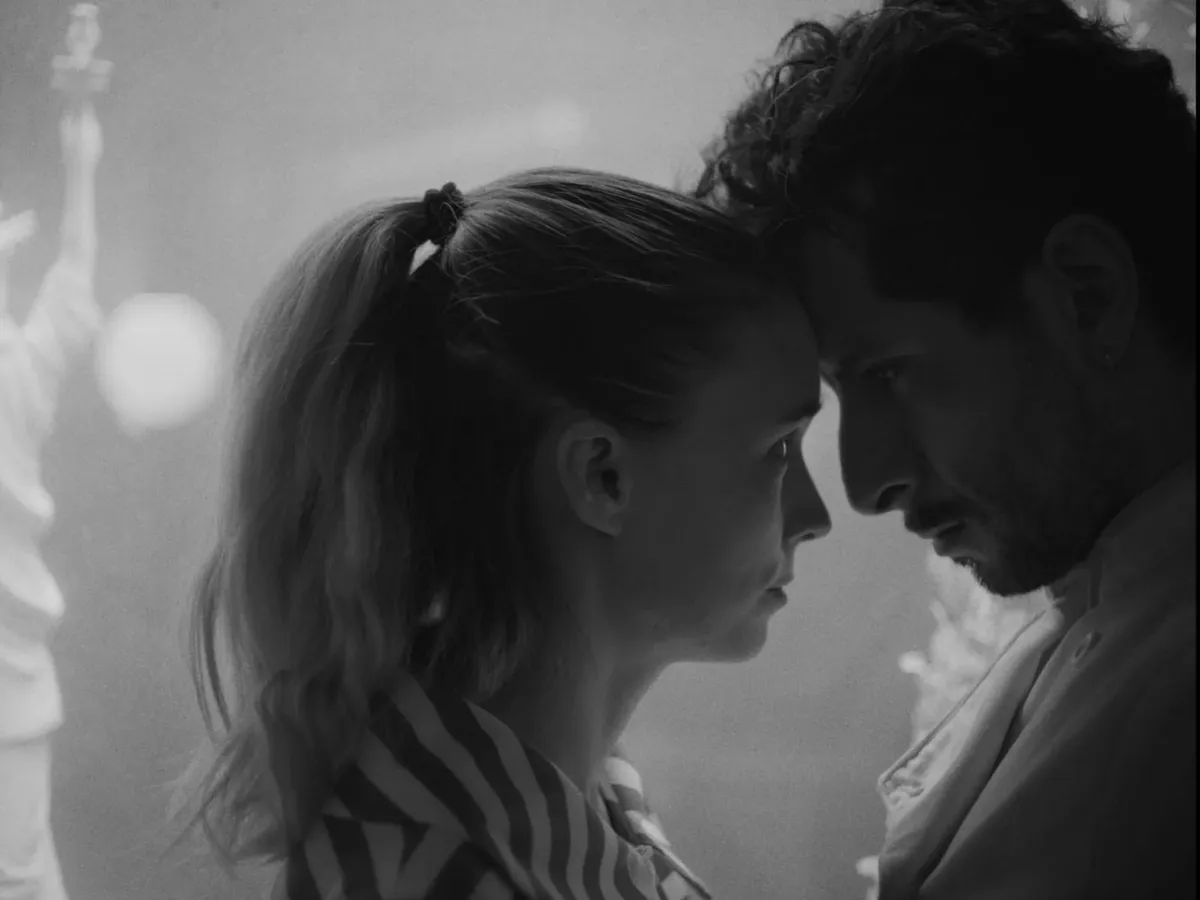
The pace increases by the lunch time, reaches the peak in a stunning long run of the camera of the operator Juan Pablo Ramirez, from which the head is dizzy: plates of food are flying, waitresses are rushing, pizza dough, crumple vegetables, hiss, including wrapped people, turns into a wrapped-wrapped cooking factory. food. But, unlike many well -known “culinary” paintings like “Julie and Julia” and even the Cannes favorite “Recipe for Love”, the kitchen here becomes only a scan of torn by contradictions of the world (the idea, frankly, is not new). A boiler, so to speak, where the fate of the seekers of happiness in America melts. And this cauldron is damn far from the blown up American dream. Once Alonso Ruppalasios himself worked in a London restaurant, so there are a lot of recognizable details.
The kitchen is Noah's Ark on which migrants float. In this Babylon, everyone has their own language, mentality, memories, experience, drama: they do not understand each other. "Speak in English!" - the whitish butcher shouts to his colleagues. Easy to say. But at least at the time of this race, the preparation of the dinner “Big Ghost”, they manage to become part of one conveyor. Among the personnel-symbols, on which the director is generous, is a restaurant aquarium, where large lobsters are omitted. And they slowly but steadily go to the bottom. There are also banal shots, like an application of a lonely bird in the sky.
The film was shot in the genre of tragicomedy. However, with all the funny moments and the installation of attractions, elements of absurdity and drama, the authors follow a beaten path. The grand choir that sounds at the beginning and in the finale is crying for unfulfilled dreams.
For all the sophistication of black and white images with a degree of emotions and demonstrations, Ruppalaisios was somewhat overwhelmed. The ordeal of migrants evoke sympathy, but in 139 minutes, fatigue also accumulates.
And it is too obvious that a black and white image needs the director for a story about contrasts: strangers and their own, hopes and reality, love and disappointment. And the homeland is remembered by these people with the side of the road only instant outbursts, greased shots, as if the past scattered into half -forgotten fragments.
Among the many memorable small roles are the most brightly the characters of Rooney Mara and the incredible Raul Briones charged with electricity (he was already starring with Ruppalass in the film “Police”). I hope that the film will be shown from us, negotiations about its purchase are already underway.
More about the cinema
Larisa Malyukova leads a telegram channel about the cinema and not only. Subscribe here .