
Translated material
Akunin without fandorin
He is not an extremist, but one of the main writers of Russia. Novyevropa talks about the enormous world of the author, in which there is far from a place not only to detectives
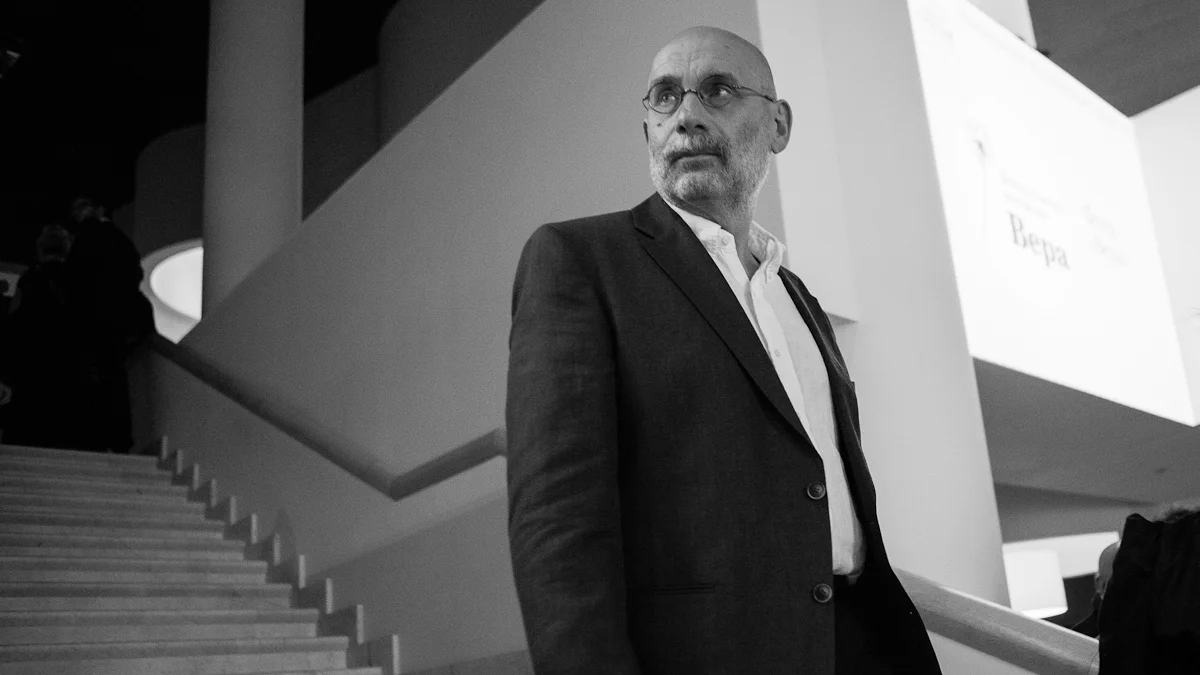
Photo: Dmitry Smirnov / Flickr (CC by-SA 2.0 Deed)
Boris Akunin, the formal cause of which we analyzed in recent material , followed attempts by propaganda to depreciate the cultural significance of one of the best -selling writers of modern Russia. In addition to the accusations of the “terrorist, the Actremist-Ino-Agent, the employees of the pro-government media undertook to mention the negative characteristics of the writer's work in passing.
For example, RIA Novosti noted the “pseudo -historicality” of its detectives, and “arguments and facts” completely called them “imperial bast about blessed times, on which the black cloud of the revolution is approaching” - tendentious reading, obliged exclusively “representations of a significant part of the Russian elite at the beginning of the 21st century”.
However, the last position can even be called curious. Akunin detectives are really closely related to the political context of Russia of the 1990s-early 2000s. But fixation on the "Erastophandorin" side of the bibliography of Akunin is a significant distortion of the author’s creative path. This distortion is now used by propagandists who are exposed to Grigory Chkhartishvili “simply” by a commercial fiction writer like Daria Dontsova or Paulo Coelho.
Grigory Chkhartishvili is by no means Boris Akunin, the adventures of Erast Fandorin and the resonant project “History of the Russian State”. This is also Anna Borisova, Anatoly Brusnikin, all kinds of postmodern experiments, the most important translations from Japanese and religious publishing series.
This side of his work is undeservedly “darkened”. Now, against the background of the disappearance of his books from shops and libraries, it's time to illuminate it.
Confession of masks
The 2000s were marked by the sudden renaissance of the traditions of literary masks and hoaxes. Let us recall, for example, the mysterious “necropa -pedagogical community” Ilya Masodov, “Yegor Moldanov”, who deceived the jury of the Debut Award, or Gangsta Fiction, the novel “Plonol”, which, according to all obvious signs, wrote Vladislav Surkov.
Therefore, when AST in 2007 invested the fabulous “million y. e. " In the advertisement of the book "Nine Savior", this gave rise to natural suspicions among cultural observers. The author of an unequivocally Slavic novel with a stylized by the Palekh miniature cover was declared an unknown author-Department Anatoly Brusnikin, who was praised by prose writers-the zero superstars in the promoterials. Sergei Minaev “was delighted”, Sergey Lukyanenko “amazed”, Polina Dashkova “could not break away”, and Boris Akunin admitted that he would also like to write a work in the setting of the Petrine era, but it’s better than that of Brusnikin ... It is unlikely that it will work out. ”
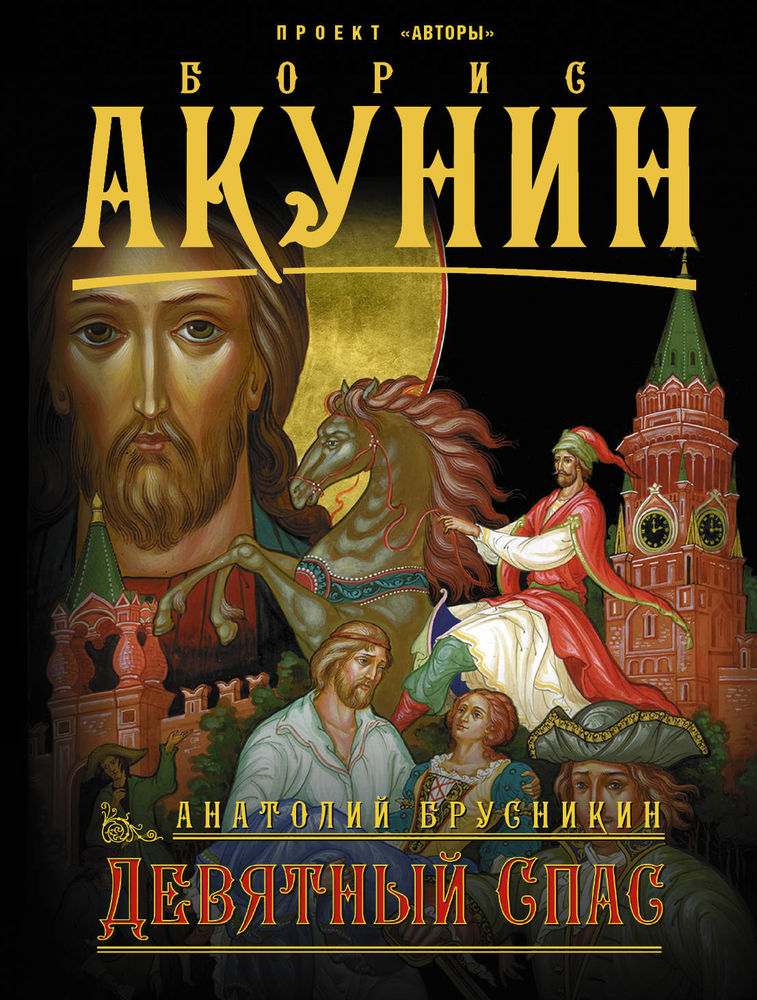
It was a very distinctive publishing performance: as Chkhartishvili told in 2012 after the “Kaming-out” , back in 2007, he concluded an agreement with AST, according to which he pledged to release six works under pseudonyms and to reveal the “rules of the game” at the latter. So it happened. All five years, AST has actively fueled interest in the mysterious project “Authors”, including through the newsletter of the media of photographs of virtual writers, promoting their “biographies” and even organizing interviews by e -mail.
“I have long wanted to start writing fiction somehow differently. To imagine that I am not me, but a slightly different or even completely different author. But the Boris Akunin mask has grown too tightly to me, ” wrote Chkhartishvili in 2012. As he previously told Kommersant, “if the text is signed by the surname Akunin, wait for the enthusiasm”-and when the reader did not receive something of the action and gaming under the Akunin brand, this provoked indignation. "Therefore, I made the right sender."
The names of Anatoly Brusnikin and Anna Borisova - “historian and museum worker” and “adult wealthy lady” appeared on Moscow advertising shields. For the best navigation in the artistic universes, Chkhartishvili is important to understand that Brusnikin and Borisov masks were not stretched over by it, but precisely on top of the Akunin mask, since this is his most famous pseudonym and is responsible for the “fiction -based direction inside it”.
So what is their conceptual uniqueness?
Let us return to the propaganda accusations against Chkhartishvili and we find that RIA Novosti among his “sins” also mentions commitment to Westernism, right -capacity and globalism. Actually, the writer himself never hid his values and Brusnikin was conceived as the opposite of his worldview “Game of Slavophilism” - and the rules of this game were determined precisely from the standpoint of a person, committed by Eurocentatric views.
“Well, Slavophilism - if you count it from the word“ philosopher ”, from the word“ love ”. Well, here a person loves everything Slavic, everything is Russian. That's how he would write? What is bad about that? Nothing, ”this approach was determined by“ lingonberry Slavophilism ”, which had nothing to do with views, for example, popular in the 2000s of Coxenophobes reactionaries from prose like Alexander Prokhanov or Yuri Polyakov.
Just because of the very unusual neoslavophil optics, the Brusnikin trilogy “Nine Savior”, “Hero of another time” and “Bellona” is of interest now.
In the first novel, for example, the philosophical narrative is reduced to the recognition of the greatness of the Peter's reforms, combined with their criticism as a “fruit of state violence” and a comparison with the Stalinist “great -power test”. The second - according to the author, written by him “for himself,” it seems more “thoughtful”, is replete with literary allusions and rather entertaining dialogues about the fate of the Motherland, for example, about the “formula of patriotism” and the meaninglessness of the enforcement of the Caucasus. In the dedicated Crimean War, Bellon is noteworthy, the clash of the Cosmopolitanism of the “Russian British” Alexander Black, criticizing Tsarist Russia from the standpoint reminding “Russia in 1839” by Astolph de Custine, with unconditional “trench” patriotism from the first part. But this is just a very exciting and well-written historical and adventure prose.
With the Anna Borisova project, which can be more complicated as a postmodern experiment to a greater extent. Let's push away from the substantiation of the “right to life” of this mask from Chkhartishvili itself:
“The writer who did not want to be a writer is bored. That is, try to imagine what it feels like to be a woman and look at the world with female eyes. ”
“I wanted to try the strength in fiction, which is very close to the line, behind which serious literature is already beginning. Consider that I envied Lyudmila Ulitskaya, ”which, by the way, Borisov (again, even before the“ camming out ”) seemed very“ generous ”and“ wasteful author ”. Ulitskaya’s wastefulness probably saw in structural twisting, the sudden appearance of new storylines and even unusual for traditional Akunin Neymdroping, indeed stylistically reminiscent of a cross between “female prose”, for example, Polina Dashkova and “moderate postmodernism” Dmitry Lipskurov. From the trilogy of Anna “There”, “Creative” and Vremena Goda, it was the last novel that seemed to me the most integral, the main value of which out of 2024 is his ability to briefly immerse the reader into the atmosphere of the Russian 2000s.
New postmodern or extracurricular reading
It will correctly warn that this section does not claim to be a strict classification of the works mentioned in it as postmodernist. These are artistic, philosophical and conceptual practices of Grigory Chkhartishvili, which in the context of his work can be designated as non -canonical. At the same time, they were published either on behalf of Boris Akunin, or - Chkhartishvili in "co -authorship" with Akunin.
We are talking about dozens of works, but I will allow myself a subjective sample.
Chronologically, it is worth starting with the series “The Adventures of the Master” - it consists of four books telling about the descendant of Erast Fandorin Nicholas. They are noteworthy by the hyperspace and deconstruction of Russian classics. The third book of the cycle, “F.M.”, is a cocktail of Dostoevsky’s stamps, from the “lost” version of “crime and punishment” and the plot rod in the form of a detective story from Moscow “zero”, which also fully corresponded to the then literary trends (see “Idiot” Fedor Mikhailov, M., “Zakharov”, 2001).
In the preceding "F.M." The two -volume “Extracurricular Reading” the author was even more “wasteful” than in the case of Vremena Goda. Such a pile under one cover of various stylistic methods, plexus of plot and temporary dimensions, references and direct quotes, again, should still be searched from Russian classics. As this novel Dmitry Bykov described , he is interesting "mainly not for the layman (although the book is quite exciting) - for the researcher."
“Akunin’s work is the first attempt in Russian literature to consider our main national treasure (which, without a doubt, is culture-oil will end sooner or later) without gross sociologization, without tightening the classic on one or another side; All that he does is not so much literature as entertaining literary criticism, that is, in the full sense of extracurricular reading, ” said Bykov in 2002 for Kommersant. This is also relevant for the "out -of -off" Akunin experiments of that time. For example, for the collection of stories “Fairy Tale for Idiots”, where, through almost the Sorokinsky stylization, the author is ironic over the release for the year of release (2000) topics: over the general who involuntarily shouting slogans in the spirit of “good Jew - Dead Jew!” During public speeches, over Prime Minister Viktor Stepanovich Loris-Melikov, who decided to let the Chechnya “to the will”, or the “new Russian” Vovan traveling in time. Subsequently, he will appear in another experimental work of the author, the play “Comedy/Tragedy”-“The Book-Pereshertysh”, which can be started from different sides and fall into different chronological canvas, in 2000 or 1900.
However, the most extraordinary works of Chkhartishvili found their place in the epic “Family Album”, written in “Co -authorship” with Boris Akunin. She opened with a novel with the mysterious name "Aristonomy." “The quality, which, as I am convinced, depends on the fate of mankind, I called“ Aristonomy ”... The concept of“ dignity ”is closest to Aristonomy,” the novel that published in 2012 explains. This year has become largely a turning point for the writer, who was then got rid of all the “third” literary masks and actively joined the flared protest movement.
In isolation from the last fact, “Aristonomy” is quite difficult to perceive. This is a philosophical romance, where a description of the utopian concept of an ideal state and man is combined with an artistic narrative of the intelligent young man Anton Klobukov, who fell into the whirlpool of the revolution and the civil war.
Chkhartishvili called this work to his “first serious novel” and explained double authorship by the fact that he “put into this work what he learned both as a fiction writer and as an essyist.” The critic Anna Narinskaya then compared Aristonomy with the “Dr. Zhivago” (not in favor of the first) and noted that the novel does not disappoint from the point of view of the abundance of conversations “On the fate of Russia”.
In my opinion, they are “family album” and noteworthy - as a kind of sum of the writer's views about the ideal world order, echoing with his “history of the Russian state”, but with an emphasis on Akunin metaphysics. Moreover, if “Aristonomy” after the exit was criticized for “moralizing caricature” and tiring, then further in the tandem of Chkhartishvili - Akunin, the second, obviously, began to dominate. There are more dynamics and wit. This is especially noticeable in the third book of the Happy Russia cycle, the action of which - in the dissonance of the name - unfolds in 1937 and smoothly leads the reader to the idea of the futility of internal emigration in the midst of state terror.
Evil person with the Order of the Rising Sun
In 2002, calling Akunin “the last Russian classic”, Dmitry Bykov noted that “such a writer had to appear, and it was from the philological environment.” The emergence of the Boris Akunin mask, which it is known to us now, in 1998 was dictated by the release of Grigory Chkhartishvili from this very environment.
“I was still a solid person-the deputy chief editor in an important magazine, a critic-publicist, a member of that and this, well, just an elderly uncle with a bald head and a beard. And suddenly detectives. It is now to our brother to the detectiveman the attitude of a decent audience somewhat softened, and ten years ago it was like composing pornographic novels.
For this, even not with a stick, but with a broom was kicked out of the human company. So I decided to hide just in case, ”Charrtishvili told Kommersant in 2007.
In the late 1990s, he, a graduate of the Historical and Philology of the Institute of Asia and Africa, Moscow State University, a translator and researcher of Japanese literature with more than ten years of experience, was the chairman of the board of the Pushkin Library of the Soros Foundation and held the position of the deputy editor-in-chief of a truly important magazine “Foreign Literature”, which was published since the late 1980s. Actually, the pseudonym Akunin himself is a Japanese word that, in an approximate translation into Russian, means “evil man” or “robber”.
Chkhartishvili’s professional interest in Japanese literature in the homeland of Yukio Mishima, Kenji Maruyama and other authors, whose books in Russia were published in its translation, were appreciated very highly in Japan. In 2005, the writer received an honorary diploma and a silver cup with the imperial coat of arms from the Japanese Foreign Ministry, in 2007-the NomaAward for the translation of the works of Yukio Misima, and in 2009 he became the gentleman of the Order of the Rising Sun, the third most important Japanese award. Among the most famous translations of Chkhartishvili are the “Golden Temple”, “Confession of the Mask” and “My Friend Hitler” Yukio Misima and “Heartbean” by Kenji Maruayama.
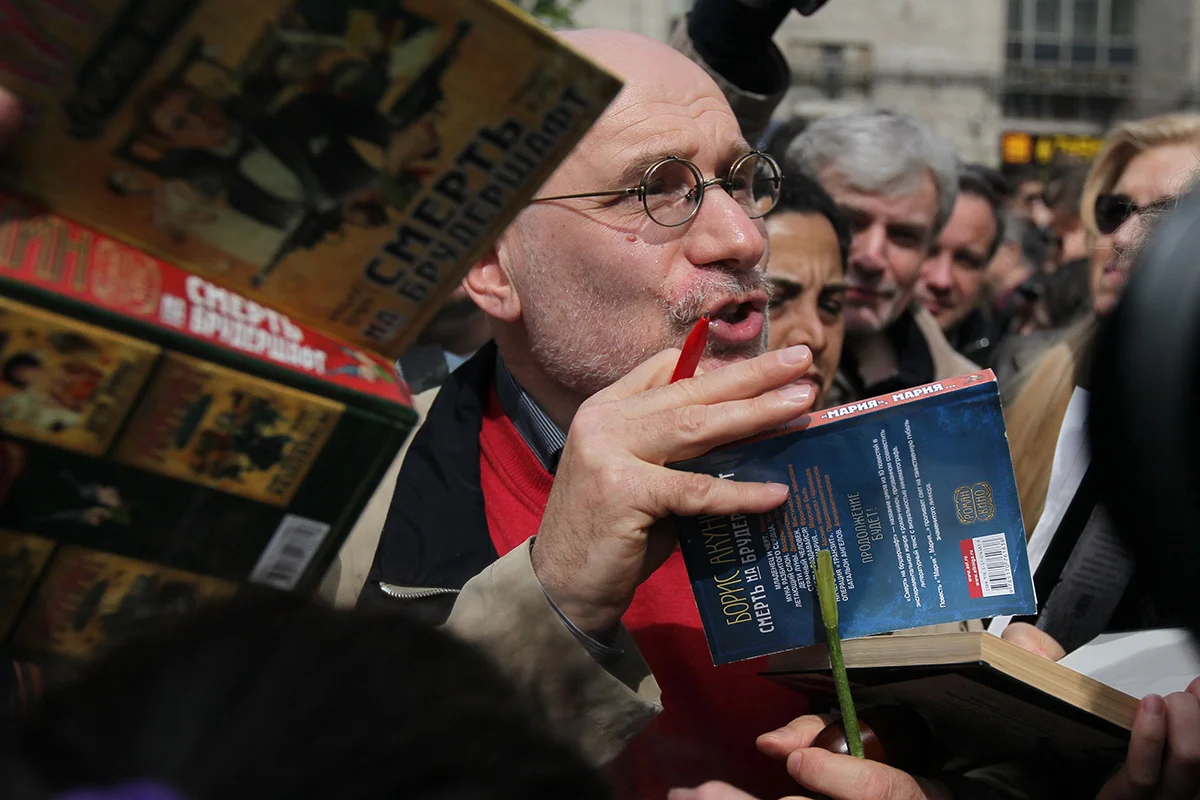
The last work was first published in Foreign Literature, and subsequently reprinted several times a “foreigner”. This is one of the most significant publishing houses in Russia of the 2000s, which opened many religious Western prose writers for the domestic reader, from Frederick Begbeder to Michel Welbek. Books from such series of “Foreigner” as “Illuminator”, “For the Illuminator” and “Cure for Boredom,” now represent a great bukinistic value - and Grigory Chartishvili is also appropriate for them.
In the 2000s, he actively collaborated with the publishing house and was responsible for compiling a number of series, including the famous thriller-detective “medicine for boredom” under the slogan “A serious approach to the frivolous genre”. Among the authors of the series were Val McDermide, Jean-Cristopher Grange, Yu Nesbyo and other famous writers who sometimes even came to Russia at the invitation of “Foreigners” to meet with readers.
Meanwhile, a major literary success to Boris Akunin has already come. In October 2000, he left the “foreign literature” to fully concentrate on fiction. Kommersant asked him about the fees, and the Contract with the Publishing House of Zakharov, according to which “in the event the author makes a decision not to disclose the secret of the pseudonym, the publisher undertakes to take away the above secret with him to the grave, and if he does not take away, he will be buried in the grave with the publishing house,” finally lost his relevance.
Deviation from the median path
“Behind the masterfully built plot and hidden quotes from the classics, the author hides a detailed ethical and political program: Fandorin is a real Russian intellectual in the sovereign service, he is devoted to flattering and sanity, his court readiness and destructive radicalism are equally disgusting to him. Fandorin is a role-playing model for those who are ready to get out of the basement “ O.G. ” and go “change the world for the better”, ”wrote Yuri Saprykin in a recent article for Kommersant.
Probably, the author of “arguments and facts”, whose statement about the views of “a significant part of the Russian elite of the early 21st century”, I quoted at the beginning of the text, spoke about the same “mid -Middle Way” fandorin, which the country's leadership rejected over time.
The essence of this phenomenon is difficult to explain, but it is quite easy to understand at the level of sensations. It is enough to read the first “black” cycle “New Detective (K) A” about Fandorin, “Provincial Detective (Kommersant) A” about Pelagia, to get acquainted with the series of “Biography and Memoirs” “Respectable and Irjoy” Publishing House, “Zakharov”, which first printed Akuinin, or read the Columanists of the “Kommersant” of that era. The era fleeting and pretty forgotten by the borders from the default of 1998 to the start of the Yukos case in 2003, such an “island of normality” with a gradual release from the 1990s and the beginning of economic reforms under the leadership of the new young president, which has already urgently “urgently” in the toilet, but still relatively sane. This “normality” also consisted in the fact that in those years the culture of modern Russia has probably reached the maximum and absolutely natural point of approaching European in its entire post -Soviet history.
“Mumiy Troll” and Zemfira recorded and brought in London a Russified British Pop, Tatu received prizes for millions of albums sold in Europe, The Guardian took an interview from Viktor Pelevin, and the British detective Val McDermide, who visited Moscow, was well aware of who Akunin was and urged colleagues. “Swallow your fears and come” to Russia.
Probably, under the “significant part of the Russian elite of the beginning of the 21st century”, which was read out by the adventures of Fandorin and supported similar trends, we mean the current “traitors” like Andrei Illarionov, Boris Nemtsov or Yegor Gaidar. Their time, the time of moderate “respectable bourgeois”, the dominance of the Eurocentric approach to culture and the generally active participation of Russia in the processes of globalization soon came to an end.
“Mumiy Troll” can no longer conduct concert activities in Russia, Zemfira and Illarionov - “foreign agents”, Tatu for his public image would now have passed in the case of extremism, Nemtsov is killed, and Akunin is a terrorist and an extremist whose books can no longer find his reader in Russia. His cosmopolitanism and freedom are incompatible with the current course of the authorities, but the country is very necessary that will once inevitably return to a healthy “Meditudinal Way” and will draw its identity, including from the “Lubca of Blessed Times”. “ The key to that is the existence of a beautiful writer in today's Russia with the Georgian surname, the Japanese surname and a cozy British mentality.”